PARALLEL LINES AND ANGLES
Subscribe to our ▶️ YouTube channel 🔴 for the latest videos, updates, and tips.
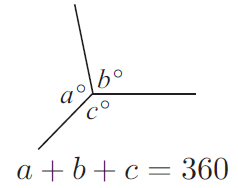
Angles at a point
The sum of the sizes of the angles at a point is 360°.
Adjacent Angles on a Straight Line
Two angles which have same vertex and share a common arm are called adjacent angles
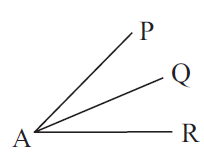
∠PAQ and ∠QAR are adjacent angles.
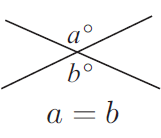
Vertically Opposite Angles
Vertically opposite angles are equal in size.
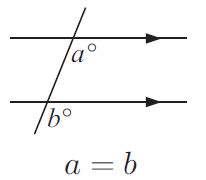
Corresponding Angles
When two lines are parallel lines are cut by a third line, the angles in corresponding positions are equal in size.
Alternate Angles
When two parallel lines are cut by a third line, then angles in alternate positions are equal in size.
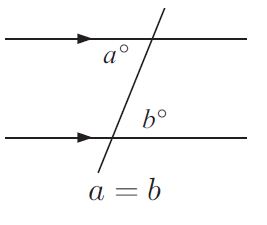
Co Interior Angles
When two parallel lines are cut by a third line, co-interior angles are supplementary.
Co-interior are also called as consecutive interior angles.
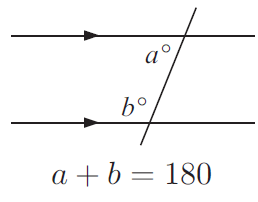
- Problems on co-interior angles
- Co-interior angles practice worksheet
- Finding the missing angles of transversal
- Parallel lines and transversal worksheet
Complementary and Supplementary Angles
Two angles are complementary, if the sum of their measures is equal to 90.
Two angles are supplementary angles if the sum of their measures is equal to 180 degrees.
- Problem on complementary and supplementary angles
- Complementary and supplementary angles practice questions
- Word problems on complementary and supplementary angles
- Complementary and supplementary angles worksheet
- Word problems on worksheet
Question 1 :
A ___ is simply two angles that are next to each other and together they form a straight line.
Solution :
The angles lies next to each other and they form a straight line, then they must be supplementary or linear pair.
Question 2 :
In parallel cut by a transversal, one of the property is each pair of interior alternate angles are ______ ?
Solution :
Two parallel lines cut by the transversal, the angles lies inside and at alternate position, then they are called alternate interior angles and they are equal.
Question 3 :
In parallel cut by a transversal, one of the property is each pair of corresponding angles are ___________ ?
Solution :
Two parallel lines cut by the transversal, the angles are the same position they are called corresponding angles and they are equal.
Question 4 :
The sum of two angles in a linear pair is always ?
Solution :
The sum of two angles in a linear pair is always equal and its measure will be 180 degree.
Question 5 :
This line passes through two lines in the same plane at two distinct points.
Solution :
Transversal line,
Question 6 :
Lines that are equidistant from each other and never meet, no matter how much they may be extended in either directions.
Solution :
Parallel lines will be equidistance and they never meet and travel in the same direction.
Question 7 :
In parallel cut by a transversal, one of the property is each pair of vertical opposite angles are __________
Solution :
Vertically opposite angles are equal.
Question 8 :
Two angles are called ______ when their measures add upto 180 degree
Solution :
Two angles are known as linear pair or supplementary when their measures add upto 180 degree.
Question 9 :
The _______ says that if you add the measures of the two remote interior angles, you get the measure of the exterior angle.
Solution :
The exterior angle theorem says if you add the measures of the two remote interior angles, you get the measure of the exterior angle.
Question 10 :
The measure of the exterior angle equals the sum of the two ___________
Solution :
The measure of the exterior angle equals the sum of the two remote interior angles.
Question 11 :
Classify the angle pair as corresponding, alternate interior, alternate exterior, or consecutive interior angles.
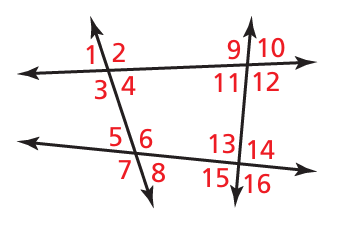
a) ∠5 and ∠1
b) ∠11 and ∠13
c) ∠6 and ∠13
d) ∠2 and ∠11
Solution :
a) ∠5 and ∠1 are at the same positions, they are known as corresponding angles.
b) ∠11 and ∠13 lies inside on the same side of the transversal, then they are known as co-interior angles.
c) ∠6 and ∠13 lies inside on the same side of the transversal, then they are known as co-interior angles.
d) ∠2 and ∠11 lies at the alternate position, then they are called alternate interior angles.
Question 12 :
In a pair of complementary angles the measurement of the larger angle is 71 degree, what is the measurement of the smaller angle ?
Solution :
Let x be the smaller angle.
Larger angle = 71
x + 71 = 90
x = 90 - 71
x = 19
So, the required angle is 19 degree
Question 13 :
In a complementary angles, the measurement of one angle is 28, what is the measurement of the other angle ?
Solution :
Let x be the other angle. One angle = 28
x + 28 = 90
x = 90 - 28
x = 62
So, the other angle is 62 degree.
Question 14 :
The supplement of an angle is 38 more than the angle. What are the measurements of two angles ?
Solution :
Let x be one angle, then the other angle is x + 38
x + 38 + x = 180
2x = 180 - 38
2x = 142
x = 142/2
x = 71
x + 38 ==> 71 + 38
= 109
So, the required angles are 71 and 109.
Subscribe to our ▶️ YouTube channel 🔴 for the latest videos, updates, and tips.
Recent Articles


-
Finding Range of Values Inequality Problems
May 21, 24 08:51 PM
Finding Range of Values Inequality Problems -
Solving Two Step Inequality Word Problems
May 21, 24 08:51 AM
Solving Two Step Inequality Word Problems -
Exponential Function Context and Data Modeling
May 20, 24 10:45 PM
Exponential Function Context and Data Modeling