PROBLEMS ON COMPLEMENTARY AND SUPPLEMENTARY ANGLES
Subscribe to our ▶️ YouTube channel 🔴 for the latest videos, updates, and tips.
Complementary angles :
Two angles are complementary, if the sum of their measures is equal to 90.
Supplementary angles :
Two angles are supplementary angles if the sum of their measures is equal to 180 degrees.
Find the values of unknowns :
Problem 1 :
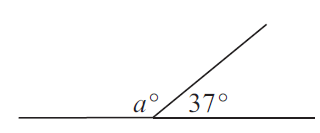
Solution :
In the picture the above angles are linear pairs.
a + 37 = 180
a = 180 - 37
a = 143
Problem 2 :
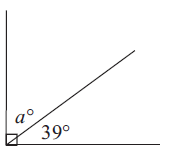
Solution :
Since the angles a and 39 are complementary, sum of those angles will be 90°.
a + 39 = 90
a = 90 - 39
a = 51°
Problem 3 :
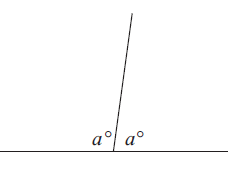
Solution :
In the picture the above angles are linear pairs.
a + a = 180
2a = 180
a = 180/2
a = 90
Problem 4 :
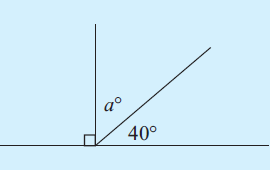
Solution :
From the picture, it is clear
90 + a + 40 = 180
130 + a = 180
a = 180 - 130
a = 50
Problem 5 :
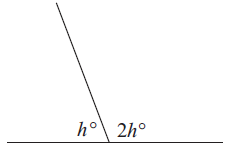
Solution :
h and 2h are supplementary.
h + 2h = 180
3h = 180
Divide by 3, we get
h = 180/3
h = 60
Problem 6 :
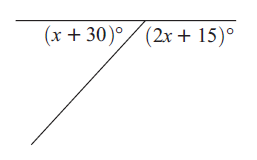
Solution :
x + 30 and 2x + 15 are supplementary.
x + 30 + 2x + 15 = 180
3x + 45 = 180
Subtracting 45
3x = 180 - 45
3x = 135
Divide by 3
x = 135/3
x = 45
Problem 7 :
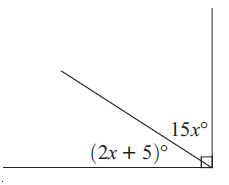
Solution :
2x + 5 and 15x are complementary.
2x + 5 + 15x = 90
17x + 5 = 90
Subtracting 5 on both sides.
17x = 90 - 5
17x = 85
Dividing by 17 on both sides.
x = 85/17
x = 5
Problem 8 :
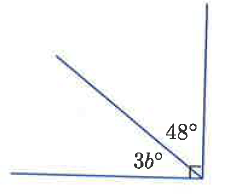
Solution :
3b and 48 are complementary.
3b + 48 = 90
Subtracting 48 on both sides.
3b = 90 - 48
3b = 42
Dividing by 3, we get
b = 42/3
b = 14
Problem 9 :
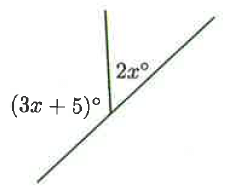
Solution :
3x + 5 and 2x are supplementary.
3x + 5 + 2x = 180
5x + 5 = 180
Subtracting 5 on both sides.
5x = 180 - 5
5x = 175
Divide by 5 on both sides.
x = 175/5
x = 35
Problem 10 :
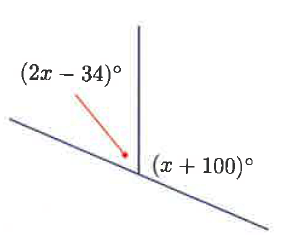
Solution :
2x - 34 and x + 100 are supplementary.
2x - 34 + x + 100 = 180
3x + 66 = 180
Subtracting 66 on both sides.
3x = 180 - 66
3x = 114
Dividing by 3 on both sides.
x = 114/3
x = 38
Problem 11 :
∠UVW and ∠XYZ are complementary angles, m∠UVW = (x − 10)°, and m∠XYZ = (4x − 10)°.
Solution :
If two angles are complementary, then they add upto 90 degree.
m∠UVW + m∠XYZ = 90
x - 10 + 4x - 10 = 90
5x - 20 = 90
5x = 90 + 20
5x = 110
x = 110/5
x = 22
Applying the value of x in m∠UVW = (x − 10)°
m∠UVW = (22 - 10)°
= 12°
m∠XYZ = 90 - 12
= 78
Problem 12 :
∠EFG and ∠LMN are supplementary angles, m∠EFG = (3x + 17)°, and m∠LMN = ( (1/2) x − 5)°.
Solution :
If two angles are supplementary, then they add upto 180 degree.
m∠EFG + m∠LMN = 180
3x + 17 + (1/2) x − 5 = 180
3x + (x/2) + 12 = 180
(6x+x)/2 = 180 - 12
7x/2 = 168
7x = 168(2)
x = 336/7
x = 48
Applying the value of x in m∠EFG = 3x + 17
= 3(48) + 17
= 144 + 17
= 161
m∠LMN = 180 - 161
= 19
Problem 13 :
Use the figure.
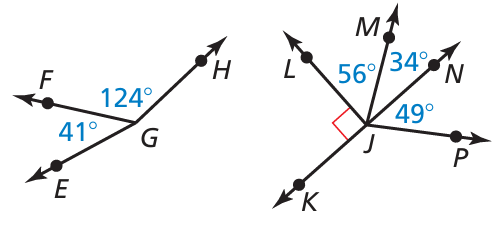
a) Name a pair of adjacent complementary angles.
b) Name a pair of adjacent supplementary angles.
c) Name a pair of nonadjacent complementary angles.
d) Name a pair of nonadjacent supplementary angles.
Solution :
a) ∠LJM and ∠MJN are adjacent angles.
∠LJM + ∠MJN = 56 + 34
= 90
∠LJM and ∠MJN are adjacent and complementary angles.
b) ∠KJL and ∠LJN are adjacent angles.
∠KJL + ∠LJN = 90 + (56 + 34)
= 90 + 90
= 180
So, ∠KJL and ∠LJN adjacent supplementary angles.
c) ∠MJN and ∠NJP are adjacent angles. They are not complementary.
∠MJN + ∠NJP = 34 + 49
= 83 (not equal to 90 degree)
Since the sum of the angles is not equal to 90 degree, they are not complementary. So, ∠MJN and ∠NJP are adjacent and non complementary angles.
d) ∠FJH and ∠LJM are non adjacent, but they add upto 180. They they are non adjacent and supplementary angles.
Problem 14 :
Find the measure of each angle.
a)Two angles form a linear pair. The measure of one angle is twice the measure of the other angle.
b) Two angles form a linear pair. The measure of one angle is 1/3 the measure of the other angle.
Solution :
a) Let x b the one angle measure.
The other angle be 2x.
Linear pairs add upto 180 degree. Then,
x + 2x = 180
3x = 180
x = 180/3
x = 60
2x ==> 2(60) ==> 120
So, the required angles are 60 and 120 degree.
b) Let x be the other angle, then one angle will be 1/3 of x
x + x/3 = 180
(3x + x)/3 = 180
4x = 180(3)
x = 180(3)/4
x = 135
Subscribe to our ▶️ YouTube channel 🔴 for the latest videos, updates, and tips.
Recent Articles


-
Finding Range of Values Inequality Problems
May 21, 24 08:51 PM
Finding Range of Values Inequality Problems -
Solving Two Step Inequality Word Problems
May 21, 24 08:51 AM
Solving Two Step Inequality Word Problems -
Exponential Function Context and Data Modeling
May 20, 24 10:45 PM
Exponential Function Context and Data Modeling