PROBLEMS ON COINTERIOR ANGLES
Subscribe to our ▶️ YouTube channel 🔴 for the latest videos, updates, and tips.
When two parallel lines are cut by a third line, co-interior angles are supplementary.
Co-interior are also called as consecutive interior angles.
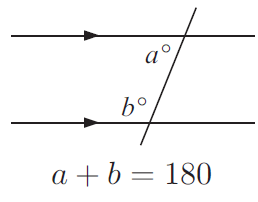
Find the values of the variables in the following :
Problem 1 :
Solution :
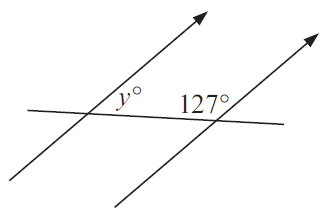
y and 127 are cointerior angles are consecutive interior angles.
y + 127 = 180
Subtracting 127 on both sides.
y = 180 - 127
y = 53
Problem 2 :
Solution :
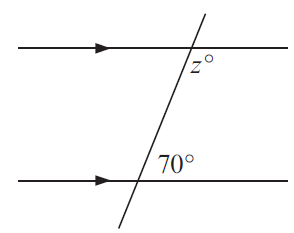
z and 70 are cointerior angles are consecutive interior angles.
z + 70 = 180
Subtracting 70 on both sides.
y = 180 - 70
y = 110
Problem 3 :
Solution :
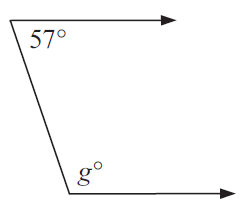
g and 57 are cointerior angles are consecutive interior angles.
g + 57 = 180
Subtracting 57 on both sides.
g = 180 - 57
g = 123
Problem 4 :
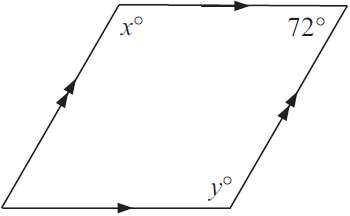
Solution :
Since the opposite sides are parallel.
|
x + 72 = 180 x = 180 - 72 x = 108 |
y + 72 = 180 y = 180 - 72 y = 108 |
Problem 5 :
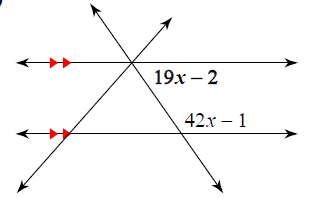
Solution :
19x - 2 + 42x - 1 = 180
61x - 3 = 180
Adding 3.
61x = 180 + 3
61x = 183
Dividing by 61 on both sides.
x = 183/61
x = 3
Problem 6 :
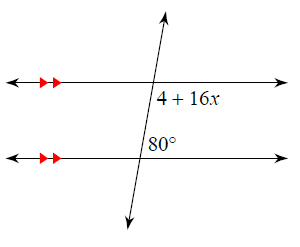
Solution :
4 + 16x + 80 = 180
16x + 84 = 180
Subtracting 84.
16x = 180 - 84
16x = 96
Dividing by 16 on both sides.
x = 96/16
x = 6
Problem 7 :
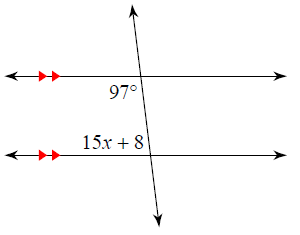
Solution :
97 + 15x + 8 = 180
15x + 105 = 180
Subtracting 105 on both sides.
15x = 180 - 105
15x = 75
Dividing by 15 on both sides.
x = 75/15
x = 5
Problem 8 :
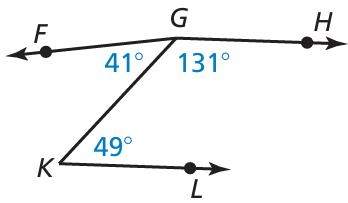
a) Name a pair of complementary angles, a pair of supplementary angles, and a pair of adjacent angles.
b) Are ∠KGH and ∠LKG adjacent angles? Are ∠FGK and ∠FGH adjacent angles? Explain.
c) ∠1 is a complement of ∠2, and m∠2 = 5°. Find m∠1.
d) ∠3 is a supplement of ∠4, and m∠3 = 148°. Find m∠4.
Solution :
a)
- ∠LKG and ∠FGK are complementary angles, because they add upto 90 degree.
- ∠GKL and ∠KGH are supplementary angles, because they add upto 180 degree.
- ∠FGK and ∠KGH are adjacent angles.
b)
- ∠KGH and ∠LKG are not adjacent angles, because they are not next to each other.
- ∠FGK and ∠FGH are not adjacent angles, because they are not next to each other.
c) ∠1 is a complement of ∠2
m∠2 = 5°
m∠1 = 90 - m∠2
= 90 - 5
= 85
d) ∠3 is a supplement of ∠4
m∠3 = 148°
m∠4 = 180 - m∠3
= 180 - 148
= 32
Problem 9 :
a. ∠1 is a complement of ∠2, and m∠1 = 62°. Find m∠2.
b. ∠3 is a supplement of ∠4, and m∠4 = 47°. Find m∠3.
Solution :
a) ∠1 is a complement of ∠2
m∠1 = 62°
m∠2 = 90 - m∠1
= 90 - 62
= 28
d) ∠3 is a supplement of ∠4
m∠4 = 47°
m∠3 = 180 - m∠4
= 180 - 47
= 133
Problem 10 :
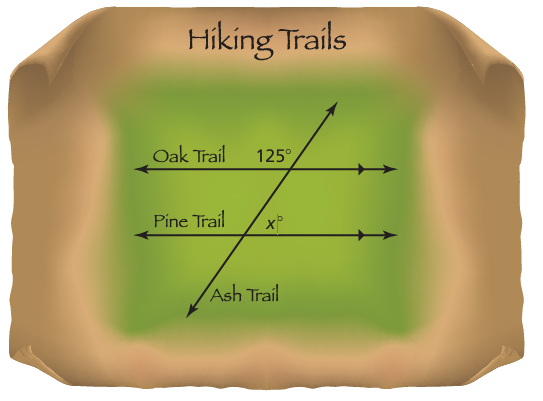
What is the value of x?
Solution :
Oak trail and Pine trail are parallel and Ash trail is transversal. Supplementary angle of 125 degree is 180 - 125 that is 55.
Corresponding angles are equal, then x = 55.
Problem 11 :
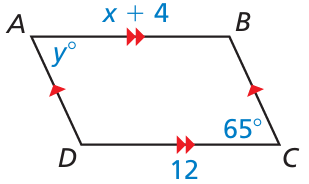
Find the values of x and y.
Solution :
m∠ADC + m∠DCB = 180
m∠ADC + 65 = 180
m∠ADC = 180 - 65
m∠ADC = 115
m∠ADC + m∠DAB = 180
115 + y = 180
y = 65
Since it is parallelogram, opposite sides will be equal.
x + 4 = 12
x = 12 - 4
x = 8
Problem 12 :
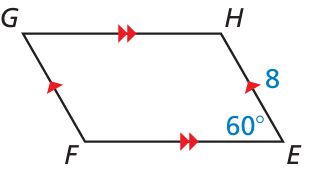
Find FG and m∠G.
Solution :
Since it is parallelogram, the opposite sides are equal and opposite angles are equal.
m∠G = 60
FG = HE
8 = HE
So, the measure of FG is 8
Problem 13 :
Find the values of x and y.
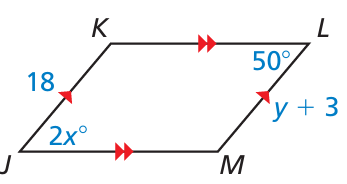
Solution :
|
∠KJM = ∠KLM 2x = 50 x = 50/2 x = 25 |
KJ = LM y + 3 = 18 y = 18 - 3 y = 15 |
Problem 14 :
For what values of x and y is quadrilateral ABCD a parallelogram? Explain your reasoning.
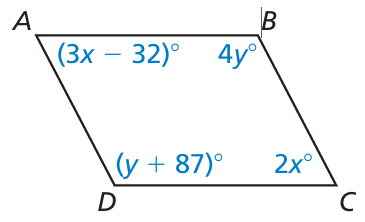
Solution :
∠A and ∠D are co-interior angles
3x - 32 + y + 87 = 180
3x + y + 55 = 180
3x + y = 180 - 55
3x + y = 125 ---- (1)
4y + 2x = 180
x + 2y = 90 -----(2)
(1) - 3(2) ==> 3x + y - (3x + 6y) = 125 - 270
y - 6y = -145
-5y = -145
y = 145/5
y = 29
Applying the value of y in (1), we get
3x + 29 = 125
3x = 125 - 29
3x = 96
x = 96/3
x = 32
Problem 15 :
You shoot a pool ball, and it rolls back to where it started, as shown in the diagram. The ball bounces off each wall at the same angle at which it hits the wall.
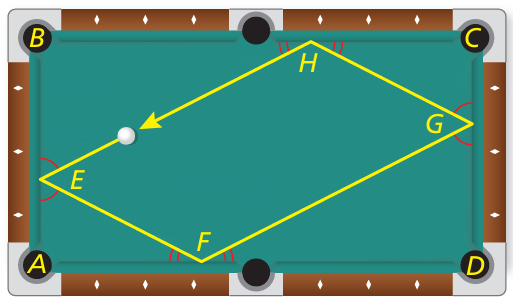
a. The ball hits the first wall at an angle of 63°. So m∠AEF = m∠BEH = 63°. What is m∠AFE? Explain your reasoning.
b. Explain why m∠FGD = 63°.
c. What is m∠GHC? m∠EHB?
d. Is quadrilateral EFGH a parallelogram? Explain your reasoning.
Solution :
a) m∠AEF = m∠BEH = 63°
m∠EAF = 90
m∠AFE + m∠AEF + m∠EAF = 180
m∠AFE + 63 + 90 = 180
m∠AFE + 153 = 180
m∠AFE = 180 - 153
m∠AFE = 27
b. m∠FGD = 63° because the ball bounces at the same angle
c. m∠GHC = 27 and m∠EHB = 27
d. Since opposite angles are equal, then it is parallelogram.
Subscribe to our ▶️ YouTube channel 🔴 for the latest videos, updates, and tips.
Recent Articles


-
Finding Range of Values Inequality Problems
May 21, 24 08:51 PM
Finding Range of Values Inequality Problems -
Solving Two Step Inequality Word Problems
May 21, 24 08:51 AM
Solving Two Step Inequality Word Problems -
Exponential Function Context and Data Modeling
May 20, 24 10:45 PM
Exponential Function Context and Data Modeling