PROBLEMS ON VERTICALLY OPPOSITE ANGLES
Subscribe to our ▶️ YouTube channel 🔴 for the latest videos, updates, and tips.
Vertically opposite angles are equal in size.
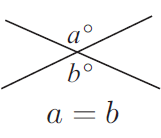
Find the unknown angles in the following figures.
Problem 1 :
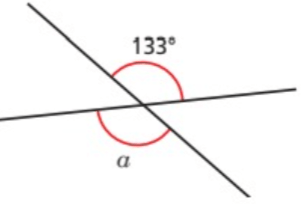
Solution :
Since a and 133 are vertically opposite, they will be equal.
So, ∠a = 133.
Problem 2 :
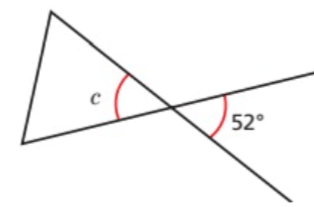
Solution :
Since c and 52 are vertically opposite, they will be equal.
So, ∠c = 52
Problem 3 :
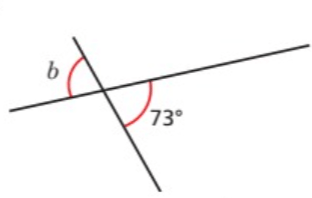
Solution :
Since b and 73 are vertically opposite, they will be equal.
So, ∠b = 73
Problem 4 :
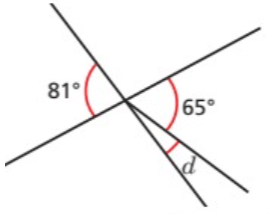
Solution :
81 = 65 + d
Subtracting 65 on both sides, we get
81 - 65 = d
d = 16
Problem 5 :
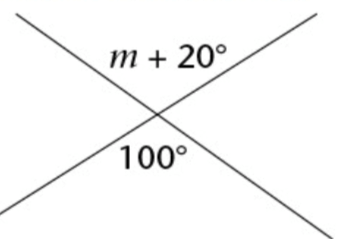
Find the value of m.
Solution :
m + 20 = 100
Subtracting 20 on both sides.
m = 100 - 20
m = 80
Problem 6 :
Solution :
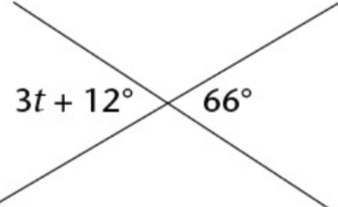
3t + 12 = 66
Subtracting 12 on both sides.
3t = 66 - 12
3t = 54
Dividing by 3, we get
t = 54/3
t = 18
Problem 7 :
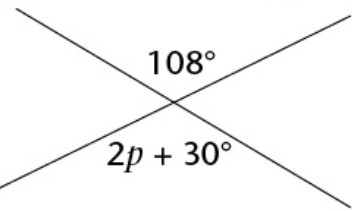
Find the value of p.
Solution :
2p + 30 = 108
Subtracting 30 on both sides.
2p = 108 - 30
2p = 78
Dividing by 2, we get
p = 78/2
p = 39
Problem 8 :
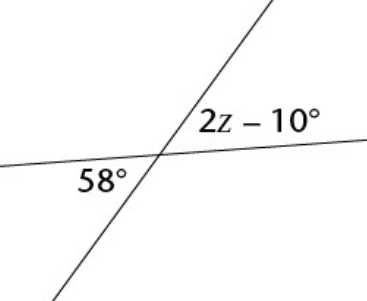
Find the value of z.
Solution :
58 and 2z - 10 are vertically opposite angles.
58 = 2z - 10
Add 10 on both sides.
68 = 2z
dividing by 2
z = 68/2
z = 34
Problem 9 :
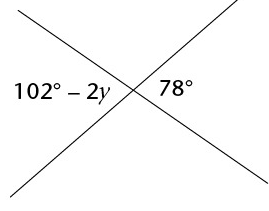
Find the value of y.
Solution :
102 - 2y and 78 are vertically opposite angles.
78 = 102 - 2y
Add 2y on both sides.
2y + 78 = 102
Subtracting 78, we get
2y = 102 - 78
2y = 24
Dividing by 2 on both sides.
y = 24/2
y = 12
Problem 10 :
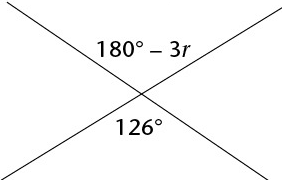
Find the value of r.
Solution :
126 and 180 - 3r are vertically opposite angles.
126 = 180 - 3r
Add 3r on both sides.
126 + 3r = 180
Subtracting 126 on both sides.
3r = 180 - 126
3r = 54
r = 54/3
r = 18
Problem 11 :
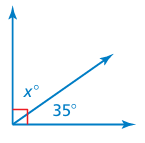
Tell whether the angles are adjacent or vertical. Then find the value of x.
Solution :
The shown angles x and 35 are next to each other. Then it must be adjacent angles.
x + 35 = 90
x = 90 - 35
x = 55
Problem 12 :
The measures of two adjacent angles have a ratio of 3 : 5. The sum of the measures of the two adjacent angles is 120°. What is the measure of the larger angle
Solution :
The sum of two adjacent angles = 120
The given angles be 3x and 5x.
3x + 5x = 120
8x = 120
x = 120/8
x = 15
3x ==> 3(15) ==> 45
5x ==> 5(15) ==> 75
So, the given angle measures are 45 and 75.
Problem 13 :
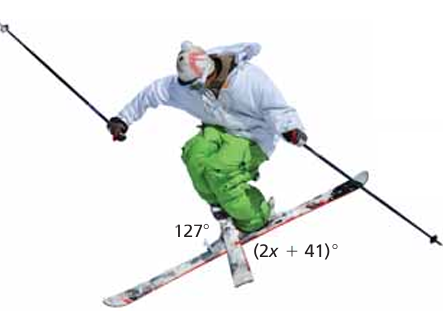
The iron cross is a skiing trick in which the tips of the skis are crossed while the skier is airborne. Find the value of x in the iron cross shown.
Solution :
127 and 2x + 41 are vertical angles, they must be equal.
127 = 2x + 41
2x = 127 - 41
2x = 86
x = 86/2
x = 43
So, the value of x is 43.
Problem 14 :
Determine whether the statement is always, sometimes, or never true.
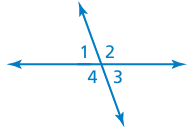
a) When the measure of ∠1 is 70°, the measure of ∠3 is 110°. When the measure of ∠4 is 120°, the measure of ∠1 is 60°.
b) ∠2 and ∠3 are congruent.
c) The measure of ∠1 plus the measure of ∠2 equals the measure of ∠3 plus the measure of ∠4.
Solution :
a) ∠1 = ∠3 (Vertically opposite angles)
It is never true.
b) ∠2 and ∠3 may be congruent. So, it is sometimes.
c) Given that,
∠1 + ∠2 = ∠3 + ∠4
∠1 and ∠2 are supplementary angles and ∠3 and ∠4 are supplementary. Then they must be equal.
Problem 15 :
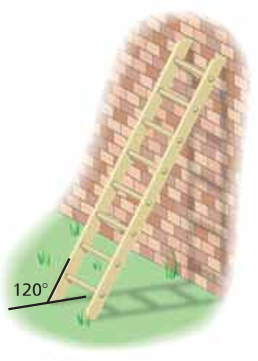
For safety reasons, a ladder should make a 15° angle with a wall. Is the ladder shown leaning at a safe angle? Explain.
Solution :
a) The adjacent angle of 120 degree is 60 degree. The sum of interior angles of a triangle is 180 degree.
Let x be the angle with a wall.
60 + 90 + x = 180
150 + x = 180
x = 180 - 150
x = 30
So, the ladder shown leaning at a safe angle.
Problem 16 :
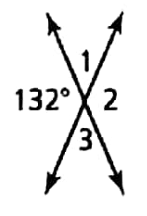
What are the measures of the other three angles formed by the intersection?
Solution :
<1 + 132 = 180
<1 = 180 - 132
<1 = 48
<1 and <3 are vertically opposite angles.
<2 = 132 (vertically opposite angles)
Problem 17 :
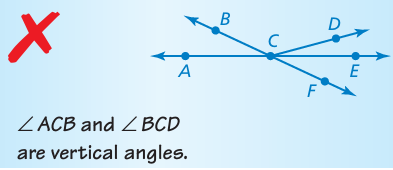
Describe and correct the error in naming a pair of vertical angles.
Solution :
<ACB and <BCD are next to each other, then they are called as adjacent angles.
Subscribe to our ▶️ YouTube channel 🔴 for the latest videos, updates, and tips.
Recent Articles


-
Finding Range of Values Inequality Problems
May 21, 24 08:51 PM
Finding Range of Values Inequality Problems -
Solving Two Step Inequality Word Problems
May 21, 24 08:51 AM
Solving Two Step Inequality Word Problems -
Exponential Function Context and Data Modeling
May 20, 24 10:45 PM
Exponential Function Context and Data Modeling