INTERIOR AND EXTERIOR ANGLES OF QUADRILATERALS WORKSHEET
Subscribe to our ▶️ YouTube channel 🔴 for the latest videos, updates, and tips.
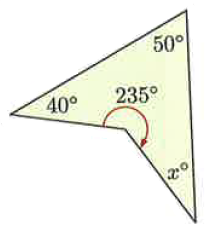
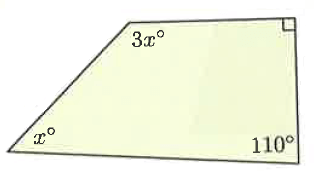
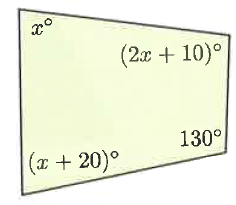
Find the value of x in the following quadrilaterals :
Problem 1 :

Problem 2 :

Problem 3 :
Problem 4 :
Problem 5 :
Problem 6 :
Find the values of a and b.
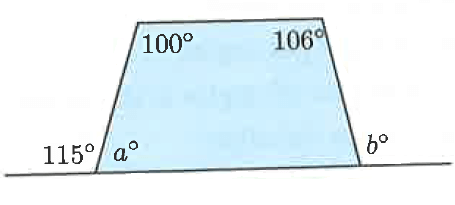
Problem 7 :
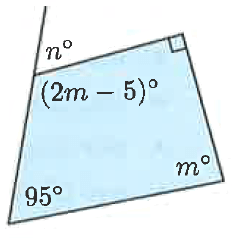
Problem 8 :
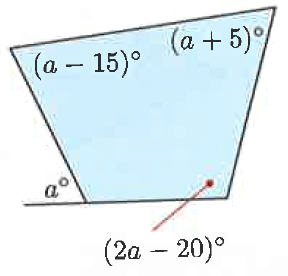
Problem 9 :
find the measures of the numbered angles in rhombus DEFG.
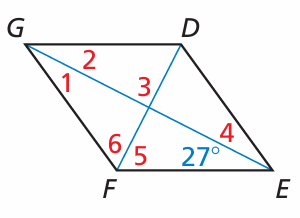
Problem 10 :
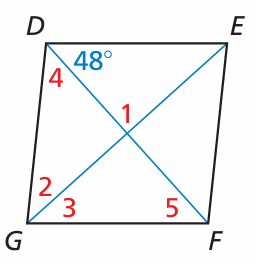
Problem 11 :
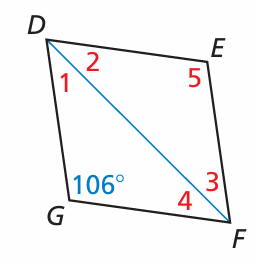
Problem 12 :
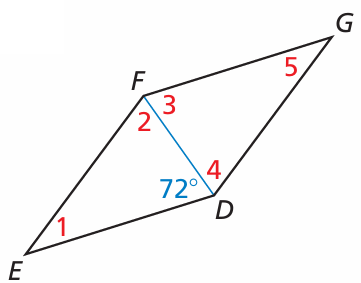
Problem 13 :
The measures of the interior angles of a quadrilateral are x°, 3x°, 5x°, and 7x°. Find the measures of all the interior angles.
Problem 14 :
Find the values of x and y that make the quadrilateral a parallelogram
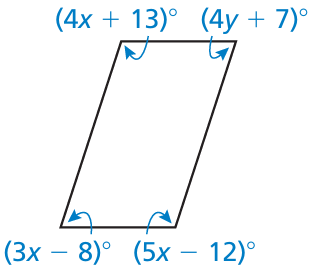
Answer Key
1) x = 65
2) x = 93
3) x = 35
4) x = 40
5) x = 50
6) a = 65 and b = 89
7) m = 60 and n = 65
8) a = 70
9) ∠4 = ∠1 = 27, ∠6 = 63, ∠5 = 63, ∠3 = 90, ∠2 = 27
10) ∠1 = 90, ∠2 = 42, ∠3 = 42, ∠5 = 48, ∠4 = 48
11) ∠1 = 37, ∠4 = ∠3 = 37 = ∠2, ∠5 = 106, ∠4 = 37
12) ∠1 = 54, ∠5 = 54, ∠2 = 72, ∠3 = 72 and ∠4 = 72
13) the required interior angles are 22.5, 67.5, 112.5 and 157.5
14) the value of x is 25 and y is 25.
Find the unknown values in the following :
Problem 1 :

Problem 2 :
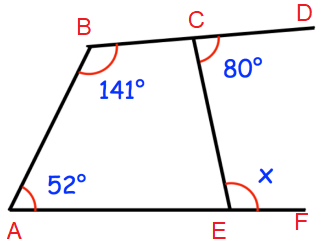
Problem 3 :
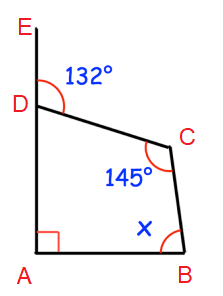
Problem 4 :
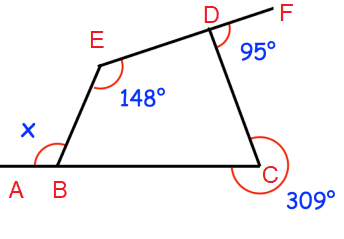
Problem 5 :
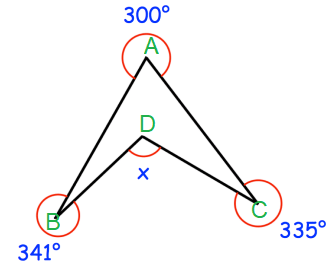
Problem 6 :
Find m∠1 if m∠G = 80, m∠F = 110 and. m∠H = 74.
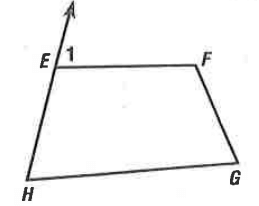
Problem 7 :
In the given figure, ABCD is a parallelogram. Find the values of x, y, z and p.
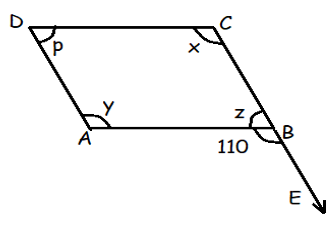
Problem 8 :
Find x + y + z + w in the given figure.
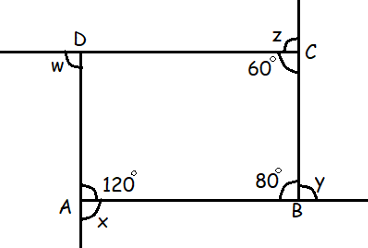
Problem 9 :
If three angles of a quadrilateral are each equal to 75°, the fourth angle is :
(a) 150° (b) 135° (c) 45° (d) 75°
Problem 10 :
What is the maximum number of obtuse angles that a quadrilateral can have ?
(a) 1 (b) 2 (c) 3 (d) 4
Problem 11 :
In the figure, ABCD is a square. If ∠DPC = 80°, then find .
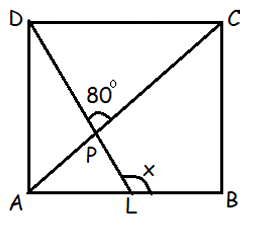
Problem 12 :
The angle of ∠M, ∠N, ∠O and ∠P of a trapezium MNOP intersect at points W and X respectively. If ∠MPX = 50, ∠NOX = 70, find the measure of the angles a, b, c and d
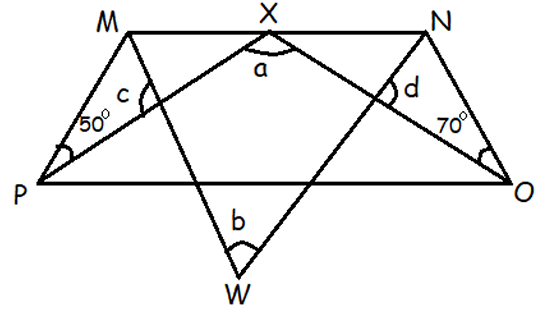
Answer Key
|
1) x = 106 2) x = 113 3) x = 77 |
4) x = 104 5) x = 104 6) m∠1 = 94 7)
8) the value of x + y + z + w is 360. 9) x = 135 10) A quadrilateral can have a maximum of three obtuse angles because the sum of all interior angles in any quadrilateral is 360°, and if three angles were obtuse (greater than 90°), their sum alone would be over 270°, leaving room for the fourth angle to be acute (less than 90°) to total 360° 11) x = 125 12) a = 60, b = 120, c = 90, d = 90 |
Find the unknown angles of a quadrilateral.
Problem 1 :
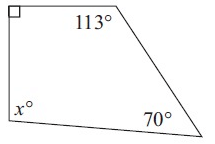
Problem 2 :

Problem 3 :
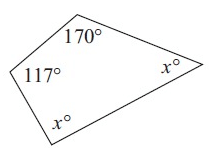
Problem 4 :
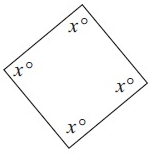
Problem 5 :
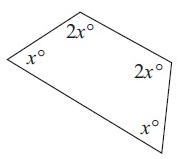
Problem 6 :
One angle of a quadrilateral is 150°and other three angles are equal. What is the measure of each of these equal angles ?
(a) 75° (b) 85° (c) 95° (d) 70°
Problem 7 :
Four angles of quadrilateral are in the ratio 3:4:5:6. Find its angles.
Problem 8 :
Three angles of a quadrilateral are 4 : 6 : 3. If the fourth angle is 100, find the three angles of a quadrilateral.
Problem 9 :
The sum of two angles of a quadrilateral is 160 the ratio 2 : 3. Find the angles.
Problem 10 :
What is the maximum number of obtuse angles that a quadrilateral can have ?
(a) 1 (b) 2 (c) 3 (d) 4
Problem 11 :
In a quadrilateral PQRS, ∠P = 50°, ∠Q = 60°,∠R = 60°. Find ∠S
Problem 12 :
In a parallelogram PQRS, if ∠P = (3x − 5)° and ∠Q = (2x + 15)°, then find the value of x.
Problem 13 :
If one angle of a parallelogram is 24° less than twice the smallest angle then, find the largest angle of the parallelogram
Problem 14 :
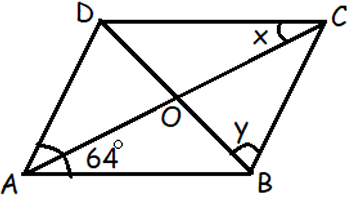
In the figure, ABCD is a rhombus. Find x and y.
Answer Key
1) x° = 87°
2) x° = 43°
3) x° = 36.5°
4) x° = 90°
5) x° = 60°
6) x = 70
7) The required angels are 60, 80, 100 and 120 respectively.
8) those three angles are 60, 80 and 120.
9) the required angles are 80 and 120 degrees respectively.
10) maximum three obtuse angles that quadrilateral can have.
11) ∠S = 190
12) x = 34
13) the larger angle is 112 degree and smaller angle is 68 degree.
14) x = 32 and y = 58
Subscribe to our ▶️ YouTube channel 🔴 for the latest videos, updates, and tips.
Recent Articles


-
Finding Range of Values Inequality Problems
May 21, 24 08:51 PM
Finding Range of Values Inequality Problems -
Solving Two Step Inequality Word Problems
May 21, 24 08:51 AM
Solving Two Step Inequality Word Problems -
Exponential Function Context and Data Modeling
May 20, 24 10:45 PM
Exponential Function Context and Data Modeling