SUM OF INTERIOR ANGLES OF A QUADRILATERAL
Subscribe to our ▶️ YouTube channel 🔴 for the latest videos, updates, and tips.
A quadrilateral is a four sided polygon. The sum of the interior angles of a quadrilateral is 360°
When we divide the quadrilateral into two triangles, each triangle has an angle sum of 180 degree, so the sum of angles in a quadrilateral is 360.
Find the unknown angles of a quadrilateral.
Problem 1 :
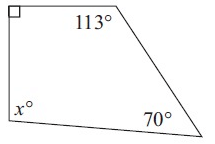
Solution :
Sum of interior angles = 360°
90° + 113° + 70° + x° = 360°
273° + x° = 360°
x° = 360° - 273°
x° = 87°
Problem 2 :

Solution :
Sum of interior angles = 360°
131° + 118° + 68° + x° = 360°
317° + x° = 360°
x° = 360° - 317°
x° = 43°
Problem 3 :
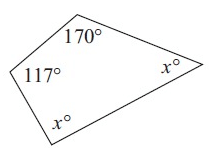
Solution :
Sum of interior angles = 360°
117° + 170° + x° + x° = 360°
287° + 2x° = 360°
2x° = 360° - 287°
2x° = 73°
x° = 73/2
x° = 36.5°
Problem 4 :
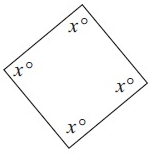
Solution :
Sum of interior angles = 360°
x° + x° + x° + x° = 360°
4x° = 360°
x° = 360°/4
x° = 90°
Problem 5 :
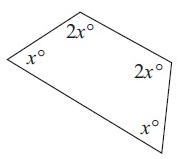
Solution :
Sum of interior angles = 360°
2x° + 2x° + x° + x° = 360°
6x° = 360°
x° = 360°/6
x° = 60°
Problem 6 :
One angle of a quadrilateral is 150°and other three angles are equal. What is the measure of each of these equal angles ?
(a) 75° (b) 85° (c) 95° (d) 70°
Solution :
Let x be those three angles.
Angels of quadrilateral are x, x, x and 150.
x + x + x + 150 = 360
3x + 150 = 360
Subtracting 150 on both sides.
3x = .360 - 150
3x = 210
Divide by 3 on both sides.
x = 210/3
x = 70
Problem 7 :
Four angles of quadrilateral are in the ratio 3:4:5:6. Find its angles.
Solution :
Let the four angles be 3x, 4x, 5x and 6x.
3x + 4x + 5x + 6x = 360
18x = 360
x = 360/18
x = 20
3x ==> 3(20) ==> 60
4x ==> 4(20) ==> 80
5x ==> 5(20) ==> 100
6x ==> 6(20) ==> 120
The required angels are 60, 80, 100 and 120 respectively.
Problem 8 :
Three angles of a quadrilateral are 4 : 6 : 3. If the fourth angle is 100, find the three angles of a quadrilateral.
Solution :
Let the three angles be 4x, 6x and 3x.
4x + 6x + 3x + 100 = 360
13x + 100 = 360
Subtracting 100 on both sides.
13x = 360 - 100
13x = 260
Dividing by 13 on both sides.
x = 260/13
x = 20
|
4x = 4(20) = 80 |
6x = 6(20) = 120 |
3x = 3(20) = 60 |
So, those three angles are 60, 80 and 120.
Problem 9 :
The sum of two angles of a quadrilateral is 160 the ratio 2 : 3. Find the angles.
Solution :
Sum of two angles of a quadrilateral = 160
Two angles are 2x and 3x
Sum of angles = 2x + 3x + 160
5x + 160 = 360
Subtracting 160 on both sides.
5x = 360 - 160
5x = 200
Dividing by 5 on both sides.
x = 200/5
x = 40
2x ==> 2(40) ==> 80
3x ==> 3(40) ==> 120
So, the required angles are 80 and 120 degrees respectively.
Problem 10 :
What is the maximum number of obtuse angles that a quadrilateral can have ?
(a) 1 (b) 2 (c) 3 (d) 4
Solution :
Total number of angles in a quadrilateral = 360
Sum of interior angle = 360
If we consider the three angles are having measures more than 90 degree, the fourth angle should be less than 90.
So, maximum three obtuse angles that quadrilateral can have.
Problem 11 :
In a quadrilateral PQRS, ∠P = 50°, ∠Q = 60°,∠R = 60°. Find ∠S
Solution :
Sum of interior angle measure of quadrilateral = 360
Given that, ∠P = 50°, ∠Q = 60°,∠R = 60°
∠P + ∠Q + ∠R + ∠S = 360
50° + 60° + 60° + ∠S = 360
170 + ∠S = 360
∠S = 360 - 170
∠S = 190
Problem 12 :
In a parallelogram PQRS, if ∠P = (3x − 5)° and ∠Q = (2x + 15)°, then find the value of x.
Solution :
Since PQRS is a parallelogram,
- PQ is parallel to RS
- QR and PS are parallel.
∠P and ∠Q are co-interior angles, then its sum is 180 degree.
3x - 5 + 2x + 15 = 180
5x + 10 = 180
5x = 180 - 10
5x = 170
x = 170/5
x = 34
So, the value of x is 34.
Problem 13 :
If one angle of a parallelogram is 24° less than twice the smallest angle then, find the largest angle of the parallelogram
Solution :
Let x be the smaller angle, then the other angle will be 2x - 24
Sum of co-interior angles = 180
x + 2x - 24 = 180
3x = 180 + 24
3x = 204
x = 204/3
x = 68
2x - 24 ==> 2(68) - 24
= 136 - 24
= 112
So, the larger angle is 112 degree and smaller angle is 68 degree.
Problem 14 :
In the figure, ABCD is a rhombus. Find x and y.
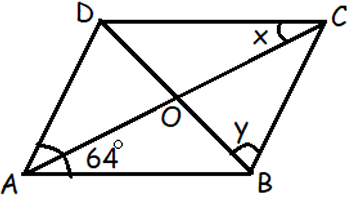
Solution :
∠DAB = 64
∠CAB = 64/2 ==> 32
x = 32 (alternate interior angle)
In triangle ACB,
∠CAB + ∠ABC + ∠BCA = 180
32 + 2y + 32 = 180
64 + 2y = 180
2y = 180 - 64
2y = 116
y = 116/2
y = 58
Subscribe to our ▶️ YouTube channel 🔴 for the latest videos, updates, and tips.
Recent Articles


-
Finding Range of Values Inequality Problems
May 21, 24 08:51 PM
Finding Range of Values Inequality Problems -
Solving Two Step Inequality Word Problems
May 21, 24 08:51 AM
Solving Two Step Inequality Word Problems -
Exponential Function Context and Data Modeling
May 20, 24 10:45 PM
Exponential Function Context and Data Modeling