PROBLEMS ON EXTERIOR ANGLES OF A QUADRILATERAL
Subscribe to our ▶️ YouTube channel 🔴 for the latest videos, updates, and tips.
Sum of exterior angle of quadrilateral is 360°.
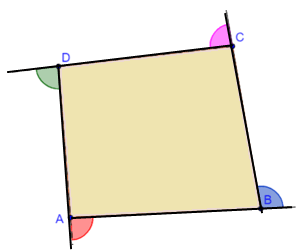
∠A + ∠B + ∠C + ∠D = 360
Find the unknown values in the following :
Problem 1 :

Solution :
∠CDA = 180 - x, ∠CDE = x
Sum of interior angles of a quadrilateral = 360
118 + 71 + 97 + 180 - x = 360
466 - x = 360
x = 466-360
x = 106
Problem 2 :
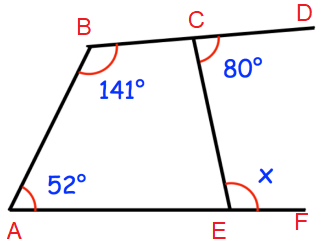
Solution :
∠BCE = 100, ∠CEA = 180 - x
Sum of interior angles of a quadrilateral = 360
52 + 141 + 100 + 180 - x = 360
473 - x = 360
Subtracting 473 on both sides.
-x = 360 - 473
-x = -113
x = 113
Problem 3 :
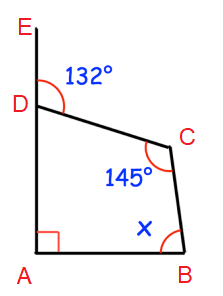
Solution :
∠DAB = 90
∠ADC = 180-132 ==> 48
Sum of interior angles = 360
90 + x + 145 + 48 = 360
283 + x = 360
Subtracting 283 on both sides.
x = 360 - 283
x = 77
Problem 4 :
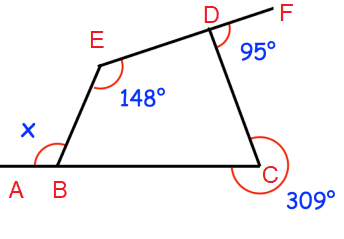
Solution :
Reflexive angle of ∠C = ∠BCD
|
∠BCD = 360 - 309 ∠BCD = 51 |
∠EBC = 180 - x ∠EDC = 180 - 95 ∠EDC = 85 |
Sum of interior angle = 360
180 - x + 51 + 85 + 148 = 360
464 - x = 360
Subtracting 464 on both sides.
-x = 360 - 464
-x = -104
x = 104
Problem 5 :
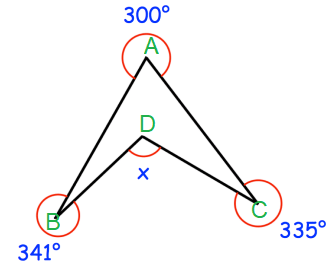
Solution :
Reflexive of ∠B = 360 - 341
∠ABD = 19
Reflexive of ∠C = 360 - 335
∠DCA = 25
Reflexive of ∠A = 360 - 300
∠CAB = 60
Reflexive of ∠BDC = 360 - x
Sum of the interior angles = 360
19 + 25 + 60 + 360 - x = 360
464 - x = 360
Subtracting 464 on both sides.
x = 464 - 360
x = 104
Problem 6 :
Find m∠1 if m∠G = 80, m∠F = 110 and. m∠H = 74.
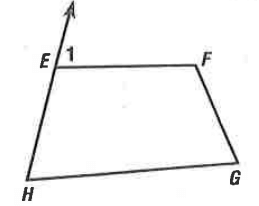
Solution :
m∠G + m∠F + m∠H + m∠HEF = 360
80 + 110 + 74 + m∠HEF = 360
264 + m∠HEF = 360
Subtracting 264 on both sides.
m∠HEF = 360 - 264
m∠HEF = 96
m∠HEF + m∠1 = 180
96 + m∠1 = 180
Subtracting 96 on both sides.
m∠1 = 180 - 96
m∠1 = 94
Problem 7 :
In the given figure, ABCD is a parallelogram. Find the values of x, y, z and p.
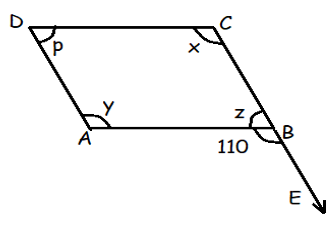
Solution :
∠ABE + z = 180 (linear pair)
110 + z = 180
z = 180 - 110
z = 70
Since it is parallelogram co-interior angles will be add upto 180 degree.
x = 100
Opposite angles will be equal.
y = 100
p = 80
Problem 8 :
Find x + y + z + w in the given figure.
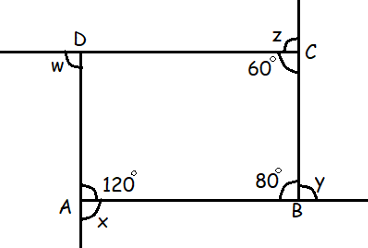
Solution :
x + 120 = 180
x = 180 - 120
x = 60
y + 80 = 180
y = 180 - 80
y = 100
z + 60 = 180
z = 180 - 60
z = 120
∠ADC = 360 - (60 + 80 + 120)
= 360 - 260
= 100
w = 180 - 100
w = 80
x + y + z + w = 60 + 100 + 120 + 80
= 360
So, the value of x + y + z + w is 360.
Problem 9 :
If three angles of a quadrilateral are each equal to 75°, the fourth angle is :
(a) 150° (b) 135° (c) 45° (d) 75°
Solution :
Let x be the fourth angle.
Sum of angles = 360
3(75) + x = 360
225 + x = 360
x = 360 - 225
x = 135
So, option b is correct.
Problem 10 :
What is the maximum number of obtuse angles that a quadrilateral can have ?
(a) 1 (b) 2 (c) 3 (d) 4
Solution :
A quadrilateral can have a maximum of three obtuse angles because the sum of all interior angles in any quadrilateral is 360°, and if three angles were obtuse (greater than 90°), their sum alone would be over 270°, leaving room for the fourth angle to be acute (less than 90°) to total 360°
Problem 11 :
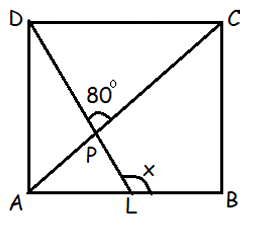
In the figure, ABCD is a square. If ∠DPC = 80°, then find .
Solution :
∠CPL = 180 - 80 ==> 100
AC is a diagonal, it must be angle bisector. ∠ACB = 45
In quadrilateral CPLB,
∠ACB + ∠CBL + ∠BLP + ∠LPC = 360
45 + 90 + x + 100 = 360
235 + x = 360
x = 360 - 235
x = 125
Problem 12 :
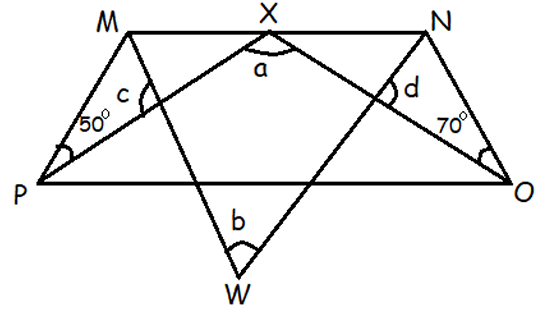
The angle of ∠M, ∠N, ∠O and ∠P of a trapezium MNOP intersect at points W and X respectively. If ∠MPX = 50, ∠NOX = 70, find the measure of the angles a, b, c and d
Solution :
In triangle PXO,
∠XPO + ∠PXO + ∠XOP = 180
50 + a + 70 = 180
120 + a = 180
a = 180 - 120
a = 60
PO and MN are parallel, then ∠PMN = 180 - 100
= 80
∠PMW = 80/2 ==> 40
∠MNO = 180 - 140
= 40
∠MNW = 40/2 ==> 20
In triangle MNW,
∠MNW + ∠NWM + ∠WMN = 180
20 + b + 40 = 180
b + 60 = 180
b = 180 - 60
b = 120
∠MPX + ∠PMW + c = 180
50 + 40 + c = 180
c = 180 - 90
c = 90
∠WNO + ∠NOX + d = 180
20 + 70 + d = 180
90 + d = 180
d = 180 - 90
d = 90
Subscribe to our ▶️ YouTube channel 🔴 for the latest videos, updates, and tips.
Recent Articles


-
Finding Range of Values Inequality Problems
May 21, 24 08:51 PM
Finding Range of Values Inequality Problems -
Solving Two Step Inequality Word Problems
May 21, 24 08:51 AM
Solving Two Step Inequality Word Problems -
Exponential Function Context and Data Modeling
May 20, 24 10:45 PM
Exponential Function Context and Data Modeling