IF A FRACTION IS TERMINATING OR REPEATING WITHOUT DIVIDING WORKSHEET
Subscribe to our ▶️ YouTube channel 🔴 for the latest videos, updates, and tips.
Terminating decimals result when the rational number has a denominator which has no prime factors other than 2 or 5.
Problem 1 :
1/2
Problem 2 :
3/4
Problem 3 :
3/5
Problem 4 :
17/50
Problem 5 :
2/3
Problem 6 :
2/9
Problem 7 :
9/40
Problem 8 :
5/6
Problem 9 :
7/8
Problem 10 :
17/80
Problem 11 :
37/125
Problem 12 :
5/12
Problem 13 :
3/20
Problem 14 :
4/11
Problem 15 :
11/25
Problem 16 :
7/9
Problem 17 :
7/90
Problem 18 :
7/99
Problem 19 :
7/999
Problem 20 :
7/9999
Answer Key
1) Terminating decimal
2) Terminating decimal
3) Terminating decimal
4) Terminating decimal
5) Non terminating decimal
6) Non terminating decimal
7) Terminating decimal
8) Non terminating decimal
9) Terminating decimal
10) Terminating decimal
11) Terminating decimal
12) Non terminating decimal
13) Terminating decimal
14) Non terminating decimal
15) Terminating decimal
16) Non terminating decimal
17) Non terminating decimal
18) Non terminating decimal
19) Non terminating decimal
20) Non terminating decimal
Convert the following recurring decimals to fractions :
Problem 1 :
0.333….
Problem 2 :
0.444….
Problem 3 :
1.0909….
Problem 4 :
2.0909….
Problem 5 :
0.5333….
Problem 6 :
1.7333….
Problem 7 :
0.9444….
Problem 8 :
2.0555…
Problem 9 :
a) Write 1/7 as a repeating decimal. How many digits repeat?
b) Write the fractions
2/7, 3/7, 4/7, 5/7 and 6/7
in decimal form. What patterns do you see? Explain how the circle of digits can help you write these fractions as decimals.
Problem 10 :
0.5454........ x 0.555...........
Problem 11 :
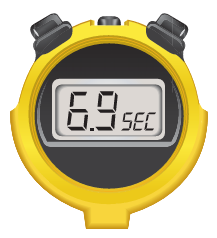
You run the 40-yard dash in 6 21/25 seconds. Your teammate runs it in the time shown. Who is faster and by how much?
Answer Key
1) 0.333… = 1/3
2) 0.444… = 4/9
3) 1.0909… = 108/99
4) 2.0909… = 207/99
5) 0.5333… = 48/90
6) 1.7333… = 156/90
7) 0.9444… = 85/90
8) 2.0555… = 185/90
9)
a) 1/7 = 0.142857142857 ................
The repeating digits are 142857. So six digits are repeating.
b) Other fractions and patterns
- 2/7: 0.285714 (starts at '2' in the cycle).
- 3/7: 0.428571 (starts at '4' in the cycle).
- 4/7: 0.571428 (starts at '5' in the cycle).
- 5/7: 0.714285 (starts at '7' in the cycle).
- 6/7: 0.857142 (starts at '8' in the cycle).
Patterns and the "Circle of Digits"
- Pattern: All fractions (1/7 to 6/7) use the exact same six digits (1, 4, 2, 8, 5, 7) in their repeating cycle, just starting at a different point.
10) the answer is 10/33.
11) you are faster by 0.06 second.
Problem 1 :
Which of these are rational?
a. 8 b. -8 c. 2 1/3 d. -3 1/4
e. √3 f. √400 g. 9.176 h. π - π
Problem 2 :
Show that these numbers are rational:
a. 0.7..... b. 0.41..... c. 0.324......
Problem 3 :
a. Why is 0.527 a rational number?
b. 0.9 is a rational number. In fact, 0.9 € Z. Give evidence to support this statement.
Problem 4 :
Explain why these statements are false:
a. The sum of two irrationals is irrational.
b. The product of two irrationals is irrational.
Problem 5 :
a. Explain why 1.3 is a rational number.
b. True or false. √4000 € Q ?
Problem 6 :
a. True or false: 1/√7 € Q ?
b. Show that 0.41 is a rational number.
Problem 7 :
Is the sum of 3√2 and 4√2 rational or irrational
Problem 8 :
Jacob is working on his math homework. He decides that the sum of the expression 1/3 + 6√5/7 must be rational because it is fraction. Is Jacob correct ?
Problem 9 :
State whether 7 - √2 is rational or irrational
Problem 10 :
Is the product of √16 and 4/7 rational or irrational ?
Answer Key
1)
a) 8
8 is a integer and it can be written as 8/1. This can be written in the form of p/q. So, it is rational.
b) -8
This can be represented as -8/1. So, it is rational.
c) 2 1/3
This mixed fraction can be converted as improper fraction as 7/3. So, it is rational.
d) -3 1/4 = - 13/4
It is rational.
e) √3
√3 = 1.732 ..........
It cannot be converted as fraction, so it is not a rational number.
f) √400
√400 = 20
It can be represented as 20/1, then it is rational.
g) 9.176
Since it is recurring decimal, it can be converted as fraction. Then, it is rational.
h) π - π
= 0
2) a) 0.7777...... = 7/9
b) x = 41/99
c) x = 36/111
3)
a.
Yes, 0.527 is a rational Number. Since it is ending decimal, it can be represented as fraction.
b. 9/10
4) a) false
b) false
5) a) 13/10
b) it is irrational.
6) a) true
b) rational number
7) Multiplying rational number by irrational number will be a irrational number.
8) It must be an irrational number, because adding, subtracting, multiplying or dividing by irrational by rational number will product rational number as result.
9) Irrational
10) rational
Subscribe to our ▶️ YouTube channel 🔴 for the latest videos, updates, and tips.
Recent Articles


-
Finding Range of Values Inequality Problems
May 21, 24 08:51 PM
Finding Range of Values Inequality Problems -
Solving Two Step Inequality Word Problems
May 21, 24 08:51 AM
Solving Two Step Inequality Word Problems -
Exponential Function Context and Data Modeling
May 20, 24 10:45 PM
Exponential Function Context and Data Modeling