GRAPHING RATIONAL FUNCTIONS WORKSHEET
Subscribe to our ▶️ YouTube channel 🔴 for the latest videos, updates, and tips.
Identify the points of discontinuity, holes, vertical asymptotes, x – intercepts, horizontal asymptote, and domain of each. Then sketch the graph.
Problem 1 :
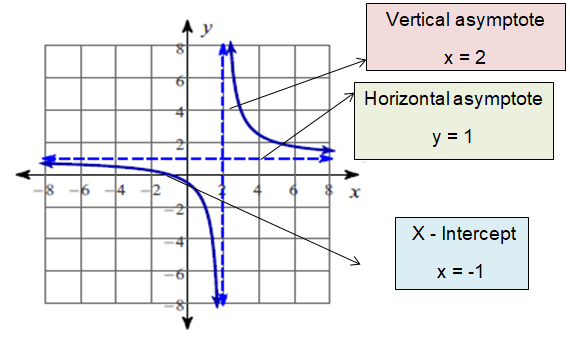
f(x) = (x + 1)/(x – 2)
Problem 2 :
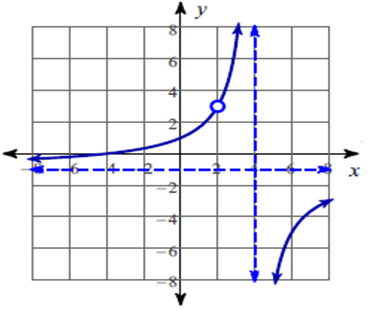
f(x) = (x2 + 2x – 8)/(-x2 + 6x – 8)
Problem 3 :
For each function
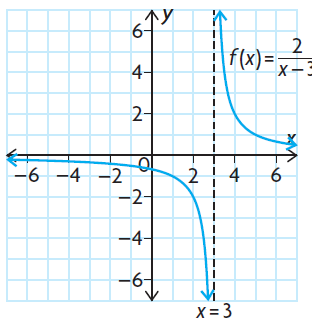
a) f(x) = 2/(x - 3)
b) f(x) = (x - 2) / (3x + 4)
c) (x) = (x - 3)/(2x - 6)
i) determine the domain, intercepts, asymptotes, and positive/negative intervals
ii) use these characteristics to sketch the graph of the function
iii) describe where the function is increasing or decreasing
Answer Key
1) discontinuous at x = 2.
No hole.
Vertical asymptote at x = 2
x – intercepts is -1.
Horizontal asymptote is y = 1
All real values except 2
2) Discontinuous at x = 2 and x = 4.
Hole at x = 2.
Vertical asymptote at x = 4.
x – intercepts is -4.
Horizontal asymptote is y = -1.
All real values except 2 and 4.
3) Domain is all real values except 3.
i) no x-intercept, y intercept is y = -2/3
- Vertical asymptote is at x = 3
- x-axis is the horizontal asymptote.
- When x ∈ (-∞, 3), y is negative
- When x ∈ (3, ∞), y is positive.
ii) Characteristics of graph :
When x --> -∞ then y-->-∞
When x --> ∞ then y--> ∞
iii) describe where the function is increasing or decreasing :
The function is decreasing in the entire domain, when x ∈ (-∞, 3) and x ∈ (3, ∞).
Identify the points of discontinuity, holes, vertical asymptotes, x – intercepts, horizontal asymptote, and domain of each. Then sketch the graph.
Problem 1 :
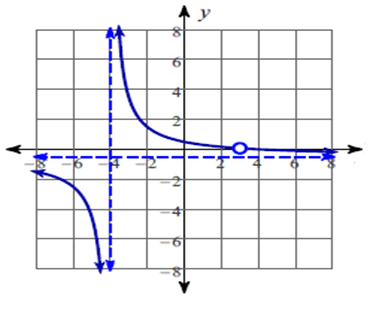
f(x) = (x2 - 7x + 12)/(-2x2 - 2x + 24)
Problem 2 :
f(x) = (3x2 - 3x - 18)/(x2 - 4)
Problem 3 :
f(x) = (x2 + 6x + 8)/(x2 + 3x - 4)
Problem 4 :
f(x) = (2x + 6)/(x2 + 5x + 6)
Problem 5 :
f(x) = (-2x - 6)/x
Problem 6 :
f(x) = (-3x + 12)/(x – 2)
1) Discontinuous at x = 3 and x = -4.
Hole at x = 3.
Vertical asymptote at x = -4.
x – intercepts is 4.
Horizontal asymptote is y = -1/2.
All real values except 3 and -4.
2) discontinuous at x = 2 and x = -2.
Hole at x = -2.
Vertical asymptotes at x = 2.
x – intercepts is 3.
Horizontal asymptote is y = 3.
All real values except -2 and 2.
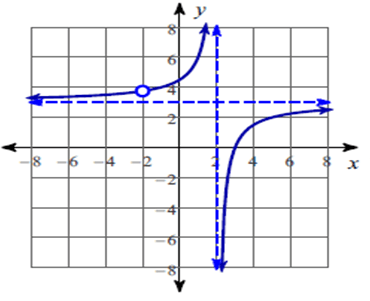
3) Discontinuous at x = -4 and x = 1.
Hole at x = -4.
Vertical asymptotes at x = 1.
x – intercepts is -2.
Horizontal asymptote is y = 1.
All real values except -4 and 1
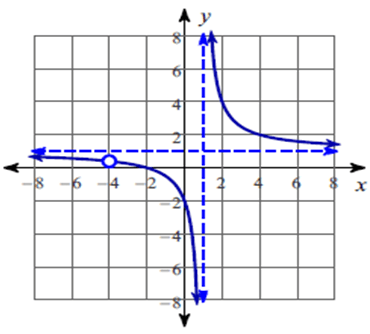
4) Discontinuous at x = -2 and x = -3.
Hole at x = -3.
Vertical asymptotes at x = -2.
x – intercepts is none.
Horizontal asymptote is y = 0
All real values except -3 and -2.
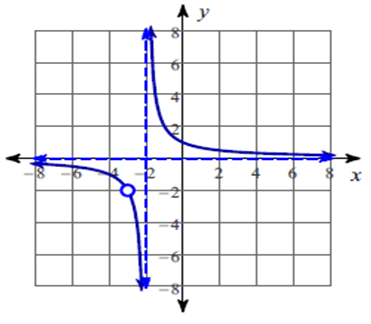
5) Discontinuous at x = 0.
No hole
Vertical asymptotes at x = 0.
x – intercepts is -3.
Horizontal asymptote is y = -2.
All real values except 0
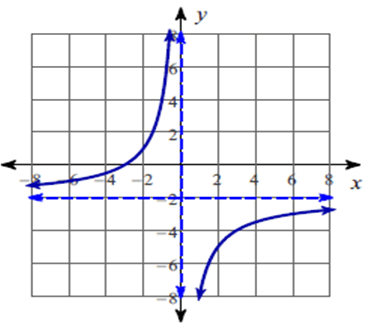
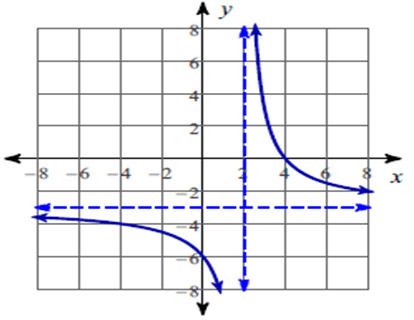
6) discontinuous at x = 2.
No hole
vertical asymptote at x = 2.
x – intercepts is 4.
horizontal asymptote is y = -3.
all real values except 2
Problem 1 :
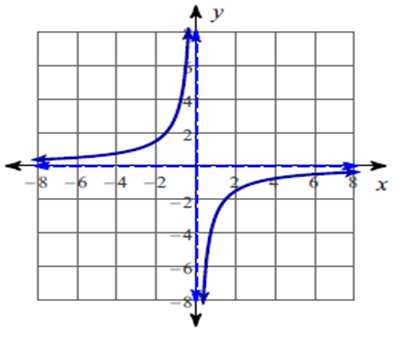
f(x) = -3/x
Problem 2 :
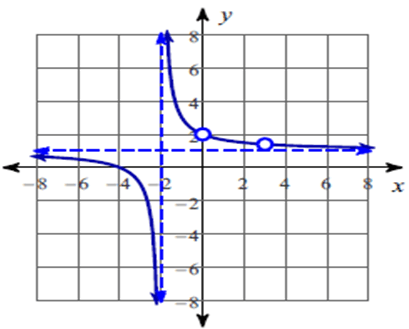
f(x) = (x3 + x2 – 12x)/(x3 – x2 – 6x)
Problem 3 :
The graph of the rational function f(x) = x2/(x2 - x + 2) intersects its asymptote y = 1. Find the point of intersection.
Problem 4 :
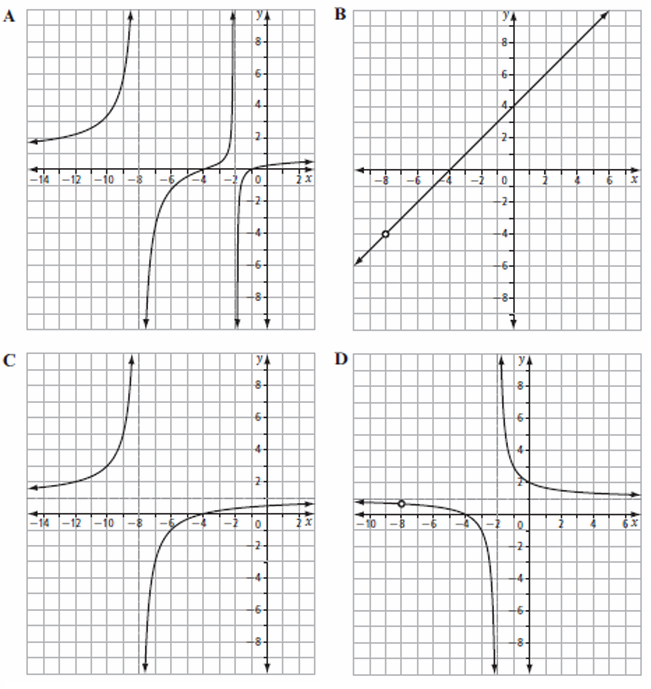
Match the equation of each rational function with its corresponding graph. Use key features such as intercepts and asymptotes to help you.
a) f(x) = (x + 4) / (x + 8)
b) f(x) = (x2 + 12x + 32) / (x + 8)
c) f(x) = (x2 + 12x + 32) / (x2 + 10x + 16)
d) f(x) = (x2 + 5x + 4) / (x2 + 10x + 16)
Answer Key
1)
Discontinuous at x = 0.
No hole
vertical asymptotes at x = 0.
No x – intercept.
Horizontal asymptote is y = 0
All real values except 0.
2)
Discontinuous at x = 0, x = -2 and x = 3.
Holes are at x = 0, x = 3.
Vertical asymptote at x = -2.
x – intercepts is -4.
Horizontal asymptote is y = 1.
All real values except 0, -2 and 3.
3) the point of intersection is at (2, 1)
4)
- a) f(x) = (x + 4) / (x + 8) ==> graph C
- b) f(x) = (x2 + 12x + 32) / (x + 8) ==> graph B
- c) f(x) = (x2 + 12x + 32) / (x2 + 10x + 16) ==> graph D
- d) f(x) = (x2 + 5x + 4) / (x2 + 10x + 16) ==> graph A
Subscribe to our ▶️ YouTube channel 🔴 for the latest videos, updates, and tips.
Recent Articles


-
Finding Range of Values Inequality Problems
May 21, 24 08:51 PM
Finding Range of Values Inequality Problems -
Solving Two Step Inequality Word Problems
May 21, 24 08:51 AM
Solving Two Step Inequality Word Problems -
Exponential Function Context and Data Modeling
May 20, 24 10:45 PM
Exponential Function Context and Data Modeling