FINDING THE AREA OF A REGULAR POLYGON USING SPECIAL RIGHT TRIANGLES
Subscribe to our ▶️ YouTube channel 🔴 for the latest videos, updates, and tips.
What is polygon ?
A polygon can be defined as a flat or plane, two-dimensional closed shape with straight sides. It does not have curved sides.
Regular polygon :
A polygon having equal sides and equal angles is a regular polygon.
To find area of regular polygon, we use the formula
What is Apothem ?
A line from the center of a regular polygon at right angles to any of its sides.
 |
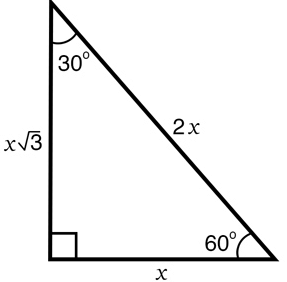 |
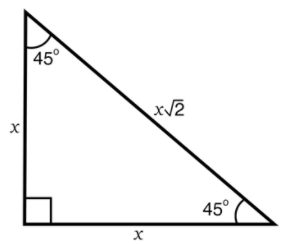
To know more about special right triangles, please visit
Use what you know about special right triangles to find the area of each regular polygon. Leave your answer in simplest form.
Example 1 :
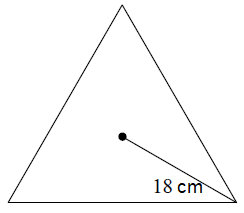
Solution :
Since the given triangle is a regular polygon, every sides will have the same measure. So, it must be a equilateral triangle.
Number of small triangles created by joining
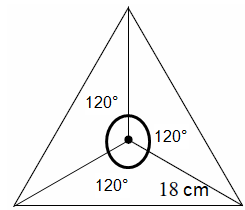
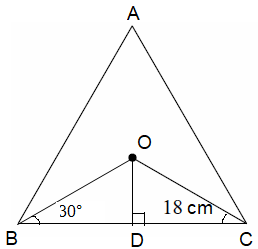
In triangle ODC,
∠ODC = 90, ∠DCO = 30, ∠COD = 60
Smallest side = OD
In 30-60-90 special right triangle, the side which is opposite to 60 is √3(Smaller side).
hypotenuse (OC) = 2(Smallest side)
OC = 2OD
Then,
18 = 2OD and OD = 9
|
OC2 = OD2 + DC2 182 = 92 + DC2 324 - 81 = DC2 DC = √243 DC = 9√3 |
BC = 2(9√3) BC = 18√3 (Side length) Apothem (OD) = 9 |
Area of polygon = (1/2) x perimeter x apothem
Perimeter = 3(18√3) ==> 54√3 cm
Area = (1/2) x 54√3 x 9
= 27√3 x 9
= 243√3 cm2
Problem 2 :
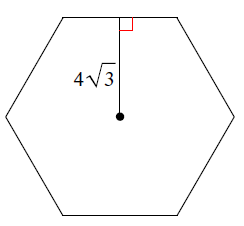
Solution :
Number of sides of a polygon = 6
by drawing lines from center to each vertex, we may draw six triangles of equal measure.
Angle measure of each triangle = 360/6 ==> 60
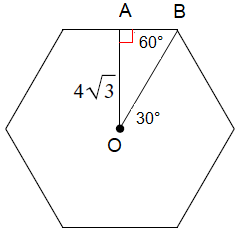
In triangle OAB,
OB = Hypotenuse, smaller side = AB
OB = 2(AB)
In special right triangle, the side which is opposite to 60 is √3(Smaller side).
OA = 4√3 then AB = 4 and OB = 2(4) ==> 8
Side length = 2(4) ==> 8
Area of polygon = (1/2) x perimeter x apothem
Perimeter = 6(8) ==> 48
Area = (1/2) x 48 x 4√3
= 24 x 4√3
= 96√3 cm2
Problem 3 :
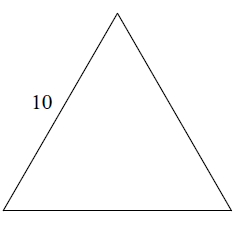
Solution :
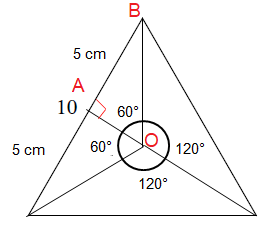
OA is perpendicular bisector, AB = 5 cm
∠AOB = 60, ∠ABO = 30
OA = Smaller side
AB = √3 (Smaller side)
5 = √3 (OA)
OA = 5/√3 (Apothem)
Side length = 10 cm
Area of polygon = (1/2) x perimeter x apothem
Perimeter = 3(10) ==> 30
height = 5/√3
Area = (1/2) x 30 x (5/√3)
= 15 x 5√3
= 75/√3
Rationalizing the denominator, we get
= (75/√3) x (√3/√3)
= 75√3/3
= 25√3 cm2
Problem 4 :
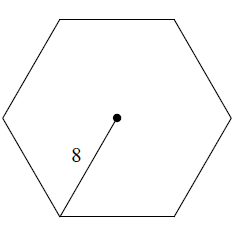
Solution :
Central angle of one triangle = 360/60
= 60 degree
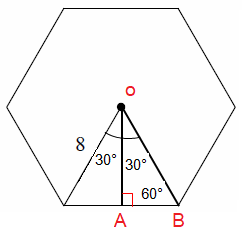
OB = 8, AB = Smaller side
2AB = OB, then AB = 4
OA = 4√3 (Apothem)
Side length = 8
Perimeter = 6(8) ==> 48
Area = (1/2) x 48 x 4√3
= 24 x 4√3
= 96√3 square units.
Problem 5 :
A honeycomb is made up of regular hexagonal cells. The length of a side of a cell is 3 mm. What is the area of a cell?
Solution :
Inside the hexagon, we have six equal triangles and one angle measure is 60 degree.
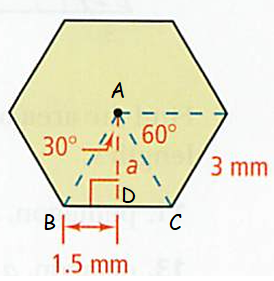
In triangle ABD, <BAD = 30 degree, BC = 1.5 mm
Opposite side = BD = 1.5 mm, Hypotenuse = AB and Adjacent side = AD = a
tan θ = Opposite side / Adjacent side
tan 30 = BD / AD
1/√3 = 1.5/a
a = 1.5√3
Length of apothem = 1.5√3
Perimeter = 6 x side length
= 6 x 3
= 18 mm
Area of polygon = (1/2) x 18 x 1.5√3
= 9 x 1.5√3
= 13.5√3
= 13.5 x 1.732
= 23.38 mm2
So, the required area of the polygon is 23 mm2
Problem 6 :
You are painting a mural of colored equilateral triangles. The radius of each triangle is 12.7 in. What is the area of each triangle to the nearest square inch?
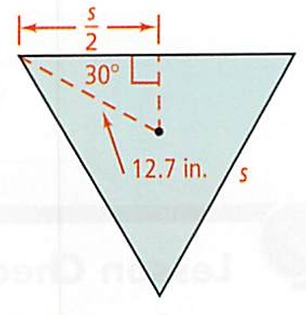
Solution :
Hypotenuse = 12.7 in
Opposite side = s/2
Adjacent side = ?
sin θ = Opposite side / Hypotenuse
Let x be the opposite side.
sin 30 = x/12.7
1/2 = x/12.7
12.7/2 = x
Opposite side = x = 6.35 inches
tan θ = Opposite side / Adjacent side
tan 30 = 6.35 / (s/2)
1/√3 = 2(6.35)/s
s = 2(6.35)(√3)
s = 2 x 6.35 x 1.732
s = 21.994
Side length = s = 22 inches
Perimeter = 3(22)
= 66 inches
Area of polygon = (1/2) x 6.35 x 66
= 33 x 6.35
= 209.55 square inches
So, the area of polygon is 210 square inches approximately.
Problem 7 :
Find the shaded area of the regular pentagon PENTA. The apothem measures about 2.0 cm.
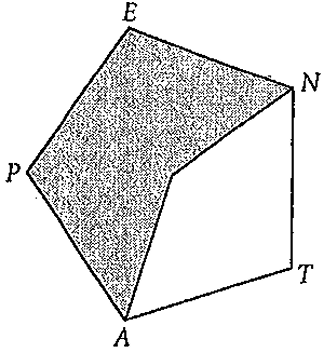
Solution :
Since it is pentagon and it has 5 equal side, five equal triangles.
One angle is 72 degree and half of the angle is 36 degree.
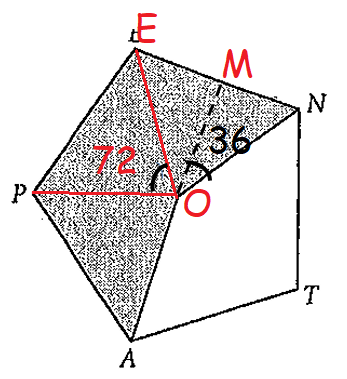
Apothem = OM = 2 cm
Side length = EN
EM = x and MN = x/2
tan θ = Opposite side / Adjacent side
tan 36 = MN/OM
0.7265 = (x/2) / 2
0.7265 = x/4
x = 0.7265(4)
x = 2.906
Area of triangle = (1/2) x base x height
= (1/2) x 2.9 x 2
= 2.9 cm2
Area of 3 equal triangles = 3 x 2.9
= 8.7 cm2
Subscribe to our ▶️ YouTube channel 🔴 for the latest videos, updates, and tips.
Recent Articles


-
Finding Range of Values Inequality Problems
May 21, 24 08:51 PM
Finding Range of Values Inequality Problems -
Solving Two Step Inequality Word Problems
May 21, 24 08:51 AM
Solving Two Step Inequality Word Problems -
Exponential Function Context and Data Modeling
May 20, 24 10:45 PM
Exponential Function Context and Data Modeling