WRITE AND GRAPH A DIRECT VARIATION EQUATION WITH THE POINT
Subscribe to our ▶️ YouTube channel 🔴 for the latest videos, updates, and tips.
Mathematical relationship between two variables that can be expressed by an equation in which one variable is equal to a constant times the other.
y = kx
here k is constant of variation.
The equation which is in the form y = kx is known as direct variation.
When one quantity is increased, the other quantity is also increased (or) when one quantity is decreased other quantity is also decreased.
This proportion is called direct proportion or direct variation.
When one quantity is increased, the other quantity decreased. This proportion is called inverse proportion or inverse variation.
Graphical form of direct variation will always be a straight line, may be
(i) Raising line (If constant of variation is positive)
(ii) Falling line (If constant of variation is negative).
Problem 1 :
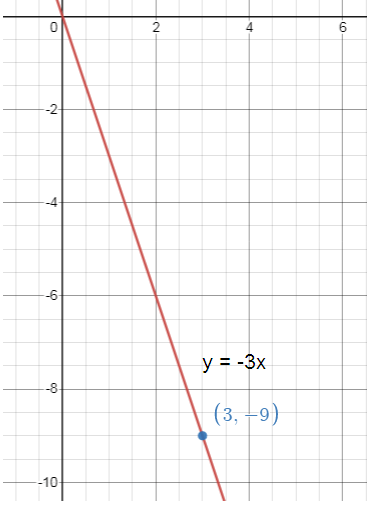
Write and graph a direct variation equation that has a solution (3, -9).
Solution :
Direct variation equation passing through the point (3, -9)
When x = 3, y = -9
Direct variation equation y = ax
|
-9 = a(3) -9/3 = a -3 = a |
When a = -3 y = ax y = (-3)x |
Problem 2 :
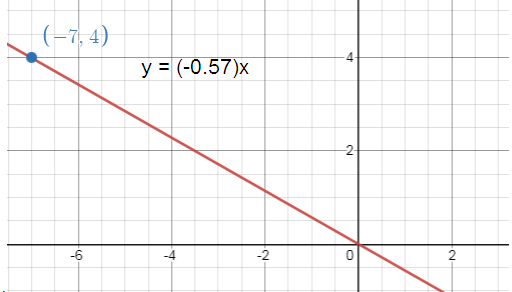
Write and graph a direct variation equation that has a solution (-7, 4).
Solution :
Direct variation equation passing through the point (-7, 4)
x = -7, y = 4
Direct variation equation y = ax
|
4 = a(-7) -4/7 = a a = -4/7 |
When a = -4/7 y = ax y = (-4x/7) |
Problem 3 :
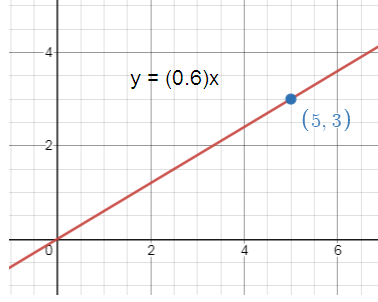
Write and graph a direct variation equation that has a solution (5, 3).
Solution :
Direct variation equation passing through the point (5, 3).
x = 5, y = 3
Direct variation equation y = ax
|
3 = a(5) 3/5 = a a = 3/5 |
y = ax When a = 3/5 y = 3x/5 |
Problem 4 :
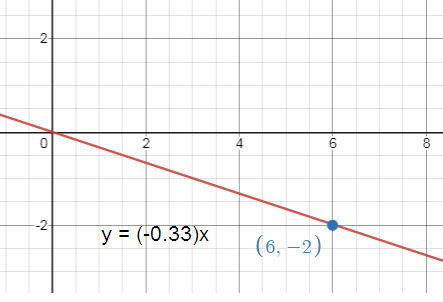
Write and graph a direct variation equation that has a solution (6, -2).
Solution :
Direct variation equation passing through the point (6, -2).
x = 6, y = -2
Direct variation equation y = ax
|
-2 = a(6) -2/6 = a a = -1/3 |
y = ax When a = -1/3 y = (-0.33)x |
Problem 5 :
A charter bus travels 210 miles in 3 1/2 hours. Assume the distance traveled varies directly with time traveled. Write and solve a direct variation equation to find how far the bus will travel in 6 hours.
Solution :
Let D be the distance traveled and t be the time taken.
D ∝ t
D = kt
When D = 210 miles, t = 3.5 hours
210 = k(3.5)
k = 210/3.5
k = 60
Applying the value of k, we get
D = 60t
When t = 6, we get
D = 60(6)
= 360 miles
So, in 6 hours the distance traveled is 360 miles.
Problem 6 :
The cost of papers varies directly with the number of reams bought. Suppose two reams cost $5.10. Write a direct variation equation to represent this relationship. Then identify the constant of variation and interpret its meaning.
Solution :
1 ream = 500 sheets
2 reams = 1000 sheets
Let C be the cost and R be the reams
C ∝ R
C = kR
5.10 = k(2)
k = 5.10/2
k = 2.55
C = 2.55R
Problem 7 :
The amount of flour needed for a recipe varies directly with the number of servings planned. Three servings required 4 1/2 cups of flour. Write the direct variation equation to represent this relationship. Then identify the constant of variation and interpret its meaning.
Solution :
Let F be the quantity of flour needed as cups and number of servings be N.
N ∝ F
N = kF
3 = k(4.5)
k = 3/4.5
k = 0.66
By applying the value of k, we get
N = 0.66 F
Problem 8 :
The cost of apps varies directly with the number of apps purchases. Aditi bought four apps for total of $5.16. She found the direct variation equation below for this relationship. Find her mistake and correct it.
y = 5.16x
Solution :
y be the cost of apps and x be the number of apps.
y ∝ x
y = kx
5.16 = k(4)
k = 5.16/4
k = 1.29
y = 1.29x
In the given equation, it is given that the constant of variation is 5.16 and that is the error.
Problem 9 :
Water pressure is measured in pounds per square inch (psl). The number of pounds per square inch y varies directly with the depth x of the water. Write and solve a direct variation equation to determine what the pressure is at a depth of 297 feet.
|
Depth (f) (x) 66 99 132 |
Pressure (psl) (y) 29 43.5 58 |
Solution :
y ∝ x
y = kx
29 = k(66)
k = 29/66
y = (29/66)x
When depth = 297 feet
y = (29/66)(297)
y = 130.5
Subscribe to our ▶️ YouTube channel 🔴 for the latest videos, updates, and tips.
Recent Articles


-
Finding Range of Values Inequality Problems
May 21, 24 08:51 PM
Finding Range of Values Inequality Problems -
Solving Two Step Inequality Word Problems
May 21, 24 08:51 AM
Solving Two Step Inequality Word Problems -
Exponential Function Context and Data Modeling
May 20, 24 10:45 PM
Exponential Function Context and Data Modeling