WORD PROBLEMS INVOLVING DECIMALS
Subscribe to our ▶️ YouTube channel 🔴 for the latest videos, updates, and tips.
Problem 1 :
Benjamin fills his car with 50 liters of petrol. How much does it cost him if petrol is selling at 94.6 cents per liter?
Solution :
Quantity of petrol filled = 50 liters
Cost of 1 liter petrol = 94.6
Cost of 50 liters petrol = 94.6 × 50
= 4730 cents
Converting it into dollars, we get
= 4730/100
= $47.30
Problem 2 :
Potting mix sells at $3.80 per kg. How much would a 3.5 kg bag of potting mix cost?
Solution :
Cost of 1 kg potting mix = 3.80 kg
Cost of 3.5 kg potting mix = 3.5 × 3.80
= 13.3 kg
Problem 3 :
The sweet shop sells licorice at $9.40 per kg. How much would 250 g of licorice cost?
Solution :
Cost of 1 kg licorice = $9.40
1 g = 0.001 kg
250 g = 0.25 kg
Cost of 0.25 kg licorice = 0.25 × 9.40
= $2.35
Problem 4 :
The cost of electricity is 43.4 cents per kilowatt for each hour. What would:
i) 500 kilowatts of electricity cost for one hour
ii) It cost to burn a 60 watt globe for 10 hours?
Solution :
i) Cost of electricity for one hour = 43.4 cents per kilowatt
= 43.4/100
= $0.434
Cost of 500 kilowatts of electricity
= 0.434 × 500
= $217
ii) 60 watt
Cost of 1 kilowatt = 0.434
1000 watt = 1 kilowatt
Cost of 1 watt = 0.434/1000
Cost of 60 watt = 60 x (0.434/1000)
Cost for 10 hours = 60 x 10 x (0.434/1000)
= 0.26
So, approximately 26 cents.
Problem 5 :
At a milk processing factory, cartons are filled from large refrigerated tanks that each hold 8400 liters. How many 600 mL cartons can be filled from one tank?
Solution :
Capacity of refrigerated tank = 8400 liters
1 liter = 1000 ml
8400 liter = 8400 × 1000
= 8400 × 1000/600
= 1000 × 14
= 14000 cartons
Problem 6 :
A large mixer at a bakery holds 0.75 tones of dough. How many bread rolls, each of mass 150 g, can be made from the dough in the mixer?
Solution :
1 tone = 1000 kg = 1000000 g
0.75 tones = 750 kg = 750000 g
= 750000/150
= 5000 bread rolls
Problem 7 :
How many dozen bottles of wine can be filled from a 9000 liter fermentation tank if each bottle holds 750 mL?
Solution :
Total bottles filled = 9000 liter
1 liter = 1000 ml
9000 liter = 9000 × 1000
= 9000000 ml
Number of cans = 9000000/750
= 12000
1 dozen = 12 items
= 12000/12
= 1000 dozen bottles
Problem 8 :
A trophy store wishes to make brass medallions, each of mass 17.5 g, from 140 kg of brass. How many medallions can be made?
Solution :
1kg = 1000 g
140 kg = 140 × 1000
= 140000 g
Number of medallions = 140000/17.5
= 8000 medallions
Problem 9 :
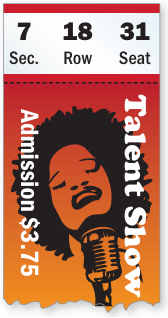
The money collected from ticket sales for the talent show is $2692.50. Estimate the number of tickets sold.
Solution :
Admission cost is = $3.75
Amount collected = 2692.50
Number of tickets = total amount collected / admission cost of each ticket
= 2692.50/3.75
Rounding for the nearest whole number
= 2700/4
= 700
So, the required number of tickets is 700.
Problem 9 :
A surf shop sits 75 feet from a shoreline. Each year 6.375 feet of the beach is lost due to erosion. Your friend says the water will reach the shop within 9 years. Is your friend correct? Explain.
Solution :
To fi nd how much beach will be lost in 9 years, estimate 6.375 × 9. If an overestimate is less than 75, you can be sure the water will not reach the shop.
6.375 × 9
≈ 7 × 9
= 63
No. Because 63 is less than 75, the water will not reach the shop
Problem 10 :
Your family is driving to visit friends who live about 420 miles away. Your car gets 27.3 miles per gallon of gasoline.
a. Estimate how many gallons you will use driving there and back.
Solution :
Distance between your place and your friend's place = 420 miles
Distance covered using one gallon of gas = 27.8 miles
Rounding for whole number, we get 28
a) To reach the friend's place, we have to cover the distance of 420 miles, to come back another 420 miles. Then the total distance to be covered is 840 miles
= 840/28
= 30 gallons
Problem 11 :
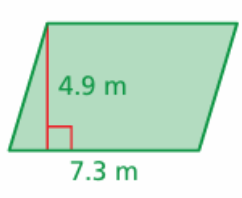
Estimate the area of the figure by rounding to the nearest whole number
Solution :
Area of parallelogram = base x height
base = 7.3 m and height = 4.9 m
Area of parallelogram = 7.3 x 4.9
= 35.77 square meter.
Rounding for the whole number, we get 36 square meter.
Problem 12 :
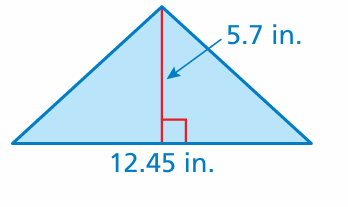
Estimate the area of the figure by rounding to the nearest whole number
Solution :
Base of the triangle = 12.45 inches
rounding for whole number, we get 12 inches
height = 5.7 inches
rounding for whole number, we get 6 inches
Area of triangle = (1/2) x base x height
= (1/2) x 12 x 6
= 6 x 6
= 36 square inches
Problem 11 :
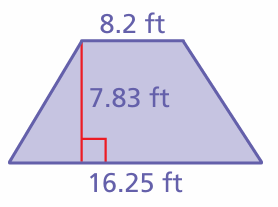
Estimate the area of the figure by rounding to the nearest whole number
Solution :
Parallel sides are, a = 8.2 ft and b = 16.25 ft and height = 7.83 ft
Rounding for whole numbers, we get
a = 8 ft, b = 16 ft and h = 8 ft
Area of trapezium = (1/2) X h x (a + b)
= (1/2) x 8 x (8 + 16)
= 4 x 24
= 96 square ft
So, the required area is 96 square ft.
Subscribe to our ▶️ YouTube channel 🔴 for the latest videos, updates, and tips.
Recent Articles


-
Finding Range of Values Inequality Problems
May 21, 24 08:51 PM
Finding Range of Values Inequality Problems -
Solving Two Step Inequality Word Problems
May 21, 24 08:51 AM
Solving Two Step Inequality Word Problems -
Exponential Function Context and Data Modeling
May 20, 24 10:45 PM
Exponential Function Context and Data Modeling