WHAT SHOULD BE ADDED TO THE POLYNOMIAL SO IT IS COMPLETELY DIVISIBLE
Subscribe to our ▶️ YouTube channel 🔴 for the latest videos, updates, and tips.
Problem 1 :
What must be subtracted from
p(x) = 8x⁴ + 14x3 - 2x2 +7x -8
so that the resulting polynomial is exactly divisible by
g(x) = 4x2 + 3x -2?
Solution :
If the polynomial is divisible by another polynomial, then the remainder will be 0.
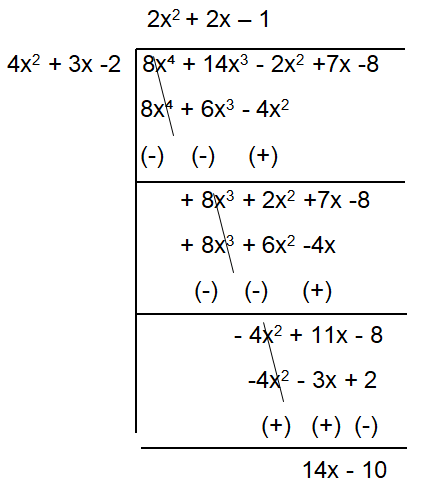
Since the remainder is 14x - 10, to get 0 as a remainder we have to subtract 14x - 10 from the given polynomial.
Problem 2 :
What must be added to
f(x) = 4x4 + 2x3 -2x2 + x - 1
so that the resulting polynomial is divisible by
g(x) = x2 +2x - 3?
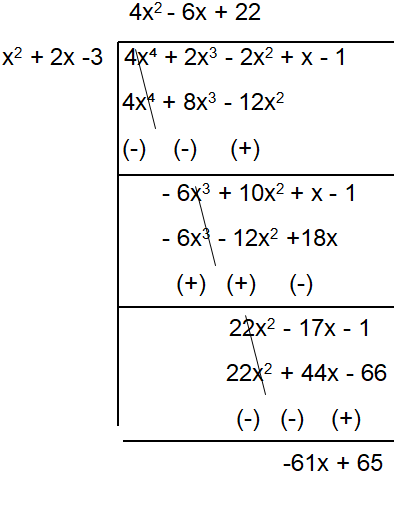
To make the remainder as 0, we need 61x - 65.
So, 61x - 65 to be added to the polynomial.
Problem 3 :
If the polynomial
x4 + 2x3 + 8x2 + 12x + 18
is divided by another polynomial x2+5, the remainder comes
out to be px + q. Find the values of ' p' and ' q'?
Solution :
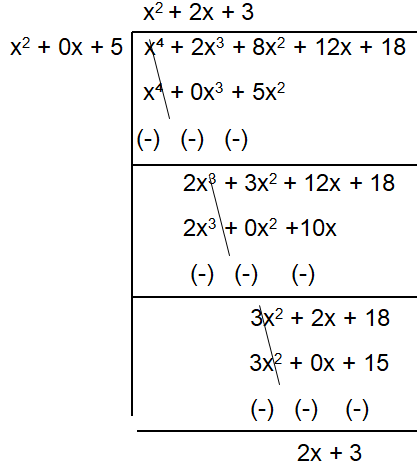
Remainder = 2x + 3
Comparing with the given remainder px + q
p = 2 and q = 3
Problem 4 :
Given P(x) = x3 + px2 + qx - 2 when P(x) is divided by x - 3 and x + 2, the remainders are 4 and -16. Find the values of p and q.
P(x) = x3 + px2 + qx - 2
x - 3 = 0
x = 3
Applying x = 3, we get the remainder 4
P(3) = 33 + p(3)2 + q(3) - 2
4 = 27 + 9p + 3q - 2
4 = 25 + 9p + 3q
9p + 3q = 4 - 25
9p + 3q = -21
Dividing by 3, we get
3p + q = -7 --------(1)
x + 2 = 0
x = -2
Applying x = -2, we get the remainder -16
P(-2) = (-2)3 + p(-2)2 + q(-2) - 2
-16 = -8 + 4p - 2q - 2
-16 = -10 + 4p - 2q
-16 + 10 = 4p - 2q
4p - 2q = -6
Dividing by 2, we get
2p - q = -3 --------(2)
(1) + (2)
3p + 2p = -7 - 3
5p = -10
p = -2
Applying the value of p, we get
3(-2) + q = -7
-6 + q = -7
q = -7 + 6
q = -1
So, the values of p and q are -2 and -1 respectively.
Problem 5 :
When the polynomial x3 - 3x + 6 and x3 - 2x2 + x + 4 are divided by x - m, the remainders are equal. Find the possible values of m.
Solution :
x - m = 0
x = m
P(x) = x3 - 3x + 6
Q(x) = x3 - 2x2 + x + 4
P(m) = m3 - 3m + 6 ----(1)
Q(m) = m3 - 2m2 + m + 4 -----(2)
(1) = (2)
m3 - 3m + 6 = m3 - 2m2 + m + 4
2m2- 3m - m + 6 - 4 = 0
2m2- 4m + 2 = 0
m2- 2m + 1 = 0
(m - 1)(m - 1) = 0
m = 1 and 1
So, the possible value of m is 1.
Problem 6 :
When a polynomial is divided by x + 1 the remainder is 5 and when it is divided by x- 4, the remainder is 15. Find the remainder when P(x) is divided by (x + 1)(x - 4)
Solution :
From the given information, it is clear that the required polynomial must be a quadratic.
x + 1 = 0 and x - 4 = 0
x = -1 and x = 4
P(-1) = 5 and P(4) = 15
Using division algorithm,
P(x) = (x + 1)(x - 4) Q(x) + a x + b
When x = -1
5 = (-1 + 1)(-1 - 4) Q(-1) + a(-1) + b
5 = -a + b
-a + b = 5 -----(1)
When x = 4
15 = (4 + 1)(4 - 4) Q(4) + a(4) + b
15 = 4a + b
4a + b = 15 -----(2)
(1) - (2)
-a - 4a = 5 - 15
-5a = -10
a = 2
Applying the value of a in (1), we get
-2 + b = 5
b = 5 + 2
b = 7
The remainder is a x + b, then 2x + 7.
Problem 7 :
The polynomials are ax4 + 2x3 + bx + 3 leaves a remainder of 15x + 19 when divided by x2 - x - 2. Find the value of a and b.
Solution :
Factoring x2 - x - 2,
= (x - 2) (x + 1)
x + 1 = 0 and x - 2 = 0
x = -1 and x = 2
P(x) = ax4 + 2x3 + bx + 3
Applying x = -1, we get
P(-1) = a(-1)4 + 2(-1)3 + b(-1) + 3
15x + 9 = a - 2 - b + 3
15(-1) + 9 = a - b + 1
a - b + 1 = -15 + 9
a - b = -6 - 1
a - b = -7 --------(1)
Applying x = 2, we get
P(2) = a(2)4 + 2(2)3 + b(2) + 3
15(2) + 9 = 16a + 16 + 2b + 3
30 + 9 = 16a + 2b + 19
16 a + 2b = 39 - 19
16a + 2b = 20
8a + b = 10 ------------(2)
(1) + (2)
a + 8a = -7 + 10
9a = 3
a = 1/3
Applying the value of a, we get
(1/3) - b = -7
1/3 + 7 = b
b = (1 + 21)/3
b = 22/3
Problem 8 :
If x + 1 is a factor of P(x) = 4x3 + 14x2 + kx - 3, determine the value of k.
Solution :
P(x) = 4x3 + 14x2 + kx - 3,
Subscribe to our ▶️ YouTube channel 🔴 for the latest videos, updates, and tips.
Recent Articles


-
Finding Range of Values Inequality Problems
May 21, 24 08:51 PM
Finding Range of Values Inequality Problems -
Solving Two Step Inequality Word Problems
May 21, 24 08:51 AM
Solving Two Step Inequality Word Problems -
Exponential Function Context and Data Modeling
May 20, 24 10:45 PM
Exponential Function Context and Data Modeling