USING DISTRIBUTIVE PROPERTY WITH RADICAL EXPRESSION
Subscribe to our ▶️ YouTube channel 🔴 for the latest videos, updates, and tips.
Before using distributive property with radical expressions, we should be aware of
- How to multiply radical terms by a constant
- How to multiply the two different radicands
- How to multiply same radicands.
Like radicals :
If the radicands are same with the same index, then we call it as like radicals. We can combine only like radicals.
Unlike radicals :
- Radicands are same, index are not same.
- Index are same, radicands are not same.
we call it as unlike radicals.
Expand and simplify :
Problem 1 :
-√2(3 - √2)
Solution :
-√2(3 - √2)
After distribution, we get
= -√2 ⋅ 3 + √2 ⋅ √2
= -3√2 + √(2 ⋅ 2)
= -3√2 + √4
= -3√2 + 2
Problem 2 :
-√2(4 - √2)
Solution :
-√2(4 - √2)
= -√2 ⋅ 4 + √2 ⋅ √2
= -4√2 + √(2 ⋅ 2)
= -4√2 + √4
= -4√2 + 2
Problem 3 :
-√3(1 + √3)
Solution :
-√3(1 + √3)
= -√3 ⋅ 1 - √3 ⋅ √3
= -√3 - √(3 ⋅ 3)
= -√3 - √9
= -√3 - 3
Problem 4 :
-√3(√3 + 2)
Solution :
-√3(√3 + 2)
= -√3 ⋅ √3 -√3 ⋅ 2
= -√(3 ⋅ 3) - 2√3
= -√9 - 2√3
= -3 - 2√3
Problem 5 :
-√5(2 + √5)
Solution :
-√5(2 + √5)
= -√5 ⋅ 2 - √5 ⋅√5
= -2√5 - √(5 ⋅ 5)
= -2√5 - √25
= -2√5 - 5
Problem 6 :
-(√2 + 3)
Solution :
-(√2 + 3)
= -√2 – 3
Problem 7 :
-√5(√5 - 4)
Solution :
-√5(√5 - 4)
= -√5 ⋅√5 + √5 ⋅ 4
= -√(5 ⋅ 5) + 4√5
= -√25 + 4√5
= -5 + 4√5
Problem 8 :
-(3 - √7)
Solution :
-(3 - √7)
= -3 + √7
Problem 9 :
-√11(2 - √11)
Solution :
-√11(2 - √11)
= -√11 ⋅ 2 + √11 ⋅ √11
= -2√11 + √(11 ⋅ 11)
= -2√11 + √121
= -2√11 + 11
Problem 10 :
-2√2(1 - √2)
Solution :
-2√2(1 - √2)
= -2√2 ⋅ 1 + 2√2 ⋅ √2
= -2√2 + 2√(2 ⋅ 2)
= -2√2 + 2√4
= -2√2 + 2 ⋅ 2
= -2√2 + 4
Problem 11 :
-3√3(5 - √3)
Solution :
-3√3(5 - √3)
= -3√3 ⋅ 5 + 3√3 ⋅√3
= -15√3 + 3√(3 ⋅ 3)
= -15√3 + 3√9
= -15√3 + 3 ⋅ 3
= -15√3 + 9
Problem 12 :
-7√2(√2 + 3)
Solution :
-7√2(√2 + 3)
= -7√2 ⋅ √2 - 7√2 ⋅ 3
= -7√(2 ⋅ 2) – 21 ⋅ √2
= -7√4 - 21√2
= -7 ⋅ 2 - 21√2
= -14 - 21√2
Problem 13 :
A particle (√7 + 3) ft/sec. How long will it take the object to travel 30 feet ?
Solution :
Distance traveled by the particle = (√7 + 3) ft/sec
Distance traveled in 30 feet = 30(√7 + 3)
Distributing 30, we get
= 30√7 + 30(3)
= 30√7 + 90
Problem 14 :
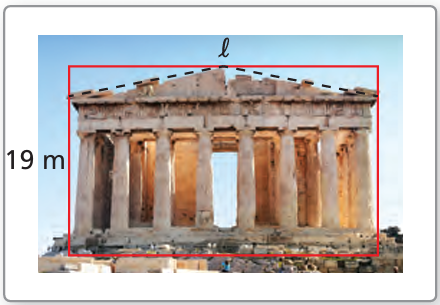
The ratio of the length to the width of a golden rectangle is (1 + √5) : 2. The dimensions of the face of the Parthenon in Greece form a golden rectangle. What is the perimeter of the this golden rectangle?
Solution :
Think of the length and height of the Parthenon as the length and width of a golden rectangle. The height of the rectangular face is 19 meters. You know the ratio of the length to the height. Find the length ℓ and then fi nd the perimeter using the formula P = 2ℓ + 2w.
(1 + √5) : 2 = l : 19
(1 + √5) / 2 = l / 19
19(1 + √5) = 2l
l = (19/2)(1 + √5)
= 9.5(1 + 2.23)
= 9.5(3.23)
l = 30.685
Perimeter of the rectangle = 2(30.68 + 19)
= 2(49.685)
= 99.37
So, the required perimeter is approximately 100 m.
Problem 15 :
√3 (8 √2 + 7 √32)
Solution :
= √3 (8√2 + 7√32)
Using distributive property, we get
= 8 √3 √2 + 7 (√3√32)
= 8 √6 + 7 √96
= 8 √6 + 7 √(2⋅2⋅2⋅2⋅2⋅3)
= 8 √6 + 7 (2⋅2)√6
= 8 √6 + 28√6
= 36√6
Problem 16 :
Are the expressions 3√2x and √18x equivalent? Explain your reasoning
Solution :
Given are, 3√2x and √18x
Simplifying √18x = √(3 ⋅ 3 ⋅ 2 ⋅ x)
= 3√2x
So, both are equal.
Problem 17 :
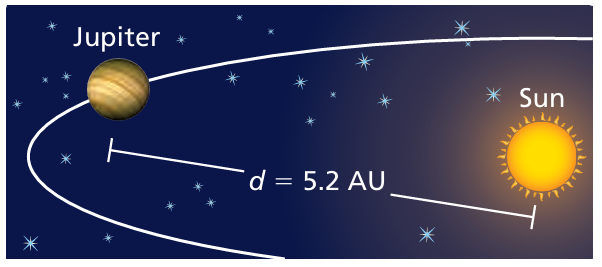
The orbital period of a planet is the time it takes the planet to travel around the Sun. You can find the orbital period P (in Earth years) using the formula P = √d3 , where d is the average distance (in astronomical units, abbreviated AU) of the planet from the Sun
a. Simplify the formula.
b. What is Jupiter’s orbital period?
Solution :
a) P = √d3
P = √(d ⋅ d ⋅ d)
P = d√d
b) P = √d3
Applying d = 5.2
= √(5.2)3
= √140.608
= 11.85
Subscribe to our ▶️ YouTube channel 🔴 for the latest videos, updates, and tips.
Recent Articles


-
Finding Range of Values Inequality Problems
May 21, 24 08:51 PM
Finding Range of Values Inequality Problems -
Solving Two Step Inequality Word Problems
May 21, 24 08:51 AM
Solving Two Step Inequality Word Problems -
Exponential Function Context and Data Modeling
May 20, 24 10:45 PM
Exponential Function Context and Data Modeling