USE THE ONE TO ONE PROPERTY OF LOGARITHMS TO SOLVE
Subscribe to our ▶️ YouTube channel 🔴 for the latest videos, updates, and tips.
One to one property of logarithms :
The one-to-one property can be used if both sides of the equation can be rewritten as a single logarithm with the same base.
If so, the arguments can be set equal to each other, and the resulting equation can be solved algebraically.
Use the One-to-One Property to solve the equation for x.
Problem 1 :
log2(x + 1) = log2 4
Solution:
log2(x + 1) = log2 4
Use One to One Property,
x + 1 = 4
x = 4 - 1
x = 3
Problem 2 :
log2(x - 3) = log2 9
Solution:
log2(x - 3) = log2 9
Use One to One Property,
x - 3 = 9
x = 9 + 3
x = 12
Problem 3 :
log(2x + 1) = log 15
Solution:
log(2x + 1) = log 15
Use One to One Property,
2x + 1 = 15
2x = 14
x = 14/2
x = 7
Problem 4 :
log(5x + 3) = log 12
Solution:
log(5x + 3) = log 12
Use One to One Property,
5x + 3 = 12
5x = 9
x = 9/5
Problem 5 :
ln(x + 2) = ln 6
Solution:
ln(x + 2) = ln 6
Use One to One Property,
x + 2 = 6
x = 6 - 2
x = 4
Problem 6 :
ln(x - 4) = ln 2
Solution:
ln(x - 4) = ln 2
Use One to One Property,
x - 4 = 2
x = 2 + 4
x = 6
Problem 7 :
ln(x2 - 2) = ln 23
Solution :
ln(x2 - 2) = ln 23
Use One to One Property,
x2 - 2 = 23
x2 = 25
x = ±5
Problem 8 :
ln(x2 - x) = ln 6
Solution:
ln(x2 - x) = ln 6
Use One to One Property,
x2 - x = 6
x2 - x - 6 = 0
(x - 3) (x + 2) = 0
x = 3 or x = -2
Problem 9 :
A population of 30 mice is expected to double each year. The number p of mice in the population each year is given by p = 30(2n). In how many years will there be 960 mice in the population?
Solution:
p = 30(2n)
Number of mice = 960
960 = 30(2n)
960/30 = 2n
32 = 2n
25 = 2n
n = 5
So, the required number of years is 5.
Problem 10 :
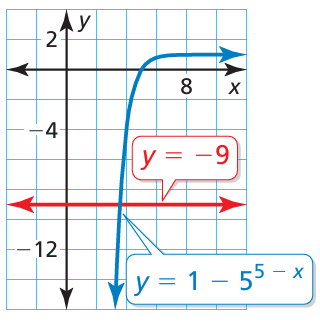
Approximate the solution of each equation using the graph
1 − 55 − x = −9
Solution :
1 − 55 − x = −9
1 + 9 = 55 − x
10 = 55 − x
log510 = 5 - x
log 10 / log 5 = 5 - x
1/0.6989 = 5 - x
1.43 = 5 - x
x = 5 - 1.43
x = 3.56
By observing the graph, the point of intersection of the horizontal line and the curve are the same.
Problem 11 :
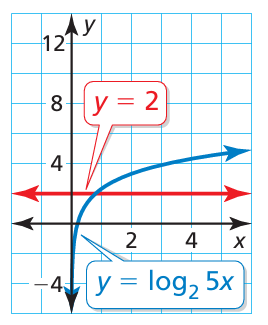
Approximate the solution of each equation using the graph
log25x = 2
Solution :
log25x = 2
5x = 22
5x = 4
x = 4/5
x = 0.8
By observing the graph, they are the same.
Problem 12 :
The apparent magnitude of a star is a measure of the brightness of the star as it appears to observers on Earth. The apparent magnitude M of the dimmest star that can be seen with a telescope is
M = 5 log D + 2
where D is the diameter (in millimeters) of the telescope’s objective lens. What is the diameter of the objective lens of a telescope that can reveal stars with a magnitude of 12?
Solution :
M = 5 log D + 2
Magnitude = 12
12 = 5 log D + 2
12 - 2 = 5 log D
10 = 5 log D
10/5 = log D
2 = log D
102 = D
D = 100
So, the required diameter is 100 millimeter.
Problem 13 :
A biologist can estimate the age of an African elephant by measuring the length of its footprint and using the equation
ℓ = 45 − 25.7e−0.09a
where ℓ is the length (in centimeters) of the footprint and a is the age (in years).
a. Rewrite the equation, solving for a in terms of ℓ.
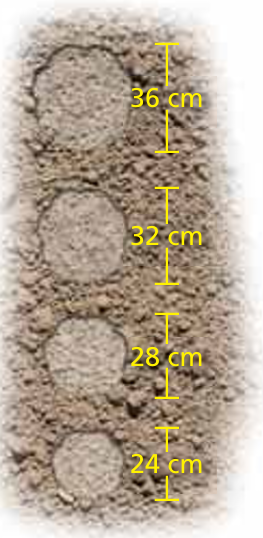
b. Use the equation in part (a) to find the ages of the elephants whose footprints are shown.
Solution :
ℓ = 45 − 25.7e−0.09a
a) Solving for a :
25.7e−0.09a = 45 - l
e−0.09a = (45 - l)/25.7
-0.09a = ln [(45 - l) / 25.7]
-0.09a = ln (45 - l) - ln 25.7
0.09a = ln 25.7 - ln (45 - l)
0.09 a = ln [25.7/(45 - l)]
a = (1/0.09) ln [25.7/(45 - l)]
b)
Age of elephant whose length of foot print = 36 cm
a = (1/0.09) ln [25.7/(45 - 36)]
= 11.11 ln (25.7/9)
= 11.1 (1.04)
= 11.54
approximately 12 years old.
Age of elephant whose length of foot print = 32 cm
a = (1/0.09) ln [25.7/(45 - 32)]
= 11.11 ln (25.7/13)
= 11.1 ln (1.97)
= 11.1 (0.68)
= 7.54
approximately 8 years old.
Age of elephant whose length of foot print = 28 cm
a = (1/0.09) ln [25.7/(45 - 28)]
= 11.11 ln (25.7/17)
= 11.1 ln (1.51)
= 11.1 (0.413)
= 4.58
approximately 5 years old.
Age of elephant whose length of foot print = 24 cm
a = (1/0.09) ln [25.7/(45 - 24)]
= 11.11 ln (25.7/21)
= 11.1 ln (1.22)
= 11.1 (0.20)
= 2.24
approximately 2 years old.
Subscribe to our ▶️ YouTube channel 🔴 for the latest videos, updates, and tips.
Recent Articles


-
Finding Range of Values Inequality Problems
May 21, 24 08:51 PM
Finding Range of Values Inequality Problems -
Solving Two Step Inequality Word Problems
May 21, 24 08:51 AM
Solving Two Step Inequality Word Problems -
Exponential Function Context and Data Modeling
May 20, 24 10:45 PM
Exponential Function Context and Data Modeling