SYSTEM OF SIMULTANEOUS LINEAR EQUATIONS WITH FRACTIONAL COEFFICIENTS
Subscribe to our ▶️ YouTube channel 🔴 for the latest videos, updates, and tips.
To solve system of linear equations, we may use different methods :
Using elimination method :
- Write the given equations in standard form.
- Compare the coefficients of the variables that we are planning to eliminate.
- If the coefficients are same and they have opposite signs, by adding those two equations, we can eliminate the variable.
- If the coefficients are not same, multiply it by some constants and make it same.
Using substitution method :
To use this method, we have to take one of the equations and solve for one variable in terms of other variable.
Cross multiplication method :
The given equations should be in the form,
a1 x + b1y + c1 = 0
a2 x + b2y + c2 = 0
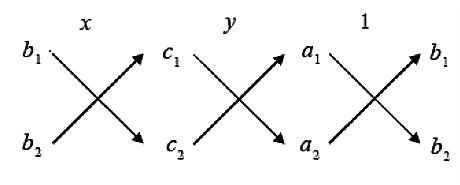
Solve the following pairs of simultaneous equations:
Problem 1 :
2x + 1/3y = 1
3x + 5y = 6
Solution:
2x + 1/3y = 1 ---> (1)
3x + 5y = 6 ---> (2)
Multiply the equation (1) by 3, we get
6x + y = 3 ---> (3)
Multiply the equation (2) by 2, we get
6x + 10y = 12 ---> (4)
Subtracting equation (3) & (4)
-9y = -9
y = 1
By applying y = 1 in equation (2)
3x + 5(1) = 6
3x + 5 = 6
3x = 1
x = 1/3
So, the solution is x = 1/3 and y = 1.
Problem 2 :
4x + 3y = 5
2x - 3/4y = 1
Solution :
4x + 3y = 5 ---> (1)
2x - 3/4y = 1 ---> (2)
Multiply the equation (2) by 4, we get
8x - 3y = 4 ---> (3)
Adding equation (1) & (3)
12x = 9
x = 3/4
By applying x = 3/4 in equation (1)
4(3/4) + 3y = 5
3 + 3y = 5
3y = 2
y = 2/3
So, the solution is x = 3/4 and y = 2/3.
Problem 3 :
1/3x + y = 10/3
2x + 1/4y = 11/4
Solution:
1/3x + y = 10/3 ---> (1)
2x + 1/4y = 11/4 ---> (2)
Multiply the equation (1) by 3, we get
x + 3y = 10 ---> (3)
Multiply the equation (2) by 4, we get
8x + y = 11 ---> (4)
(4) × 3 ==> 24x + 3y = 33 ---> (5)
Subtract equation (3) & (5)
-23x = -23
x = 1
By applying x = 1 in equation (1)
1/3(1) + y = 10/3
1/3 + y = 10/3
y = 9/3
y = 3
So, the solution is x = 1 and y = 3.
Problem 4 :
3x - 2y = 5/2
1/3x + 3y = -4/3
Solution:
3x - 2y = 5/2 ---> (1)
1/3x + 3y = -4/3 ---> (2)
Multiply the equation (2) by 3, we get
x + 9y = -4 ---> (3)
(3) × 3 ==> 3x + 27y = -12 ---> (4)
Subtracting equation (1) & (4)
-29y = 29/2
y = -1/2
By applying y = -1/2 in equation (1)
3x - 2(-1/2) = 5/2
3x + 1 = 5/2
3x = 3/2
x = 1/2
So, the solution is x = 1/2 and y = -1/2.
Problem 5 :
x = 1/3y
2y - 6x = 9
Solution:
x = 1/3y ---> (1)
2y - 6x = 9 ---> (2)
By applying x = 1/3y in equation (2)
2y - 6(1/3y) = 9
2y - 2y = 9
0 = 9
So, there is no solution.
Problem 6 :
(4/3) + (5x/4) = 28y + (5x/8)
my = (1/2)(5x - 8)
In the given system of equations, m is a constant. If the system has no solution. What is the value of m ?
Solution :
(4/3) + (5x/4) = 28y + (5x/8) ------(1)
my = (1/2)(5x - 8) ------(2)
Since the system of equation has no solution, they will not intersect each other and
From (1)
28y = (5x/4) - (5x/8) + (4/3)
28y = (10x - 5x)/8 + (4/3)
28y = (5x/8) + (4/3)
y = (5x/8 ⋅ 28) + (4/3 ⋅ 28)
y = (5x/224) + (1/21)
Slope (m1) = 5/224
y-intercept (b1) = 1/21
From (2)
my = (1/2)(5x - 8)
y = (1/2m)(5x - 8)
= (5/2m)x - (8/2m)
y = (5/2m)x - (4/m)
Slope (m2) = 5/2m
y-intercept (b2) = -4/m
m1 = m2
5/224 = 5/2m
5(2m) = 5(224)
m = 112
m = 112
Problem 7 :
If (x + y)/x = 9 and ay/3x = 32 where a is a constant. What is the value of a ?
Solution :
(x + y)/x = 9 and ay/3x = 32
x + y = 9x
x - 9x + y = 0
-8x + y = 0 ------(1)
ay/3x = 32
y = 32(3x)/a
y = 96x/a
Applying the value of y in (1), we get
-8x + (96x/a) = 0
-8ax + 96x = 0
-8ax = -96x
a = 96/8
a = 12
So, the value of a is 12.
Problem 8 :
mx - 6y = 10
2x - ny = 5
In the given system of equations m and n are constants. The system has infinitely many solutions. What is the value m/n ?
a) 1/12 b) 1/3 c) 4/3 d) 3
Solution :
mx - 6y = 10 ------(1)
2x - ny = 5 ------(2)
|
From (1), 6y = mx - 10 y = (m/6)x - (10/6) |
From (2), ny = 2x - 5 y = (2/n)x - (5/n) |
Since the system has infinitely many solution, their slopes and y-intercepts will be equal.
|
m/6 = 2/n mn = 2(6) mn = 12 |
-10/6 = -5/n -5/3 = -5/n n = 3 |
When n = 3, m = 4
m/n = 4/3
So, the value of m/n is 4/3.
Subscribe to our ▶️ YouTube channel 🔴 for the latest videos, updates, and tips.
Recent Articles


-
Finding Range of Values Inequality Problems
May 21, 24 08:51 PM
Finding Range of Values Inequality Problems -
Solving Two Step Inequality Word Problems
May 21, 24 08:51 AM
Solving Two Step Inequality Word Problems -
Exponential Function Context and Data Modeling
May 20, 24 10:45 PM
Exponential Function Context and Data Modeling