SQUARE ROOT OF DECIMAL NUMBERS BY DIVISION METHOD
Subscribe to our ▶️ YouTube channel 🔴 for the latest videos, updates, and tips.
Square root of a number is the factor that we multiply by itself two times to get that number.
Using long division method, we can find the square root of decimals without using calculator.
Simplify the square roots.
Problem 1 :
√35.88
Solution :
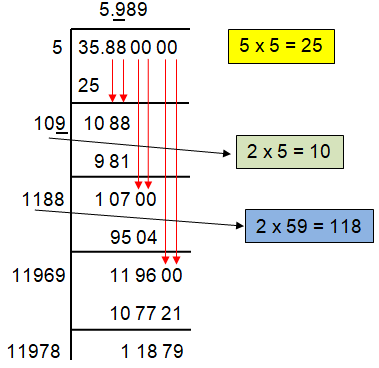
Step 1 :
We decompose the value that we find before the decimal as a product of two same values.
5 x 5 = 25 but 6 x 6 = 36 > 35
So, we choose 5 x 5 = 25.
Step 2 :
Do the subtraction, bring down the next two digits to the next step.
Step 3 :
Multiply the quotient by 2 and put it outside of division.
Step 4 :
2 x 5 = 10
Near 10, we have to use one new number, multiply this value by the value that we have written at the top.
109 x 9 = 981 < 1088
Repeat step 2 .
So, the square root of 35.88 is 5.989.
Problem 2 :
√36.46
Solution :
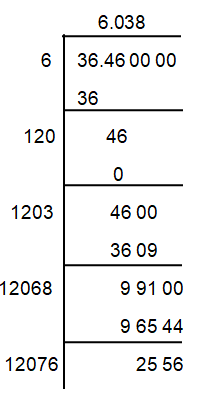
So, the square root of 36.46 is 6.038.
Problem 3 :
√89.87
Solution :
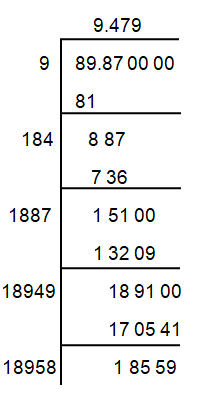
So, the square root of 89.87 is 9.479.
Problem 4 :
√99.80
Solution :
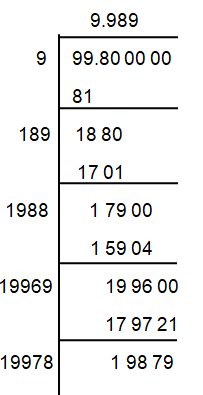
So, the square root of 99.80 is 9.989.
Problem 5 :
√62.25
Solution :
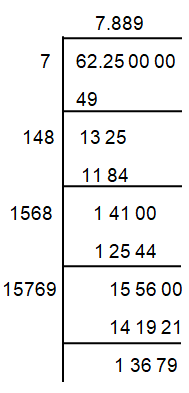
So, the square root of 62.25 is 7.889.
Problem 6 :
√97.81
Solution :
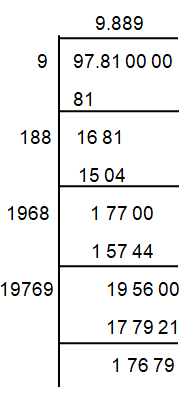
So, the square root of 97.81 is 9.889.
Problem 7 :
A checkerboard is 8 squares long and 8 squares wide. The area of each square is 14 square centimeters. Estimate the perimeter of the checkerboard.
Solution :
Area of each small square = 14 square cm
Let x be the side length of the square.
x2 = 14
x = √14
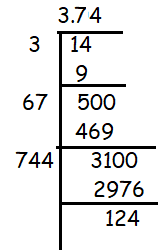
x = 3.74
Length of checkboard = 8(side length of square)
= 8(3.74)
= 29.92
Width of checker board = 8(side length of square)
= 8(3.74)
= 29.92
Perimeter of square board = 4(29.92)
= 119.68 cm
Problem 8 :
Which number is greater? Explain.
a) √20, 10
b) √15, -3.5
c) √133, 10 3/4
d) 2/3, √(16/81)
e) -√0.25, -0.25
f) -√182, -√192
Solution :
a) √20, 10
20 is not perfect square, the nearest perfect square are 16 and 25.
4 < √20 < 5
√20 = 4.4.....
So, √20 < 10
b) √15, -3.5
15 is not perfect square, the nearest perfect square are 9 and 16.
3 < √15 < 4
√15 = 3.8....
So, √15 > - 3.8
c) √133, 10 3/4
√121 = 11
√144 = 12
11 < √133 < 12
10 3/4 = 43/4
= 10.75
√133 > 10 3/4
d) 2/3, √(16/81)
√(16/81) = √(4 x 4)/(9 x 9)
= 4/9
To compare the fractions 2/3 and 4/9, we have to convert them into like fractions.
= (2/3) x (3/3)
= 6/9
Comparing the fractions 6/9 and 4/9, 6/9 is the greater.
2/3 > √(16/81)
e) -√0.25, -0.25
-√0.25 = -√(0.5 x 0.5)
= -0.5
Comparing the decimals -0.5 and -0.25, we get
-√0.25 < -0.25
f) -√182, -√192
-√169 < -√182 < -√196
-13 < -√182 < -14
Approximate value of -√182 is -13.4
Approximate value of -√192 is -13.8
-√182 > -√192
Problem 9 :
The area of a four square court is 66 square feet. Estimate the length s of one of the sides of the court

Solution :
Area of square court = 66 square feet
Side length of square is s.
s2 = 66
s = √66
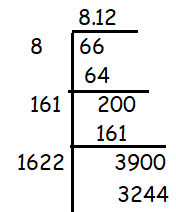
Side length of the square is 8.12 feet.
Problem 10 :
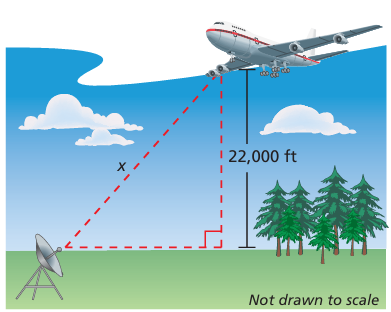
The maximum distance (in nautical miles) that a radio transmitter signal can be sent is represented by the expression 1.23 √h , where h is the height (in feet) above the transmitter.
Estimate the maximum distance x (in nautical miles) between the plane that is receiving the signal and the transmitter. Round your answer to the nearest tenth
Solution :
= 1.23 √h
Applying the value of h, we get
= 1.23 √22000
= 1.23(148.32)
= 182.43
Problem 11 :
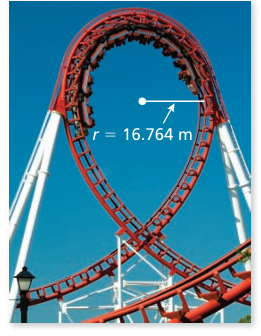
The velocity v (in meters per second) of a roller coaster is represented by the equation v = 3 √6r, where r is the radius of the loop. Estimate the velocity of a car going around the loop. Round your answer to the nearest tenth.
Solution :
v = 3 √6r
Here r = 16.764 m
Applying the value of r, we get
v = 3 √6(16.764)
= 3√100.58
= 3(10)
= 30
Approximately the velocity is 30 m.
Problem 12 :
Is √(1/4) a rational number? Is √(3/16) a rational number ? Explain.
Solution :
√(1/4) = √(1 x 1)/(2 x 2)
= 1/2
Since it is in the form of p/q, it can be considered as rational number.
√(3/16) = √3/(4 x 4)
= √3/4
Since √3 is a irrational number, dividing irrational number by a rational number we will get an irrational number.
Problem 13 :
Evaluate √12.25
Solution :
√12.25 = √12.25 x (100/100)
= √(1225 / 100)
= √(1225 / 100)
= √(35 x 35) / (10 x 10)
= 35/10
= 3.5
Subscribe to our ▶️ YouTube channel 🔴 for the latest videos, updates, and tips.
Recent Articles


-
Finding Range of Values Inequality Problems
May 21, 24 08:51 PM
Finding Range of Values Inequality Problems -
Solving Two Step Inequality Word Problems
May 21, 24 08:51 AM
Solving Two Step Inequality Word Problems -
Exponential Function Context and Data Modeling
May 20, 24 10:45 PM
Exponential Function Context and Data Modeling