SOLVING WORD PROBLEMS WITH DIAGONALS OF 2D SHAPES
Subscribe to our ▶️ YouTube channel 🔴 for the latest videos, updates, and tips.
Problem 1 :
Find the diagonal of a square whose perimeter is 60 cm.
Solution :
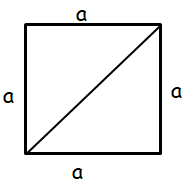
4a = 60
a = 60/4 ==> 15
Square of diagonal = sum of squares of remaining sides
a2 + a2 = (diagonal)2
(diagonal)2 = 152 + 152
(diagonal)2 = 225 + 225
(diagonal)2 = 450
diagonal = √450
diagonal = √3 x 3 x 5 x 5 x 2
= (3 x 5)√2
= 15√2
So, the length of diagonal of the square is 15√2.
Problem 2 :
Perimeter of a rhombus is 146 cm and the length of one of its diagonals is 48 cm. Find the length of its other diagonal.
Solution :
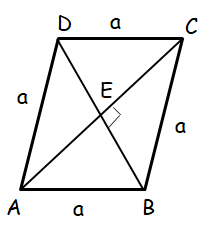
AC = 48 cm, DB = x
AE = EC = 24 cm and EB = x/2 cm
Perimeter of rhombus = 146 cm
4a = 146
a = 146/4
a = 36.5
In triangle AEB,
AB2 = AE2 + EB2
(36.5)2 = 242 + (x/2)2
1332.25 = 576 + (x2 / 4)
1332.25 - 576 = (x2 / 4)
4 (756.25) = x2
x = √4 (756.25)
x = 55 cm
DB = 55 cm
So, the length of the other diagonal is 55 cm.
Problem 3 :
If diagonal of one square is double the diagonal of another square, then find the ratio of their areas.
Solution :
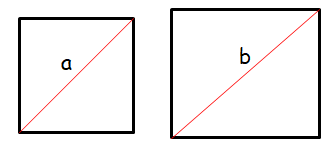
b = 2a
Side length of small square = a/√2
Side length of large square = b/√2
Area of square = (side)2
(a/√2)2 : (b/√2)2
(a/√2)2 : (2a/√2)2
(a2 / 2) : (4a2 / 2)
a2 : 4a2
1 : 4
So, the required ratio is 1 : 4
Problem 4 :
If diagonal of a rectangle is thrice its smaller side, then find the ratio of its length and width.
Solution :
Length be the longer side and width be the smaller side
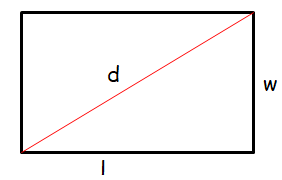
d = 3w
Using Pythagorean theorem,
l2 + w2 = d2
l2 + w2 = (3w)2
l2 + w2 = 9w2
l2 = 9w2 - w2
l2 = 8w2
l2/w2 = 8/1
(l/w)2 = 8/1
(l/w) = √(8/1)
l : w = 2√2 : 1
Problem 5 :
A rectangular carpet has area 120 square meters and perimeter 46 meters. The length of its diagonal is ____
Solution :
Area of rectangle = 120 square meter
Let l and w be the length and width of rectangle.
l w = 120 ------(1)
perimeter of the rectangle = 46 meter
2(l + w) = 46
l + w = 46/2
l + w = 23 ------(2)
120 = 15 x 8
l = 15 cm and w = 8 cm
d2 = l2 + w2
d2 = 152 + 82
d2 = 225 + 64
d2 = 289
d = 17 cm
So, the length of the diagonal is 17 cm.
Problem 6 :
If length of diagonal of a square is 20 cm, then its perimeter is _______
Solution :
Length of the diagonal of square = 20 cm
Let x be the side length of square
x2 + x2 = 202
2x2 = 400
x2 = 200
x = √200
x = √2 x 10 x 10
x = 10 √2
Perimeter of square = 4 x side length
= 4 (10 √2)
= 40√2 cm
Problem 7 :
A square dinner napkin 8 in. on each side is folded along its diagonal. Find the area of the folder napkin.
Solution :
Length of the diagonal of square = 8 in
Let x be the length of diagonal.
The diagonal will divide the square into two right triangles.
Using Pythagorean theorem,
x2 + x2 = 82
2x2 = 64
x2 = 64/2
x2 = 32
x = √32
x = 4√2 cm
Area of square = 32 square cm.
Problem 8 :
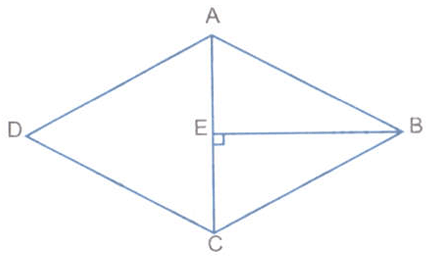
What is the area of the rhombus ABCD, if AC = 6 cm, and BE = 4 cm?
Solution :
The diagonal of rhombus will bisect each other at right angles.
AC = 6 cm, AE = 3 cm
In right triangle AEB,
AE2 + EB2 = AB2
32 + 42 = AB2
9 + 16 = AB2
AB2 = 25
AB = 5 cm
Length of one diagonal = BD = 8 cm
Length of other diagonal = AC = 6 cm
Area of rhombus = (1/2) product of diagonals
= (1/2) x 8 x 6
= 24 cm2
Problem 9 :
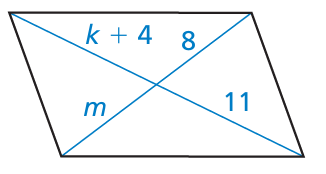
find the value of each variable in the parallelogram.
Solution :
Since the shape shown is parallelogram, the diagonals will bisect each other.
k + 4 = 11
m = 8
k = 11 - 4
k = 7
So, the values of k and m are 7 and 8 respectively.
Problem 10 :
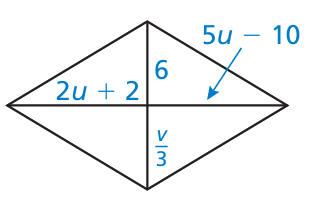
Solution :
|
2u + 2 = 5u - 10 2u - 5u = -10 - 2 -3u = -12 u = 12/3 u = 4 |
v/3 = 6 v = 6(3) v = 18 |
Problem 11 :
The sides of ▱MNPQ are represented by the expressions below. Sketch ▱MNPQ and find its perimeter.
MQ = −2x + 37 QP = y + 14
Solution :
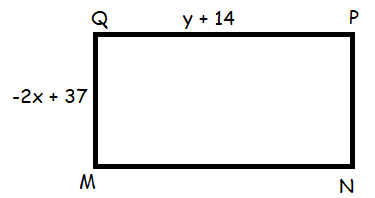
Perimeter of rectangle = 2(length + width)
Length = y + 14, width = -2x + 37
= 2(y + 14 - 2x + 37)
= 2(y - 2x + 51)
= 2y - 4x + 102
So, the perimeter of the rectangle is 2y - 4x + 102.
Subscribe to our ▶️ YouTube channel 🔴 for the latest videos, updates, and tips.
Recent Articles


-
Finding Range of Values Inequality Problems
May 21, 24 08:51 PM
Finding Range of Values Inequality Problems -
Solving Two Step Inequality Word Problems
May 21, 24 08:51 AM
Solving Two Step Inequality Word Problems -
Exponential Function Context and Data Modeling
May 20, 24 10:45 PM
Exponential Function Context and Data Modeling