SOLVING QUADRATIC INEQUALITIES WORD PROBLEMS
Subscribe to our ▶️ YouTube channel 🔴 for the latest videos, updates, and tips.
Solve for the following quadratic inequalities.
Example 1 :
Given 𝐴 = 𝑥2 − 7 and 𝐵 = −4𝑥 + 5, for what values of 𝑥 is 𝐴 < 𝐵?
Solution :
𝐴 = 𝑥2 − 7 and 𝐵 = −4𝑥 + 5
Given that A < B
𝑥2 − 7 < -4x + 5
𝑥2 + 4x − 7 - 5 < 0
𝑥2 + 4x − 12 < 0
𝑥2 + 6x - 2x - 12 < 0
Finding critical numbers :
x(x + 6) - 2(x + 6) = 0
(x - 2)(x + 6) < 0
x = 2 and x = -6
Converting into intervals :
(-∞, -6) (-6, 2) and (2, ∞)
|
When x ∈ (-∞, -6) f(x) < 0 (x - 2)(x + 6) < 0 When x = -7 = (-7 - 2)(-7 + 6) = -9(-1) = 9 < 0 (false) |
When x ∈ (-6, 2) f(x) < 0 (x - 2)(x + 6) < 0 When x = 0 = (0 - 2)(0 + 6) = -2(6) = -12 < 0 (True) |
When x ∈ (2, ∞)
f(x) < 0
When x = 3
= (3 - 2)(3 + 6)
= 1(9)
= 9 < 0 (False)
So, the solution is (-6, 2).
Example 2 :
When a projectile is fired into the air, its height h, in meters, t seconds later is given by the equation ℎ(𝑡) = 11𝑡 − 3𝑡2. When is the projectile at least 6 m above the ground?
Solution :
Given that ℎ(𝑡) = 11𝑡 − 3𝑡2
At least 6 m above the ground, then
11𝑡 − 3𝑡2 > 6
− 3𝑡2 + 11t - 6 > 0
Multiplying by negative, we get
3𝑡2 - 11t + 6 < 0
3𝑡2 - 9t - 2t + 6 < 0
3t(t - 3) - 2(t - 3) < 0
(3t - 2) (t - 3) < 0
Finding critical numbers :
3t - 2 = 0 and t - 3 = 0
t = 2/3 and y = 3
(-∞, 2/3) (2/3, 3) and (3, ∞)
|
When x ∈ (-∞, 2/3) x = 0 (3t - 2) (t - 3) < 0 (3(0) - 2) (0 - 3) < 0 -2(-3) < 0 6 < 0 False |
When x ∈ (2/3, 3) x = 1 (3t - 2) (t - 3) < 0 (3(1) - 2) (1 - 3) < 0 1(-2) < 0 -2 < 0 True |
When x ∈ (3, ∞)
x = 4
(3t - 2) (t - 3) < 0
(3(4) - 2) (4 - 3) < 0
6(1) < 0
6 < 0
False
So, the solution is (2/3, 3). The possible values of x are 2/3 < x < 3.
Example 3 :
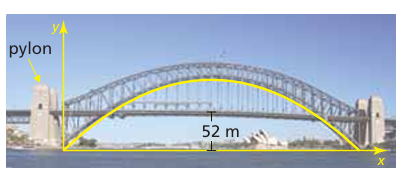
The arch of the Sydney Harbor Bridge in Sydney, Australia, can be modeled by
y = −0.00211x2 + 1.06x
where x is the distance (in meters) from the left pylons and y is the height (in meters) of the arch above the water. For what distances x is the arch above the road?
Solution :
y = −0.00211x2 + 1.06x
−0.00211x2 + 1.06x > 52
−0.00211x2 + 1.06x - 52 > 0
multiplying by negative sign, we get
0.00211x2 - 1.06x + 52 > 0
a = 0.00211, b = -1.06 and c = 52
x = [-b + √(b2 - 4ac)]/2a
= [-(-1.06) ± √(-1.06)2 - 4(0.00211)(52)] / 2(0.00211)
= [1.06 ± √(1.1236 - 0.43888)] / 0.00422
= [1.06 ± √0.68472] / 0.00422
= [1.06 ± 0.8274] / 0.00422
= (1.06 + 0.8274) / 0.00422 and (1.06 - 0.8274) / 0.00422
= 1.8874/0.00422 and 0.2326 / 0.00422
= 447.25 and 55.11
Since the arch is above the road for distances between the roots, the answer is
55.11 < x < 447.25
Example 4 :
The number T of teams that have participated in a robot-building competition for high-school students over a recent period of time x (in years) can be modeled by
T(x) = 17.155 x2 + 193.68 x + 235.81, 0 ≤ x ≤ 6.
After how many years is the number of teams greater than 1000? Justify your answer.
Solution :
T(x) = 17.155 x2 + 193.68 x + 235.81
Number of teams greater than 1000
17.155 x2 + 193.68 x + 235.81 > 1000
17.155 x2 + 193.68 x + 235.81 - 1000 > 0
17.155 x2 + 193.68 x - 764.19 > 0
a = 17.155, b = 193.68 and c = -764.19
x = [-b + √(b2 - 4ac)]/2a
= [-193.68 ± √(193.68)2 - 4(17.155)(-764.19)] / 2(17.155)
= [-193.68 ± √(37511.94 + 52438)] / 34.31
= [-193.68 ± √(89949.94)] / 34.31
= [-193.68 ± √(89949.94)] / 34.31
= [-193.68 ± 299.9] / 34.31
= [-193.68 + 300] / 34.31, [-193.68 - 300] / 34.31
x = 106.32/34.31, 493.68/34.31
x = 3.09
Example 5 :
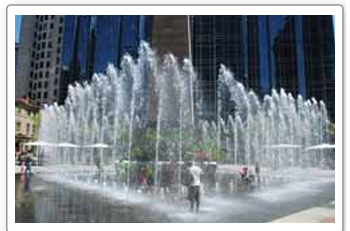
A rectangular fountain display has a perimeter of 400 feet and an area of at least 9100 feet. Describe the possible widths of the fountain.
Solution :
Let x and y be the length and width of the rectangle.
Perimeter of rectangle = 400 feet
2(x + y) = 400
x + y = 200
y = 200 - x -----(1)
Area of rectangle at least 9100
xy > 9100
x(200 - x) > 9100
200x - x2 > 9100
- x2 + 200 x > 9100
- x2 + 200 x - 9100 > 0
Multiplying by negative, we get
x2 - 200 x + 9100 > 0
x2 - 130x - 70x + 9100 > 0
x(x - 130) - 70(x - 130) > 0
(x - 130)(x - 70) > 0
Finding critical numbers :
x - 130 = 0 and x - 70 = 0
x = 130 and x = 70
(-∞, 70) (70, 130) and (130, ∞)
|
When x ∈ (-∞, 70) x = 0 (x - 130)(x - 70) > 0 (0 - 130)(0 - 70) > 0 130(70) > 0 9100 > 0 True |
When x ∈ (70, 130) x = 80 (x - 130)(x - 70) > 0 (80 - 130)(80 - 70) > 0 -50(10) > 0 -500 > 0 False |
When x ∈ (130, ∞)
x = 140
(x - 130)(x - 70) > 0
(140 - 130)(140 - 70) > 0
10(70) > 0
700 > 0
True
The possible solutions are (-∞, 70) and (130, ∞).
Subscribe to our ▶️ YouTube channel 🔴 for the latest videos, updates, and tips.
Recent Articles


-
Finding Range of Values Inequality Problems
May 21, 24 08:51 PM
Finding Range of Values Inequality Problems -
Solving Two Step Inequality Word Problems
May 21, 24 08:51 AM
Solving Two Step Inequality Word Problems -
Exponential Function Context and Data Modeling
May 20, 24 10:45 PM
Exponential Function Context and Data Modeling