SOLVING LOGARITHMIC EQUATIONS WITH BASE
Subscribe to our ▶️ YouTube channel 🔴 for the latest videos, updates, and tips.
To solve logarithmic equation, first we should know how to convert the logarithmic form to exponential form.
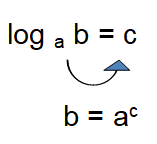
Step 1 :
Move the base to the other side of the equal sign.
Step 2 :
Create the same base on both sides.
Step 3 :
Using the properties of exponents, if the bases are same on both sides of the equal sign, then we can equate the powers.
Find the value of y.
Problem 1 :
log5 25 = y
Solution :
In logarithmic form :
log5 25 = y
Converting into exponential form :
5y = 25
Write 25 as base of 5.
5y = 52
Since bases are equal, we equate the powers.
y = 2
Problem 2 :
log31 = y
Solution :
In logarithmic form :
log3 1 = y
Converting into exponential form :
3y = 1
3y = 30 (30 = 1)
Since bases are equal, we equate the powers.
y = 0
Problem 3 :
log16 4 = y
Solution :
In logarithmic form :
log16 4 = y
Converting into exponential form :
16y = 4
(24)y = 22
24y = 22
4y = 2
y = 2/4
y = 1/2
Problem 4 :
log2 (1/8) = y
Solution :
In logarithmic form :
log2 (1/8) = y
Converting into exponential form :
2y = 1/8
2y = 2-3 (2-3 = 1/8)
y = -3
Problem 5 :
log51 = y
Solution :
In logarithmic form :
log5 1 = y
Converting into exponential form :
5y = 1
5y = 50 (50 = 1)
y = 0
Problem 6 :
log2 8 = y
Solution :
In logarithmic form :
log2 8 = y
Converting into exponential form :
2y = 8
2y = 23 (23 = 8)
y = 3
Problem 7 :
log7 (1/7) = y
Solution :
log7 (1/7) = y
Converting from logarithmic form to exponential form, we get
7y = 1/7
7y = 7 -1 (7-1 = 1/7)
y = -1
Problem 8 :
log3 (1/9) = y
Solution :
log3 (1/9) = y
Converting from logarithmic form to exponential form, we get
3y = 1/9
3y = 3-2 (3-2 = 1/9)
y = -2
Problem 9 :
logy 32 = 5
Solution :
logy 32 = 5
Converting from logarithmic form to exponential form, we get
y5 = 32
y5 = 25
Since powers are equal, we equate the bases.
So,
y = 2
Problem 10 :
log9 y = -1/2
Solution :
log9 y = -1/2
9-1/2 = y
(32)-1/2 = y
3-1 = y
y = 1/3
Problem 11 :
log4 (1/8) = y
Solution :
y = logb x ó by = x
log4 (1/8) = y
4y = 1/8
(22)y = 1/23
22y = 2-3
2y = -3
y = -3/2
Problem 12 :
Log9 (1/81) = y
Solution :
log9 (1/81) = y
9y = 1/81
9y = 9-2
Since bases are equal, we equate the powers.
So,
y = -2
Problem 13 :
Describe the similarities and difference between in solving the equations
45x - 2 = 16 and log4(10x + 6) = 1
Then solve the each equation
Solution :
45x - 2 = 16 and log4(10x + 6) = 1
In general by finding the inverse of exponential function, we will get the logarithmic function.
Solving the exponential function :
45x - 2 = 16
Writing 16 in exponential form, we get
45x - 2 = 42
5x - 2 = 2
5x = 2 + 2
5x = 4
x = 4/5
Solving logarithmic function :
log4(10x + 6) = 1
10x + 6 = 41
10x + 6 = 4
10x = 4 - 6
10x = -2
x = -2/10
x = -1/5
Problem 14 :
For a sound with intensity I (in watts per square meter) the loudness L(I) of the sound (in decibels) is given by the function
L(I) = 10 log (I/I0)
Where I0 is the intensity of barely audible sound (about 10-12 watts per square meter) An artist in a recording studio turns up the volume of a track so that the intensity of the sound doubles. By how many decibels does the loudness increase ?
Solution :
L(I) = 10 log (I/I0)
Let I be the original intensity then 2I is the double intensity
Increase in loudness = L(2I) - L(I)
= 10 log (2I/I0) - 10 log (I/I0)
Factoring 10, we get
= 10 [log (2I/I0) - log (I/I0)]
= 10 [log (2I) - log I0 - (log I - log I0)]
= 10 [log (2I) - log I0 - log I + log I0]
= 10 [log (2I) - log I]
= 10 [log 2 + log I - log I]
= 10 [log 2]
The loudness increases by 10 log 2 decibels or about 3 decibels.
Problem 15 :
The length ℓ (in centimeters) of a scalloped hammerhead shark can be modeled by the function
ℓ = 266 − 219e−0.05t
where t is the age (in years) of the shark. How old is a shark that is 175 centimeters long?
Solution :
ℓ = 266 − 219e−0.05t
Solving for t, we get
219 e−0.05t = 266 - l
e−0.05t = (266 - l)/219
1/e0.05t = [(266 - l)/219]
When l = 175 cm
219/(266 - l) = e0.05t
e0.05t = 219/(266 - 175)
= 219/91
e0.05t = 2.4
0.05t = ln (2.4)
0.05t = 0.87
t = 0.87/0.05
t = 17.5
Approximately 18 years.
Subscribe to our ▶️ YouTube channel 🔴 for the latest videos, updates, and tips.
Recent Articles


-
Finding Range of Values Inequality Problems
May 21, 24 08:51 PM
Finding Range of Values Inequality Problems -
Solving Two Step Inequality Word Problems
May 21, 24 08:51 AM
Solving Two Step Inequality Word Problems -
Exponential Function Context and Data Modeling
May 20, 24 10:45 PM
Exponential Function Context and Data Modeling