SOLVE SYSTEMS OF EQUATIONS BY GRAPHING
Subscribe to our ▶️ YouTube channel 🔴 for the latest videos, updates, and tips.
What is solution in systems of linear equations ?
The point of intersection is known as solution. In general , two lines may meet at a point, they meet at infinitely many points, they will never meet.
- If two lines are intersecting at one point, there is unique solution.
- If two lines are parallel, they will never meet. So no solution.
- If two lines are coincident, then they will touch each other at infinite number of points. So, infinitely many solutions.
To draw the graph of the line, we have different ways. Here we follow of finding intercepts and drawing the graph.
Find the simultaneous solution of the following pairs of equations using graphical methods:
Problem 1 :
y = 3x - 1
y = 2x - 2
Solution :
y = 3x - 1
|
x-intercept : y = 3x - 1 Put y = 0 3x - 1 = 0 3x = 1 x = 1/3 (1/3, 0) |
y-intercept : y = 3x - 1 Put x = 0 y = 3(0) - 1 y = -1 (0, -1) |
By connecting these two points, we get the first line.
y = 2x - 2
|
x-intercept : y = 2x - 2 Put y = 0 2x - 2 = 0 2x = 2 x = 1 (1/3, 0) |
y-intercept : y = 2x - 2 Put x = 0 y = 2(0) - 2 y = -2 (0, -2) |
By connecting these two points, we get the second line.
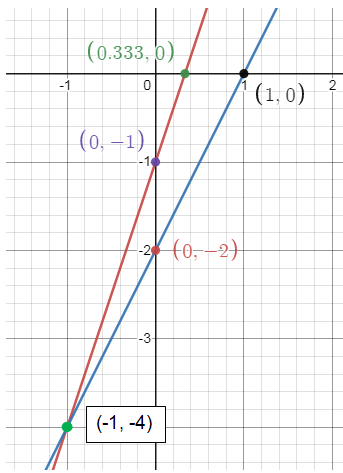
In the graph, the lines are intersecting at a point (-1, -4).
So, the solution is (-1, -4).
Problem 2 :
y = -2x + 3
y = x + 6
Solution :
y = -2x + 3
|
x-intercept : y = -2x + 3 Put y = 0 -2x + 3 = 0 -2x = -3 x = 3/2 (3/2, 0) |
y-intercept : y = -2x + 3 Put x = 0 y = -2(0) + 3 y = 3 (0, 3) |
By connecting these two points, we get the graph of the first line.
|
x-intercept : y = x + 6 Put y = 0 x + 6 = 0 x = -6 (-6, 0) |
y-intercept : y = x + 6 Put x = 0 y = 0 + 6 y = 6 (0, 6) |
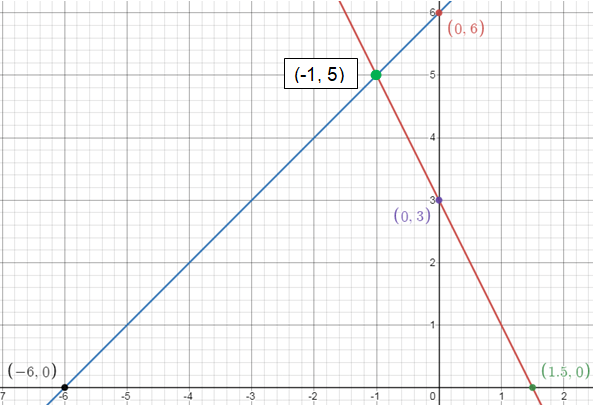
So, the solution is (-1, 5).
Problem 3 :
y = -(4/3)x + 1
x = 3
Solution :
y = -(4/3) x + 1
|
x-intercept : y = -(4/3) x + 1 Put y = 0 -(4/3)x + 1 = 0 -(4/3)x = -1 x = 3/4 (3/4, 0) |
y-intercept : y = -(4/3) x + 1 Put x = 0 y = -(4/3)(0) + 1 y = 1 (0, 1) |
By connecting the points (3/4, 0) and (0, 1), we get the graph of the first line.
The second line is x = 3, it is vertical line passes through 3 on the x-axis.
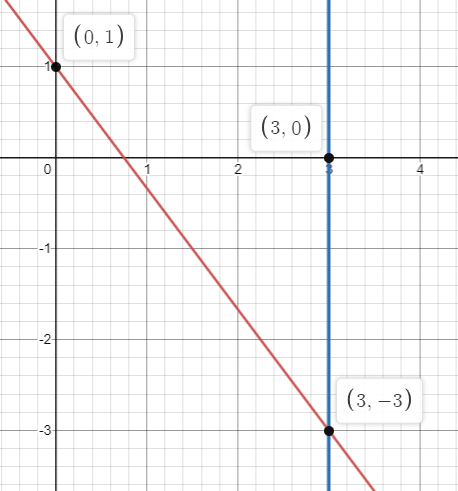
So, (3, -3) is the solution.
Problem 4 :
2x - 5y = a
bx + 10y = -8
In the given system of equations a and b are constants. If the system has infinitely many solutions, what is the value of a ?
a) -4 b) 1/4 c) 4 d) 16
Solution :
2x - 5y = a ----(1)
bx + 10y = -8 ----(2)
Given that the system has infinitely many solution, then their slopes and y-intercepts will be equal.
From (1),
5y = 2x - a
y = (2/5)x - (a/5)
Slope (m1) = 2/5 and y-intercept (b1) = -a/5
From (2),
10y = -bx - 8
y = (-b/10)x - (8/10)
y = (-b/10)x - (4/5)
Slope (m2) = -b/10 and y-intercept (b2) = -4/5
-a/5 = -4/5
By comparing the numerators, we get a = 4. Option c is correct.
Problem 5 :
-5x = 8 - ky
18y + 5x = -10x + 21
In the given system of equations, k is a constant. If the system has no solution, what is the value of k ?
Solution :
Given that, the system has no solution. Then there must be no point of intersection and they will have same slope and same y-intercept.
-5x = 8 - ky -----(1)
18y + 5x = -10x + 21 -----(2)
From (1),
ky = 5x + 8
y = (5/k) x + (8/k)
Slope (m1) = 5/k and y-intercept (b1) = 8/k
From (2),
10x + 5x + 18y = 21
15x + 18y = 21
Dividing by 3, we get
5x + 6y = 7
6y = -5x + 7
y = (-5/6)x + (7/6)
Slope (m2) = -5/6 and y-intercept (b2) = 7/6
5/k = -5/6
k = -6
So, the value of k is -6.
Problem 6 :
9(2x + 1) + 27(y - 4) = 810
(2x + 1) + (y - 4) = -393
The solution to the given system of equations is (x, y). What is the value fo 8(y - 4) ?
Solution :
9(2x + 1) + 27(y - 4) = 810 ----(1)
(2x + 1) + (y - 4) = -393 -----(2)
Without expanding the equations, let us multiply the second equation by9 and subtract.
9(2x + 1) + 27(y - 4) - [9(2x + 1) + 9(y - 4)] = 810 - 9(-393)
9(2x + 1) + 27(y - 4) - 9(2x + 1) - 9(y - 4) = 810 + 3537
18(y - 4) = 810 + 3537
18(y - 4) = 4347
(y - 4) = 4347/18
8(y - 4) = 8(241.5)
8(y - 4) = 1932
So, the value of 8(y - 4) is 1932.
Subscribe to our ▶️ YouTube channel 🔴 for the latest videos, updates, and tips.
Recent Articles


-
Finding Range of Values Inequality Problems
May 21, 24 08:51 PM
Finding Range of Values Inequality Problems -
Solving Two Step Inequality Word Problems
May 21, 24 08:51 AM
Solving Two Step Inequality Word Problems -
Exponential Function Context and Data Modeling
May 20, 24 10:45 PM
Exponential Function Context and Data Modeling