REFLECTION OVER Y EQUALS X
Subscribe to our ▶️ YouTube channel 🔴 for the latest videos, updates, and tips.
Reflection about y = x
The rule of reflection about y = x is
(x, y) ==> (y, x)
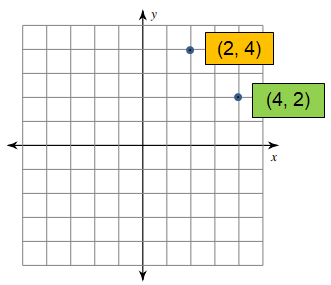
What is preimage ?
Preimage In a transformation, the original figure is called the preimage.
What is image ?
Image In a transformation, the final figure is called the image.
Reflections can be performed easily in the coordinate plane using the general rules below.
Graph the image of the figure using the transformation given.
Problem 1 :
Reflection across the y = x.
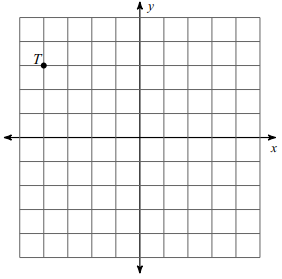
Solution :
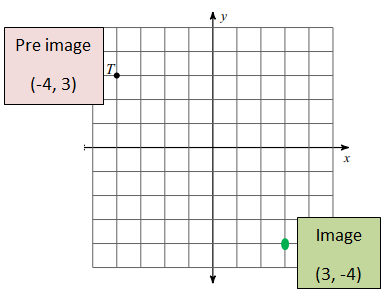
By observing the figure given above, the coordinate of T is
(-4, 3)
Rule :
(x, y) ==> (y, x)
T (-4, 3) ==> T' (3, -4)
Problem 2 :
Reflection across the y = x of the point U(-3, 1). Find the new coordinate of U'.
Solution :
U (-3, 1) ==> U' (1, -3)
Problem 3 :
Reflection across the line y = x
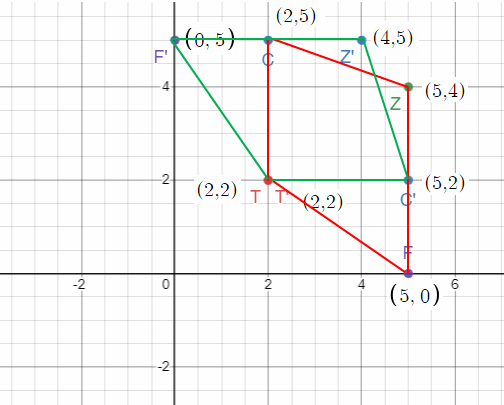
T(2, 2), C(2, 5), Z(5, 4), F(5, 0)
Solution :
By observing the coordinates, to use the rule we have to remember
(x, y) ==> (y, x)
T (2, 2) ==> T' (2, 2)
C (2, 5) ==> C' (5, 2)
Z (5, 4) ==> Z' (4, 5)
, F (5, 0) ==> F' (0, 5)
Problem 4 :
Reflection across y = x for F(2, 2), W(2, 5), K(3, 2). Find the new coordinates of F', W' and K'.
Solution :
Rule for reflection of y = x :
(x, y) ==> (y, x)
F (2, 2) ==>F' (2, 2)
W (2, 5) ==> W' (5, 2)
K (3, 2) ==> K' (2, 3)
Graph the image of the figure using the transformation given.
Problem 5 :
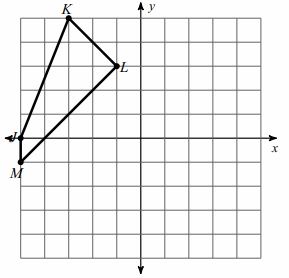
Reflection about y = x.
Solution :
By observing the coordinates of the vertices given above,
J(-5, 0), M(-5, -1), L(-1, 3) and K(-3, 5)
Using the rule :
(x, y) ==> (y, x)
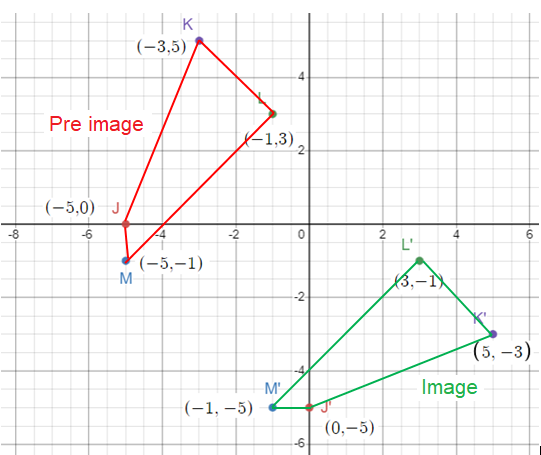
J(-5, 0) ==> J' (0, -5)
M(-5, -1) ==> M' (-1, -5)
L(-1, 3) ==> L' (3, -1)
K(-3, 5) ===> K' (5, -3)
Problem 6 :
Graph △ABC with vertices
A(1, 3), B(5, 2), and C(2, 1) and its image after the reflection described.
a. In the line n: x = 3
b. In the line m: y = 1
Solution :
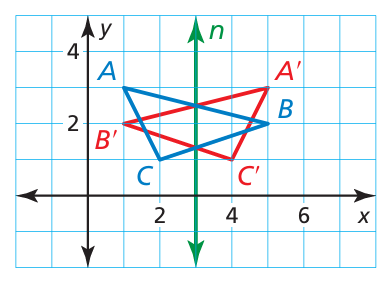
Point A is 2 units left of line n, so its reflection A′ is 2 units right of line n at (5, 3). Also, B′ is 2 units left of line n at (1, 2), and C′ is 1 unit right of line n at (4, 1).
Problem 7 :
Graph FG with endpoints F(−1, 2) and G(1, 2) and its image after a reflection in the line y = x.
Solution :
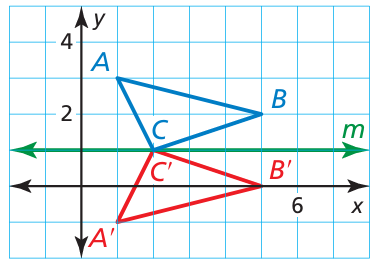
Point A is 2 units above line m, so A′ is 2 units below line m at (1, −1). Also, B′ is 1 unit below line m at (5, 0). Because point C is on line m, you know that C = C′.
Problem 8 :
Graph FG with endpoints F(−1, 2) and G(1, 2) and its image after a reflection in the line y = x.
Solution :
Reflection about the line y = x
F(-1, 2) ==> F'(2, -1)
G(1, 2) ==> G'(2, 1)
Problem 9 :
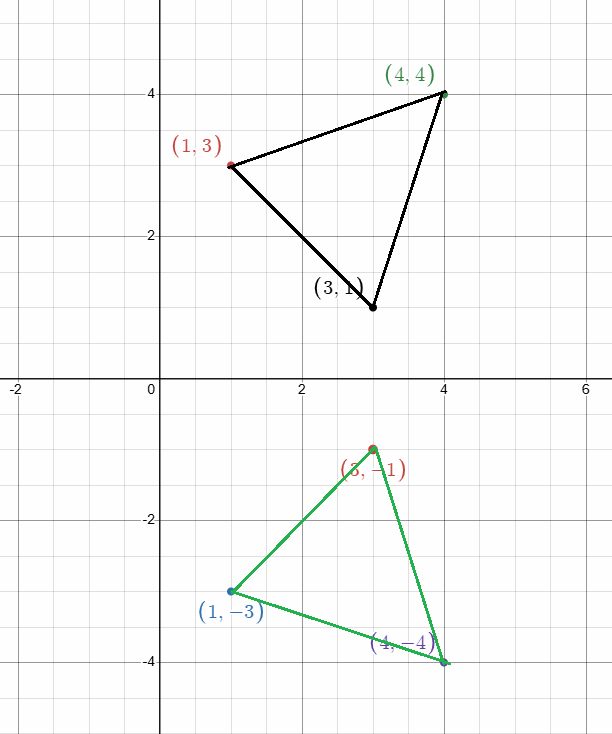
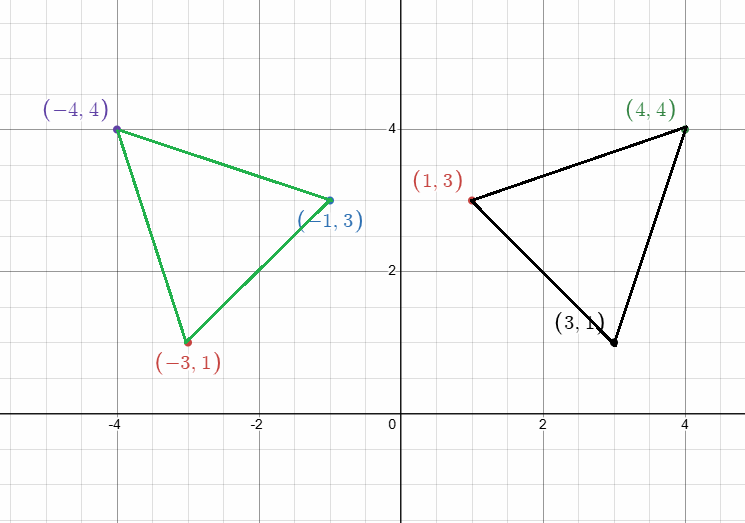
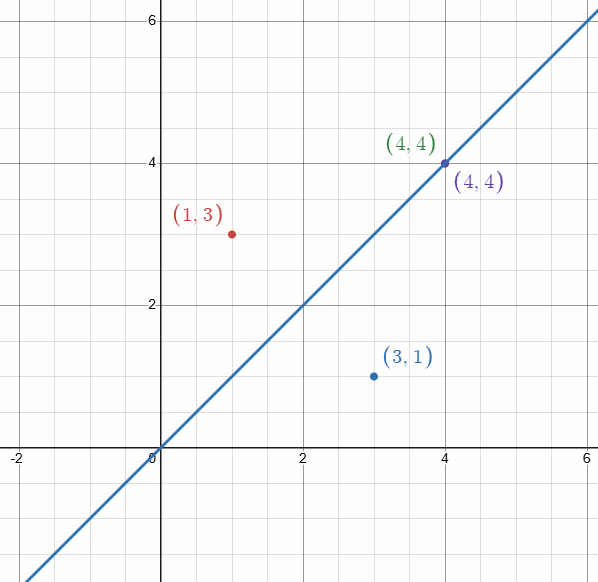
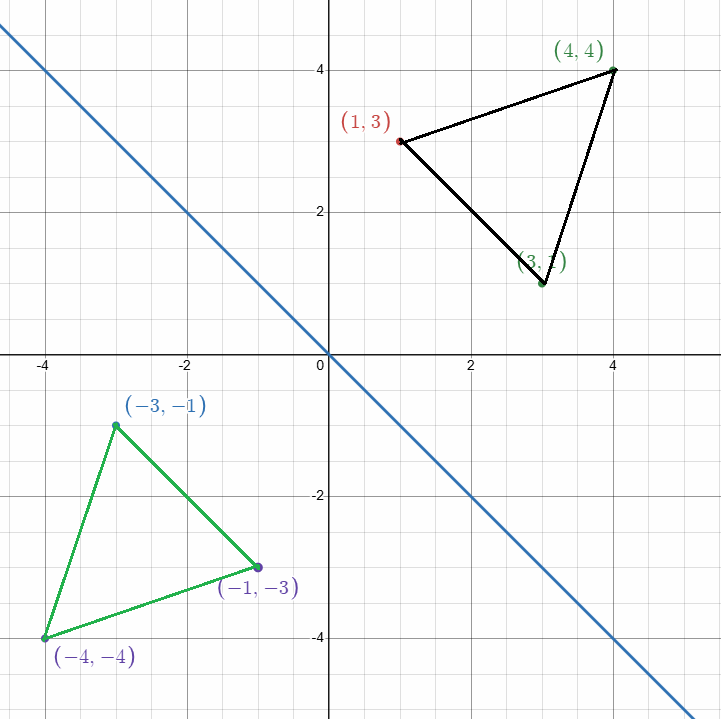
The vertices of △JKL are J(1, 3), K(4, 4), and L(3, 1).
a) Graph △JKL and its image after a reflection in the x-axis.
b) Graph △JKL and its image after a reflection in the y-axis. 7
c) Graph △JKL and its image after a reflection in the line y = x.
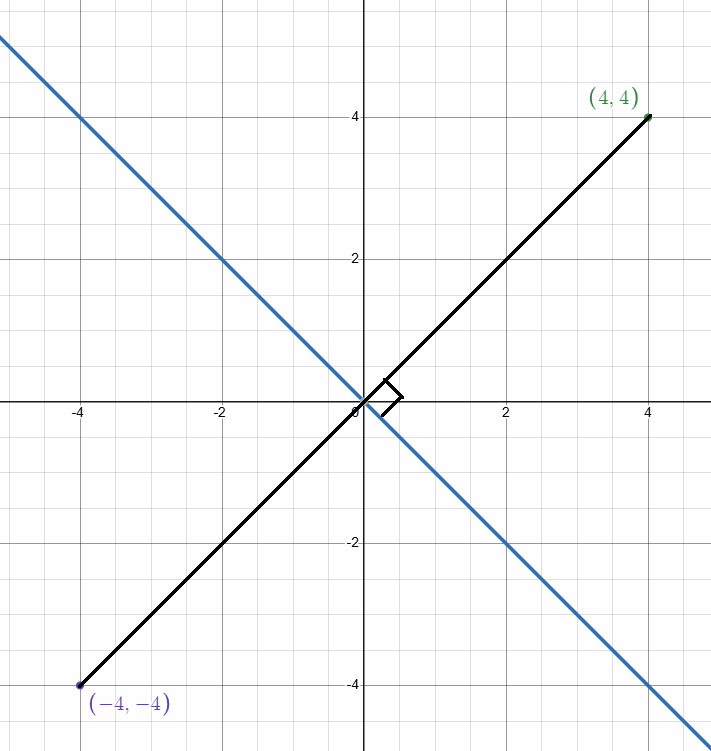
d) Graph △JKL and its image after a reflection in the line y = −x
e) verify that FF′ is perpendicular to y = −x
Solution :
J(1, 3), K(4, 4), and L(3, 1)
a) Reflection across x-axis :
(x, y) ==> (x, -y)
J(1, 3) ==> J'(1, -3)
K(4, 4) ==> K'(4, -4)
L(3, 1) ==> L'(3, -1)
b) reflection in the y-axis
(x, y) ==> (-x, y)
J(1, 3) ==> J'(-1, 3)
K(4, 4) ==> K'(-4, 4)
L(3, 1) ==> L'(-3, 1)
c) reflection in the line y = x :
(x, y) ==>(y, x)
J(1, 3) ==> J'(3, 1)
K(4, 4) ==> K'(4, 4)
L(3, 1) ==> L'(1, 3)
d) reflection in the line y = −x
(x, y) ==>(-y, -x)
J(1, 3) ==> J'(-3, -1)
K(4, 4) ==> K'(-4, -4)
L(3, 1) ==> L'(-1, -3)
e) verify that FF′ is perpendicular to y = −x
Problem 10 :
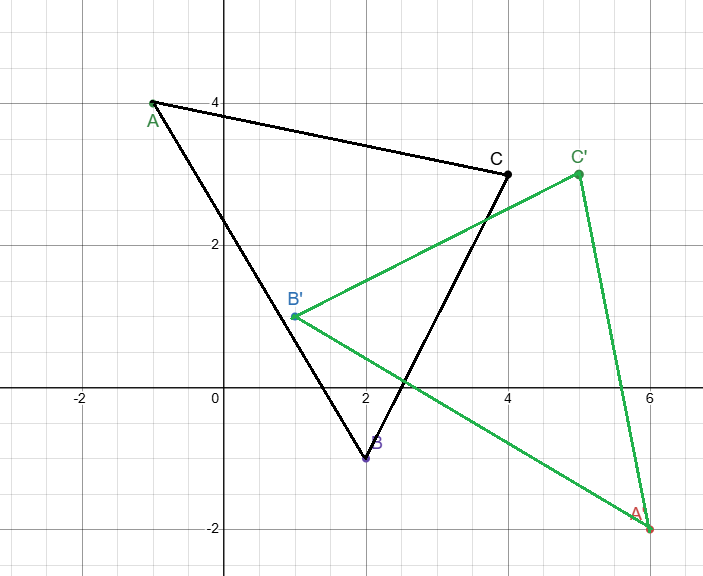
Graph triangle ABC with vertices A (-1, 4) B (2, -1) and C (4, 3) and its image after the glide reflection.
Translation (x, y) ==> (x + 2, y - 1)
Reflection : in the line y = x
Solution :
Given points are A (-1, 4) B (2, -1) and C (4, 3)
Reflection about y = x
A (-1, 4) ==> A' (4, -1)
B (2, -1) ==> B'(-1, 2)
C (4, 3) ==> C' (3, 4)
Translation (x, y) ==> (x + 2, y - 1)
A (4, -1) ==> A' (4 + 2, -1 - 1) ==> A' (6, -2)
B (-1, 2) ==> B'(-1 + 2, 2 - 1) ==> B' (1, 1)
C (3, 4) ==> C' (3 + 2, 4 - 1) ==> C' (5, 3)
Subscribe to our ▶️ YouTube channel 🔴 for the latest videos, updates, and tips.
Recent Articles


-
Finding Range of Values Inequality Problems
May 21, 24 08:51 PM
Finding Range of Values Inequality Problems -
Solving Two Step Inequality Word Problems
May 21, 24 08:51 AM
Solving Two Step Inequality Word Problems -
Exponential Function Context and Data Modeling
May 20, 24 10:45 PM
Exponential Function Context and Data Modeling