REFLECTION OVER VERTICAL AND HORIZONTAL LINES
Subscribe to our ▶️ YouTube channel 🔴 for the latest videos, updates, and tips.
Reflection about horizontal and vertical lines :
For horizontal line of reflection, the vertical distance between a point and its reflection point will be the same from the line of reflection.
For vertical line of reflection, the horizontal distance between a point and its reflection point will be the same from the line of reflection.
Problem 1 :
Reflection across y = -1
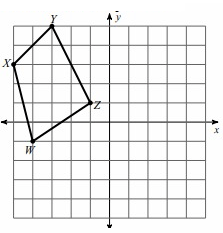
Solution :
By observing the figure given above,
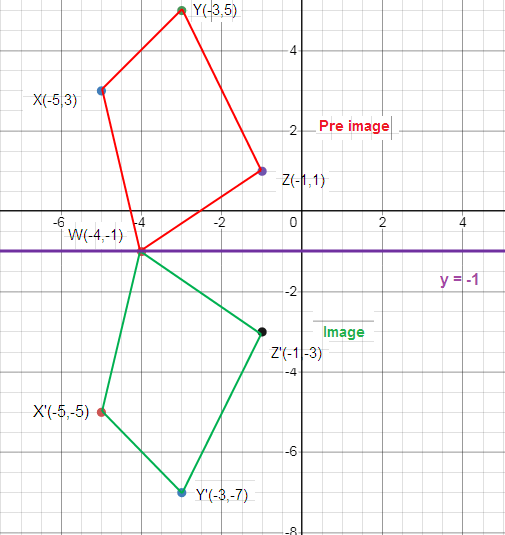
W (-4, -1), X (-5, 3), Y (-3, 5) and Z (-1, 1)
How to get W’?
Distance between y = -1 and W is 0 unit. So, the same point is W’.
W and W’ are the same.
How to get X’?
To reach X from y = -1, we move up 4 unit. So, to reach the reflection of X, that is X’ we have to move down 4 unit.
X (-5, 3) ==> X’ (-5, -5)
How to get Y’?
To reach Y from y = -1, we move up 6 unit. So, to reach the reflection of Y, that is Y’ we have to move down 6 unit.
Y (-3, 5) ==> Y’ (-3, -7)
How to get Z’?
To reach Z from y = -1, we move up 2 unit. So, to reach the reflection of Z, that is Z’ we have to move down 2 unit.
Z (-1, 1) ==> Z’ (-1, -3)
Problem 2 :
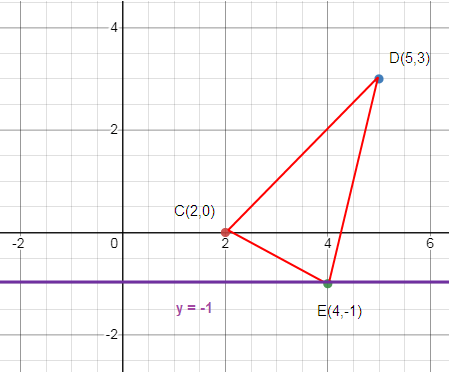
Reflection across y = -1
C (2, 0), D (5, 3), E (4, -1)
Solution :
Plotting the points and creating the sides.
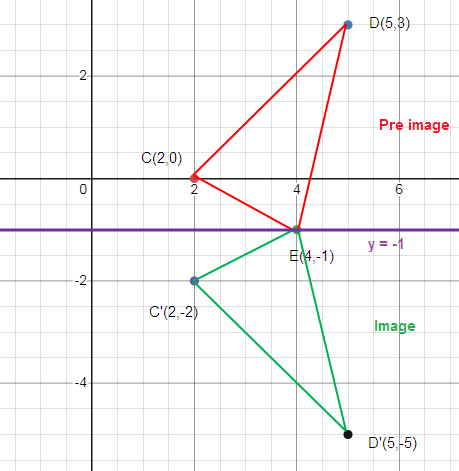
How to get C’?
To reach C from y = = -1, we move up 1 unit. So, to reach the reflection of C, that is C’ we have to move down 1 unit.
C (2, 0) ==> C’ (2, -2)
How to get D’?
To reach D from y = -1, we move up 4 unit. So, to reach the reflection of D, that is D’ we have to move down 4 unit.
D (5, 3) ==> D’ (5, -5)
How to get E’?
Distance between y = -1 and E is 0 unit. So, the same point is E’.
E and E’ are the same.
Problem 3 :
Reflection across y = -1
Q (-3, -4), R (-4, 0), S (-2, 0)
Solution :
Plotting the points and creating the sides.
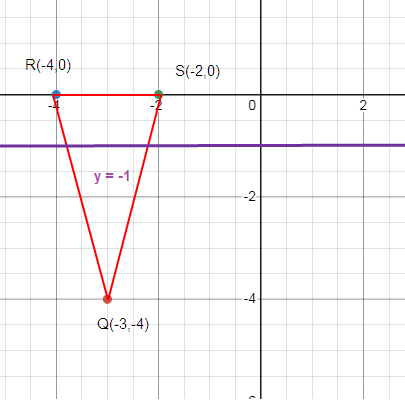
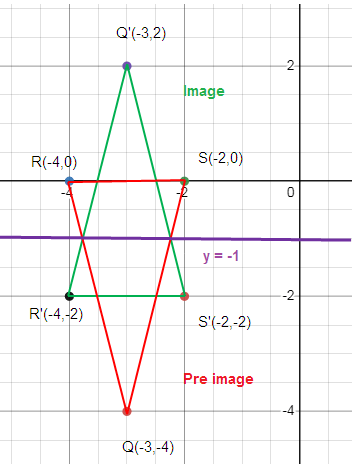
How to get Q’?
To reach Q from y = -1, we move down 3 unit. So, to reach the reflection of Q, that is Q’ we have to move up 3 unit.
Q (-3, -4) ==> Q’ (-3, 2)
How to get R’?
To reach R from y = -1, we move up 1 unit. So, to reach the reflection of R, that is R’ we have to move down 1 unit.
R (-4, 0) ==> R’ (-4, -2)
How to get S’?
To reach S from y = -1, we move up 1 unit. So, to reach the reflection of S, that is S’ we have to move down 1 unit.
S (-2, 0) ==> S’ (-2, -2)
Problem 4 :
Reflection across x = -2
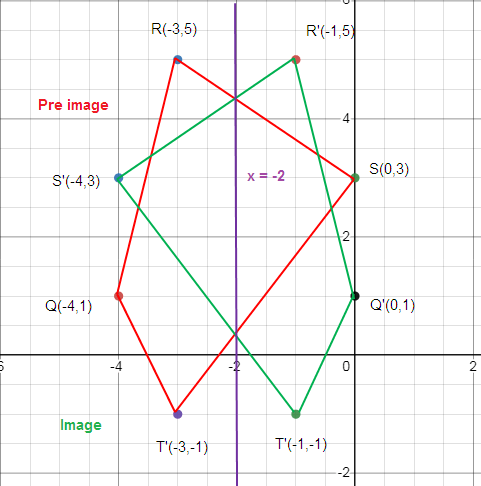
Q (-4, 1), R (-3, 5), S (0, 3), T (-3,-1)
Solution :
Plotting the points and creating the sides.
How to get Q’?
To reach Q from x = -2, we move left 2 unit. So, to reach the reflection of Q, that is Q’ we have to move right 2 unit.
Q (-4, 1) ==> Q’ (0, 1)
How to get R’?
To reach R from x = -2, we move left 1 unit. So, to reach the reflection of R, that is R’ we have to move right 1 unit.
R (-3, 5) ==> R’ (-1, 5)
How to get S’?
To reach S from x = -2, we move right 2 unit. So, to reach the reflection of S, that is S’ we have to move left 2 unit.
S (0, 3) ==> S’ (-4, 3)
How to get T’?
To reach T from x = -2, we move left 1 unit. So, to reach the reflection of T, that is T’ we have to move right 1 unit.
T (-3, -1) ==> T’ (-1, -1)
Problem 5 :
(a) Point P (a, b) is reflected in x-axis to P′ (4, – 3). Write down the values of a and b.
(b) P′′ is the image of P when reflected in y-axis. Write down the co-ordinates of P′′.
(c) Name a single transformation that maps P′ to P′′.
Solution :
(a) Rx (a, b) = (a, –b) ⇒ (a, –b) = (4, –3) ⇒ a = 4 and b = 3
(b) Ry (4, 3) = (–4, 3) Hence, P'' has coordinates (– 4, 3)
(c) P' → P" means (4, –3) → (– 4, 3)
Also, Ro(4, –3), = (–4, 3)
Problem 6 :
The point A (–6, 4) on reflection in y-axis is mapped as A′. Point A′ on reflection in the origin is mapped as A′′.
(a) Find the co-ordinates of A′.
(b) Find the co-ordinates of A′′.
(c) Write down a single transformation that maps A to A′′.
Solution :
(a) Ry (–6, 4) = (6, 4)
(b) Ro (6, 4) = (– 6, – 4)
(c) A → A" means (– 6, 4) → (– 6, – 4)
Also, Rx (– 6, 4) = (– 6, – 4).
So, reflection in the x-axis is the required single transformation.
Subscribe to our ▶️ YouTube channel 🔴 for the latest videos, updates, and tips.
Recent Articles


-
Finding Range of Values Inequality Problems
May 21, 24 08:51 PM
Finding Range of Values Inequality Problems -
Solving Two Step Inequality Word Problems
May 21, 24 08:51 AM
Solving Two Step Inequality Word Problems -
Exponential Function Context and Data Modeling
May 20, 24 10:45 PM
Exponential Function Context and Data Modeling