REFLECTION OF ABSOLUTE VALUE FUNCTION FOR A GIVEN FUNCTION
Subscribe to our ▶️ YouTube channel 🔴 for the latest videos, updates, and tips.
Reflections in the x-axis :
The graph of y = −f(x) is a reflection in the x-axis of the graph of y = f (x).
Note :
Multiplying the outputs by −1 changes their signs.
Reflections in the y-axis :
The graph of y = f(-x) is a reflection in the y-axis of the graph of y = f (x).
Note :
Multiplying the inputs by −1 changes their signs.
Problem 1 :
Let
f(x) = ∣x + 3∣ + 1
a) Write a function g whose graph is a reflection in the x-axis of the graph of f.
b) Write a function h whose graph is a reflection in the y-axis of the graph of f.
Solution :
f(x) = ∣x + 3∣ + 1
Finding reflection on x-axis :
Let g(x) be the reflected function about x-axis.
Put g(x) = -f(x)
g(x) = -(|x + 3| + 1)
g(x) = -|x + 3| - 1
So, the reflected function is g(x) = -|x + 3| - 1.
Finding reflection on y-axis :
Let h(x) be the reflected function about y-axis.
Put h(x) = f(-x)
Put x = -x
h(x) = ∣-x + 3 ∣ + 1
Factoring negative from absolute function.
h(x) = ∣-(x - 3) ∣ + 1
h(x) = ∣x - 3∣ + 1
So, the reflected function is h(x) = ∣x - 3∣ + 1
Problem 2 :
Find reflection of the function f(x) about x-axis.
f(x) = − ∣x + 2∣ − 1
Solution :
f(x) = − ∣x + 2∣ − 1
Let g(x) be the reflected function.
g(x) = -f(x)
g(x) = − (− ∣x + 2∣ − 1)
g(x) = ∣x + 2∣ + 1
So, the reflected function g(x) is ∣x + 2∣ + 1.
Problem 3 :
f(x) = ∣6x∣ − 2; reflection in the y-axis
Solution :
Let g(x) be the reflected function about y-axis.
g(x) = f(-x)
g(x) = ∣6(-x)∣ − 2
g(x) = ∣-6x∣ − 2
g(x) = ∣6x∣ − 2
So, the reflected function g(x) is ∣6x∣ − 2.
Problem 4 :
f(x) = ∣2x − 1∣ + 3; reflection in the y-axis
Solution :
Let g(x) be the reflected function about y-axis.
g(x) = f(-x)
g(x) = ∣2(-x) - 1∣ + 3
g(x) = ∣-2x - 1∣ + 3
g(x) = ∣-(2x + 1)∣ + 3
g(x) = ∣2x + 1∣ + 3
So, the reflected function g(x) is ∣2x + 1∣ + 3
Problem 5 :
f(x) = −3 + ∣x − 11∣ ; reflection in the y-axis
Solution :
Let g(x) be the reflected function about y-axis.
g(x) = f(-x)
g(x) = −3 + ∣x − 11∣
g(x) = −3 + ∣-x − 11∣
g(x) = -3 + |-(x + 11)|
g(x) = -3 + |x + 11|
So, the reflected function g(x) is -3 + |x + 11|.
Problem 6 :
The shape 𝑓(𝑥) = |x|, moved 6 𝑢𝑛𝑖𝑡𝑠 upward and 3 𝑢𝑛𝑖𝑡𝑠 to the left.
Solution :
𝑓(𝑥) = |x|
Moving 6 units up, then f(x) = |x| + 6
Moving 3 units left, f(x) = |x - (-3)| + 6
f(x) = |x + 3| + 6
So, the required function after the transformation is f(x) = |x + 3| + 6.
Problem 7 :
The shape 𝑓(𝑥) = |x|, moved 3 𝑢𝑛𝑖𝑡𝑠 to the left and reflected in the 𝑥−𝑎𝑥𝑖𝑠
Solution :
Using the order of transformation, the reflection should be done first and then transformation.
Reflection across x-axis, then put y = -y
-f(x) = |x|
f(x) = -|x|
Moving 3 units to the left, then f(x) = -|x - (-3)|
f(x) = -|x + 3|
Use the graph of 𝑓(𝑥) = |x| to write an equation for each function whose graph is shown. Each transformation includes only reflections or expansions/compressions.
Problem 8 :
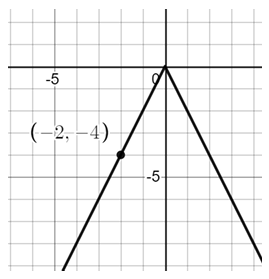
Solution :
f(x) = |x|
By observing the graph, it is reflection across x-axis and it passes through the point (-2, -4).
f(x) = -|x|
f(x) = -a|x|
-4 = -a|-2|
4/2 = a
a = -2
So, the required function is f(x) = -2|x|
Problem 9 :
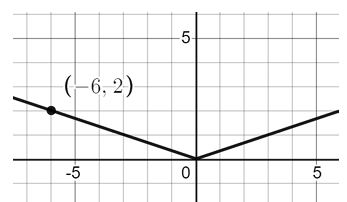
Solution :
f(x) = |x|
By observing the graph, there is no reflection and it passes through the point (-6, 2).
2 = a|-6|
6a = 2
a = 2/6
a = 1/3
So, the required function is f(x) = (1/3)|x|
Problem 10 :
Given the function
f(x) = -1/2 |4x - 5| + 3
determine for what x values of the function values are negative.
Solution :
f(x) = -1/2 |4x - 5| + 3
We are trying to determine where f(x) < 0, which is when f(x) < 0
-1/2 |4x - 5| + 3 < 0
-1/2 |4x - 5| < -3
1/2 |4x - 5| > 3
|4x - 5| > 6
|
4x - 5 = 6 4x = 6 + 5 4x = 11 x = 11/4 |
4x - 5 = -6 4x = -6 + 5 4x = -1 x = -1/4 |
We can now either pick test values or sketch a graph of the function to determine on which intervals the original function value are negative. Notice that it is not even really important exactly what the graph looks like, as long as we know that it crosses the horizontal axis at x = -1/4 and x = 11/4 , and that the graph has been reflected vertically
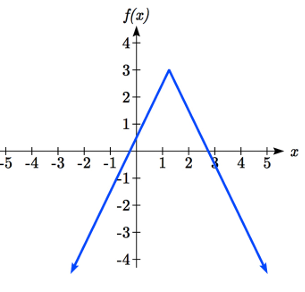
x < --1/4 or x > 11/4
In interval notation, this would be (-∞, -1/4) U (11/4, ∞)
Subscribe to our ▶️ YouTube channel 🔴 for the latest videos, updates, and tips.
Recent Articles


-
Finding Range of Values Inequality Problems
May 21, 24 08:51 PM
Finding Range of Values Inequality Problems -
Solving Two Step Inequality Word Problems
May 21, 24 08:51 AM
Solving Two Step Inequality Word Problems -
Exponential Function Context and Data Modeling
May 20, 24 10:45 PM
Exponential Function Context and Data Modeling