RATIONAL NUMBERS BETWEEN TWO RATIONAL NUMBERS WORKSHEET
Subscribe to our ▶️ YouTube channel 🔴 for the latest videos, updates, and tips.
Problem 1 :
Find out a rational numbers lying between 1/4 and 1/3.
Problem 2 :
Find out a rational numbers lying between 2 and 3.
Problem 3 :
Find out a rational numbers lying between -1/3 and 1/2.
Problem 4 :
Find out two rational numbers lying between -3 and -2.
Problem 5 :
Find out six rational numbers lying between -4/8 and 3/8.
Problem 6 :
Find out ten rational numbers lying between -4/13 and 7/13.
Problem 7 :
Find out three rational numbers lying between 4 and 5.
Problem 8 :
Find out three rational numbers lying between 2/3 and 3/4.
Answer Key
1) 7/24
2) 5/2.
3) -1/6 < 0/6 < 1/6 < 2/6
4) -5/2, -9/4.
5) -3/8, -2/8, -1/8, 0, 1/8, 2/8.
6) -2/13,-1/13, 0/13, 1/13, 2/13, 3/13, 4/13, 5/13
7) 17/4 < 18/4 < 19/4
8) 33/48 < 34/48 < 35/48
Problem 1 :
Find three rational numbers between 2/3 and 3/4.
Problem 2 :
Find ten rational numbers between -2/5 and 1/2
Problem 3 :
Find five rational numbers between 2/3 and 4/5
Problem 4 :
Find five rational numbers between -3/2 and 5/3
Problem 5 :
Find five rational numbers between 1/4 and 1/2
Problem 6 :
Find each weighted average.
a. The coordinate 2 has a weight of 1, and the coordinate 8 has a weight of 2.
b. The coordinate 3 has a weight of 1, the coordinate 5 has a weight of 3, and the coordinate 9 has a weight of 2.
Problem 7 :
Identify the segment bisector of XY. Then find the length of XY.
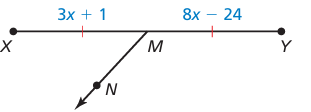
Problem 8 :
Identify the segment bisector of XY. Then find the length of XY.
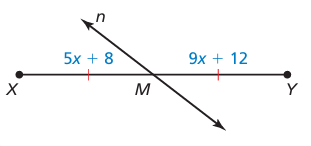
Problem 9 :
identify the segment bisector of line segment JK. Then find length of JM.
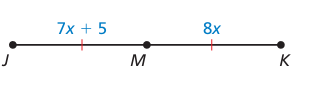
Problem 10 :
identify the segment bisector of line segment JK. Then find length of JM.
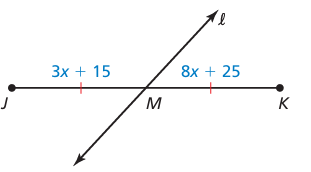
Answer Key
1) 33/48, 34/48, 35/48
2) -7/10, -6/10, -5/10, -4/10, -3/10, -2/10, -1/10, 1/10, 2/10, 3/10
3) 31/45, 32/45, 33/45, 34/45, 35/45
4) -8/6, -7/6, -6/6, -5/6, -4/6
5) 3/8, 5/16, 9/32
6) a) 6
b) 6
7) 32 units.
8) Length of JM is 40 units
9) Length of JM is 21 units.
Classify each number as RATIONAL (Q) or IRRATIONAL (I)
Problem 1 :
√47
Problem 2 :
11/9
Problem 3 :
19/4
Problem 4 :
√96
Problem 5 :
19/14
Problem 6 :
15/4
Problem 7 :
√84
Problem 8 :
-9
Problem 9 :
√72
Problem 10 :
0
Problem 11 :
8/9
Problem 12 :
Which statement is not always true?
1) The product of two irrational numbers is irrational.
2) The product of two rational numbers is rational.
3) The sum of two rational numbers is rational.
4) The sum of a rational number and an irrational number is irrational
Problem 13 :
Determine if the product of 3√2 and 8 √18 is rational or irrational ? Explain your answer.
Problem 14 :
Which of the following numbers is irrational?
a) 0.252525… b) 0.875 c) 0.3754152… d) -0.121212…
Problem 15 :
The product of any two irrational numbers is:
a) always an irrational number b) always a rational number
c) always an integer d) sometimes rational, sometimes irrational
Problem 16 :
Between two rational numbers:
a) there is no rational number b) there is exactly one rational number
c) there are infinitely many rational numbers
d) there are only rational numbers and no irrational numbers
Problem 17 :
If a = -2 , b = -1, then find 𝑎−𝑏 − 𝑏𝑎.
Problem 18 :
Find the three rational numbers between:
(i) -1 and -2
(ii) 0.1 and 0.11
Answer Key
1) √47 is irrational number.
2) 11/9 is a rational number.
3) 19/4 is a rational number.
4) √96 is irrational.
5) 19/14 is a rational number.
6) 15/4 is a rational number.
7) √84 is irrational number.
8) -9 is a rational number.
9) √72 is irrational number
10) 0 is a rational number.
11) 8/9 is a rational number.
12) option a is not true always.
13) The product of two irrational number is a rational number.
14) 0.3754152…
15) product of two rational numbers is sometimes rational sometimes irrational.
16) c) there are infinitely many rational numbers
17) 1
18) i) -3/2, -7/2 and -11/2 are three rational numbers in between them.
ii) 0.105, 0.1075 and 0.10875 are rational numbers in between 0.1 and 0.11.
Tell whether each expression is rational or irrational.
Problem 1 :
-√64
Problem 2 :
√1600
Problem 3 :
±√160
Problem 4 :
√144
Problem 5 :
√125
Problem 6 :
-√340
Problem 7 :
√1.96
Problem 8 :
-√0.09
Problem 9 :
Which statement is not always true?
1) The sum of two rational numbers is rational.
2) The product of two irrational numbers is rational.
3) The sum of a rational number and an irrational number is irrational.
4) The product of a nonzero rational number and an irrational number is irrational
Problem 10 :
(-2 - √3) (-2 + √3) when simplifies is
a) Positive and irrational b) Positive and rational
c) Negative and irrational d) negative and rational
Problem 11 :
Given that following expressions.
I -5/8 + 3/5 II. 1/2 + √2 III. √5 √5 IV. 3√49
Which expression(s) result in an irrational number?
1) II, only 2) III, only 3) I, III, IV 4) II, III, IV
Problem 12 :
A teacher wrote the following set of numbers on the board:
a = √20, b = 2.5 and c = √225
explain why a + b is irrational, but b + c is rational
Answer Key
1) -√64 is rational.
2) √1600 is rational
3) ±√160 is irrational number.
4) √144 is rational.
5) √125 is irrational number.
6) -√340 is irrational number.
7) √1.96 is rational.
8) -√0.09 is a rational.
9) The product of two irrational numbers is rational "cannot be true always"
10) Positive and rational.
11) option 1) is correct.
12)
a + b = √20 + 2.5
= √(2 x 2 x 5) + 2.5
= 2 √5 + 2.5
√5 is irrational.
Product of rational and irrational is irrational.
b + c = 2.5 + √225
= 2.5 + √(15 x 15)
= 2.5 + 15
= 17.5
It can be converted into fraction.
17.5 = 175/10
After simplifying, we get
= 35/2
So, it is rational.
Subscribe to our ▶️ YouTube channel 🔴 for the latest videos, updates, and tips.
Recent Articles


-
Finding Range of Values Inequality Problems
May 21, 24 08:51 PM
Finding Range of Values Inequality Problems -
Solving Two Step Inequality Word Problems
May 21, 24 08:51 AM
Solving Two Step Inequality Word Problems -
Exponential Function Context and Data Modeling
May 20, 24 10:45 PM
Exponential Function Context and Data Modeling