QUIZ ON TYPES OF ANGLES
Subscribe to our ▶️ YouTube channel 🔴 for the latest videos, updates, and tips.
State whether
the following are true (T) or false (F) :
Problem 1 :
An angle measuring 89º is an acute angle.
Solution :
This statement is true.
Because, 89º is less than 90º.
Problem 2 :
An angle measuring 91º is an obtuse angle.
Solution :
This statement is true.
Because, 91º is less than 180º.
Problem 3 :
The size of an angle depends on the lengths of its arms.
Solution :
The size of an angle depends upon the opening between its arms.
The size of an angle does not depend on the lengths of its arms.
So, this statement is false.
Problem 4 :
When a vertical line crosses a horizontal line the angle formed is a straight angle.
Solution :
A vertical line crosses a horizontal line the angle formed is a right angle.
So, this statement is false.
Problem 5 :
3/4 of a straight angle is an acute angle.
Solution :
This statement is false.
Because straight angle is180º.
= 3/4 of 180
= (3/4) (180)
= 135 > 90
Then, 3/4 of a straight angle is an obtuse angle.
Problem 6 :
A right angle is neither an acute angle nor an obtuse angle.
Solution :
Right angle :
An angle that is exactly 90º.
Acute angle :
An angle that is less than 90º.
Obtuse angle :
An angle that is greater than 90º and less than 180º.
So, this statement is true.
State whether the following statements are true or false:
Problem 1 :
The sum of the angles of a triangle is equal to two right angles.
Solution :
The sum of the angles of a triangle = 180º.
Right angle = 90º.
The sum of the angles of a triangle = two right angles
180º = 2 × 90º
180º = 180º
So, this statement is true.
Problem 2 :
A right angled triangle can contain an obtuse angle.
Solution :
Right angle :
An angle that is exactly 90º.
Obtuse angle :
An angle that is greater than 90º and less than 180º.
This statement is false.
So, a right angled triangle cannot contain an obtuse angle.
Problem 3 :
The sum of two angles of a triangle is always greater than the third angle.
Solution :
This statement is false.
Because, the sum of any two angles of a triangle is not always greater than the third angle.
Problem 4 :
The two smaller angles of a right angled triangle are supplementary.
Solution :
This statement is false.
Because, the two smaller angles of a right angled triangle are equal.
Problem 5 :
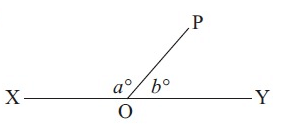
[XY] is a fixed line segment and [OP] can rotate about O between [OX] and [OY].
a. If a = 135, find b. b. If b = 67, find a. c. What is a if b is 27?
d. If a is 0, what is b? e. If a = 89, find b.
f. If a = b, what is the value of each?
Solution :
Given, [XY] is a fixed line segment.
a. Given, a = 135
To find b:
[OX] + [OY] = [XY]
a + b = 180
135 + b = 180
b = 180 – 135
b = 45
b. Given, b = 67
To find a:
[OX] + [OY] = [XY]
a + b = 180
a + 67 = 180
a = 180 – 67
a = 113
c. Given, b = 27
To find a:
[OX] + [OY] = [XY]
a + b = 180
a + 27 = 180
a = 180 – 27
a = 153
d. Given, a = 0
To find b:
[OX] + [OY] = [XY]
a + b = 180
0 + b = 180
b = 180 – 0
b = 180
e. Given, a = 89
To find b:
[OX] + [OY] = [XY]
a + b = 180
89 + b = 180
b = 180 – 89
b = 91
f. Given, a = b
[OX] + [OY] = [XY]
a + b = 180
b + b = 180
2b = 180
b = 180/2
b = 90
Problem 6 :
Tell whether the statement is always, sometimes, or never true. Explain.
a) If x and y are supplementary angles, then x is obtuse.
b)If x and y are right angles, then x and y are supplementary angles.
c) If x and y are complementary angles, then y is a right angle.
Solution :
a) When sum of angles is 180 degree, those angles are called supplementary to each other. Let those angles be x and y. One of the angle must be greater than 90 degree and the other angle may be less than 90 degree. Then, it is true. When two angles are the same and it is 90 degree, for that also as a sum we get 180 degree.
So, the given statement will be true sometimes.
b) When x and y are right angles, then x and y are supplementary angles. So, the given statement is always true.
c) The two angles are said to be complementary when the sum of the angles is 90 degree. Then one of the angle may not be 90 degree. Then it is never true.
Problem 7 :
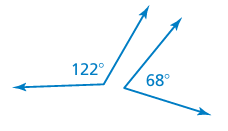
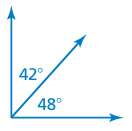
Tell whether the angles are complementary, supplementary, or neither.
i)
ii)
Solution :
i) The sum of the angles shown
= 122 + 68
= 190
Since the sum of the angles is not 180, then it is not supplementary and it is neither.
ii) The sum of the angles = 42 + 48
= 90
Since the sum of the angles is 90, then they are complementary.
Subscribe to our ▶️ YouTube channel 🔴 for the latest videos, updates, and tips.
Recent Articles


-
Finding Range of Values Inequality Problems
May 21, 24 08:51 PM
Finding Range of Values Inequality Problems -
Solving Two Step Inequality Word Problems
May 21, 24 08:51 AM
Solving Two Step Inequality Word Problems -
Exponential Function Context and Data Modeling
May 20, 24 10:45 PM
Exponential Function Context and Data Modeling