QUIZ ON PROPERTIES OF QUADRILATERALS
Subscribe to our ▶️ YouTube channel 🔴 for the latest videos, updates, and tips.
Part A
Answer the following with the response of True or False:
1) A trapezoid has one pair of parallel sides. ____________________
True
2) In an isosceles trapezoid, the non-parallel sides are congruent. ____________________
True
3) In a rhombus, all sides are congruent. ____________________
True
4) In a rectangle, diagonals are perpendicular. ____________________
False
In square and in rhombus, the diagonals are perpendicular. For Parallelogram, rectangle, and trapeziums, the diagonals are not perpendicular.
5) In an isosceles trapezoid, opposite angles are congruent. ____________________
False
The opposite angles are supplementary.
6) All quadrilaterals are rectangles. ____________________
False
Rectangle can be considered as quadrilateral but all quadrilateral not not rectangles.
Part B
Problem 1 :
Which of the following is true about every parallelogram ?
a) All four sides are congruent
b) The diagonals are perpendicular to each other.
c) Two pairs of opposite angles are congruent
d) The consecutive angles are congruent.
Solution :
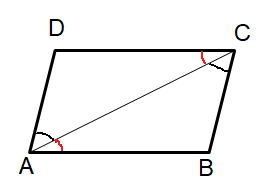
In parallelogram, opposite sides are parallel and equal.
In triangle ADC and in ABC,
∠DCA = ∠BAC (DC || AB, alternate interior angles)
∠DAC = ∠BCA (AD || BC, alternate interior angles)
AC = AC (Common)
So, triangles ADC and ABC are congruent. Using CPCT
∠D = ∠B
Opposite angles are equal.
Problem 2 :
Which reason can be used to prove that a parallelogram is a rhombus ?
a) The diagonals are congruent
b) The opposite angles are congruent
c) The diagonals are perpendicular
d) The opposite sides are parallel.
Solution :
In rhombus, the diagonal will be perpendicular. But in parallelogram the diagonals will not be perpendicular.
Problem 3 :
For which quadrilateral are the diagonals congruent but do not bisect each other ?
a) Parallelogram
b) Isosceles trapezoid
c) Rectangle
d) Rhombus
Solution :
In isosceles trapezoid, the diagonals are congruent but they will not bisect each other.
Problem 4 :
For which quadrilaterals are the diagonals congruent ?
a) Rhombus b) Parallelogram c) Isosceles trapezoid
d) Rectangle e) Square
Solution :
In Isosceles trapezoid, Rectangle and Square the diagonals are congruent.
Problem 5 :
If the diagonals of a quadrilateral do not bisect each other, then the quadrilateral could be a
a) Trapezoid b) Square c) Rectangle d) Rhombus
Solution :
In trapezoid, the diagonals do not bisect each other.
Problem 6 :
One angle of a quadrilateral is 150°and other three angles are equal. What is the measure of each of these equal angles ?
(a) 75° (b) 85° (c) 95° (d) 70°
Solution :
Let x be the equal angle measures.
Sum of interior angles of quadrilateral = 360
x + x + x + 150 = 360
3x + 150 = 360
3x = 360 - 150
3x = 210
x = 210/3
x = 70
So, the equal angle measure is 70 degree, option d is correct.
Problem 7 :
If the following quadrilaterals are parallelograms, find the values of x, y, and z.
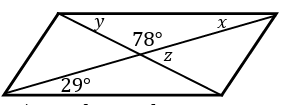
Solution :
78 + z = 180
z = 180 - 78
z = 102
Since the given quadrilateral is a parallelogram, the opposite sides will be parallel.
x = 29 (alternate interior angles)
In a triangle, the sum of interior angles is 180
78 + x + y = 180
78 + 29 + y = 180
107 + y = 180
y = 180 - 107
= 73
Problem 8 :
If the following quadrilaterals are parallelograms, find the values of x, y, and z.
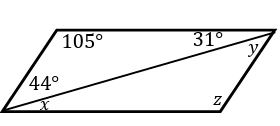
Solution :
Since it is parallelogram, co-interior angles is 180
44 + x + 105 = 180
149 + x = 180
x = 180 - 149
x = 31
y = 44 (alternate interior angles)
z = 105 (opposite angles)
Problem 9 :
Use rectangle ABCD and the given information to complete the following.
i) If 𝐴𝐶 = 4𝑥 − 60 and 𝐵𝐷 = 30 − 𝑥, find 𝐵𝐷.
ii) If ∠𝐵𝐴𝐶 = 4𝑥 + 5 and ∠𝐶𝐴𝐷 = 5𝑥 − 14, find ∠𝐶𝐴𝐷.
iii) If 𝐷𝐸 = 13, find 𝐶𝐸.
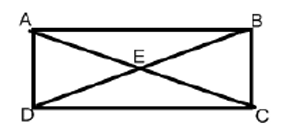
Solution :
i) If 𝐴𝐶 = 4𝑥 − 60 and 𝐵𝐷 = 30 − 𝑥
In a rectangle, diagonals will be equal.
AC = BD
4x - 60 = 30 - x
4x + x = 30 + 60
5x = 90
x = 90/5
x = 18
Applying the value of x, we get
𝐵𝐷 = 30 - 18
= 12
So, the length of BD is 12.
ii) If ∠𝐵𝐴𝐶 = 4𝑥 + 5 and ∠𝐶𝐴𝐷 = 5𝑥 − 14, find ∠𝐶𝐴𝐷.
∠𝐵𝐴𝐶 + ∠𝐶𝐴𝐷 = 90
4x + 5 + 5x - 14 = 90
9x - 9 = 90
9x = 90 + 9
9x = 99
x = 11
Applying the value of x, we get
∠𝐶𝐴𝐷 = 5(11) − 14
= 55 - 14
= 41
iii) If 𝐷𝐸 = 13, find 𝐶𝐸.
In a rectangle, diagonals will bisect each other.
DE = BE
AE = EC
13 = CE
Problem 10 :
ABCD is an isosceles trapezoid with bases 𝐴𝐵 and 𝐶𝐷, and median 𝐸𝐹. Use the given information to solve each problem.
i) If 𝐷𝐶 = 30 and 𝐴𝐵 = 42, find 𝐸𝐹.
ii) If ∠𝐴 = 5𝑥 and ∠𝐷 = 4𝑥, find the value of 𝑥.
iii) If 𝐸𝐹 = 𝑥 + 5 and 𝐴𝐵 +𝐶𝐷 = 4𝑥 + 6, find 𝐸𝐹.
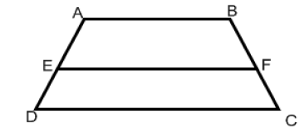
Solution :
i) If 𝐷𝐶 = 30 and 𝐴𝐵 = 42
𝐸𝐹 = (1/2) (DC + AB)
= (1/2)(30 + 42)
= (1/2) 72
= 36
So, the length of EF is 36 units.
ii) If ∠𝐴 = 5𝑥 and ∠𝐷 = 4𝑥, find the value of 𝑥.
∠𝐴 + ∠D = 180
5x + 4x = 180
9x = 180
x = 180/9
x = 20
So, the value of x is 20.
iii) If 𝐸𝐹 = 𝑥 + 5 and 𝐴𝐵 + 𝐶𝐷 = 4𝑥 + 6, find 𝐸𝐹.
𝐸𝐹 = (1/2) (DC + AB)
x + 5 = (1/2)(4x + 6)
2(x + 5) = 4x + 6
2x + 10 = 4x + 6
2x - 4x = 6 - 10
-2x = -4
x = 2
Applying the value of x, we get
EF = 2 + 5
= 7
Subscribe to our ▶️ YouTube channel 🔴 for the latest videos, updates, and tips.
Recent Articles


-
Finding Range of Values Inequality Problems
May 21, 24 08:51 PM
Finding Range of Values Inequality Problems -
Solving Two Step Inequality Word Problems
May 21, 24 08:51 AM
Solving Two Step Inequality Word Problems -
Exponential Function Context and Data Modeling
May 20, 24 10:45 PM
Exponential Function Context and Data Modeling