PROBLEMS USING INVERSE PROPERTIES LOGARITHMS
Subscribe to our ▶️ YouTube channel 🔴 for the latest videos, updates, and tips.
By the definition of a logarithm, it follows that the logarithmic function g(x) = logb x is the inverse of the exponential function f (x) = bx. This means that
g(f (x)) = logb bx = x and f (g(x)) = blogb x = x. In other words, exponential functions and logarithmic functions “undo” each other.
Problem 1 :
Simplify
10 log 4
Solution :
Given that, 10 log 4
f (g(x)) = blogb x = x
10 log 4 = 4
(because base and base of logarithm at the power both are the same)
Problem 2 :
Simplify
log5 25x
Solution :
= log5 25x
Writing 25 in exponential form, we get
52
= log5 (52)x
= log5 (52x)
This matches with the property, g(f (x)) = logb bx = x
= 2x
Problem 3 :
Find the inverse of each function.
a) f (x) = 6x
b) y = ln(x + 3)
Solution :
a) f (x) = 6x
Let g(x) be the inverse of the given function.
Using inverse properties of logarithm, g(x) = log6 x
b) y = ln(x + 3)
Let g(x) be the inverse of the given function.
ey = (x + 3)
Solving for x,
ey - 3 = x
Exchange x to y and y to x
y = ex - 3
g(x) = ex - 3
Problem 4 :
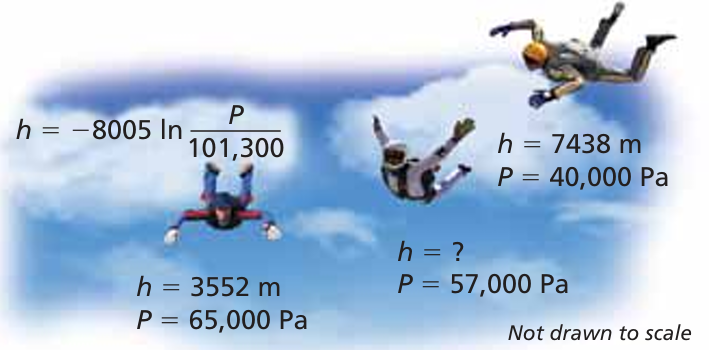
Skydivers use an instrument called an altimeter to track their altitude as they fall. The altimeter determines altitude by measuring air pressure. The altitude h (in meters) above sea level is related to the air pressure P (in pascals) by the function shown in the diagram. What is the altitude above sea level when the air pressure is 57,000 pascals?
Solution :
h = -8005 ln (p/101300)
When p = 57000
h = -8005 ln (57000/101300)
h = -8005 ln (0.562)
= -8005(-0.576)
= 4612.9
Approximately 4613 m.
Problem 5 :
The pH value for a substance measures how acidic or alkaline the substance is. It is given by the formula pH = −log[H+], where H+ is the hydrogen ion concentration (in moles per liter). Find the pH of each substance.
a. baking soda: [H+] = 10−8 moles per liter
b. vinegar: [H+] = 10−3 moles per liter
Solution :
pH = −log[H+]
a) pH substance in baking soda :
Applying [H+] = 10−8
pH = −log[10−8]
= - (-8)
= 8
a) pH substance in vinegar :
Applying [H+] = 10−3
pH = −log[10−3]
= - (-3)
= 3
Problem 6 :
The energy magnitude M of an earthquake can be modeled by
M = (2/3) log E − 9.9
where E is the amount of energy released (in ergs).
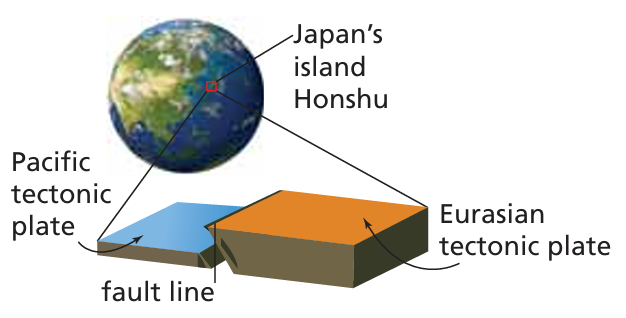
a. In 2011, a powerful earthquake in Japan, caused by the slippage of two tectonic plates along a fault, released 2.24 × 1028 ergs. What was the energy magnitude of the earthquake?
b. Find the inverse of the given function. Describe what the inverse represents.
Solution :
M = (2/3) log E − 9.9
a) E is the amount of energy released
M = (2/3) log (2.24 × 1028) − 9.9
Using the properties of logarithm,
= (2/3) [log (2.24) + (log 1028)] − 9.9
= (2/3) [0.350 + 28] − 9.9
= (2/3) [28.350] − 9.9
= 18.9 - 9.9
= 9
So, the energy of magnitude is 9
b) Finding inverse :
M + 9.9 = (2/3) log E
log E = (3/2) M + 9.9
E = 10(3/2) M + 9.9
Problem 7 :
The wind speed s (in miles per hour) near the center of a tornado can be modeled by s = 93 log d + 65, where d is the distance (in miles) that the tornado travels.
a. In 1925, a tornado traveled 220 miles through three states. Estimate the wind speed near the center of the tornado.
b. Find the inverse of the given function. Describe what the inverse represents
Solution :
s = 93 log d + 65
Here d is the distance (in miles) that the tornado travels.
s is the wind speed s (in miles per hour)
a) When d = 220 miles, s = ?
s = 93 log 220 + 65
s = 93(2.342) + 65
= 217.806 + 65
= 282.806
So, the required speed 283 miles per hour.
b)
s = 93 log d + 65
s - 65 = 93 log d
(s - 65)/93 = log d
d = 10(s - 65)/93
Problem 8 :
The function represents distance traveled with the speed of s miles per hour.
The lengthℓ (in centimeters) of a scalloped hammerhead shark can be modeled by the function
ℓ = 266 − 219e−0.05t
where t is the age (in years) of the shark. How old is a shark that is 175 centimeters long?

Solution :
ℓ = 266 − 219e−0.05t
When l = 175, t = ?
Finding inverse function :
219e−0.05t = 266 - l
e−0.05t = (266 - l)/219
e0.05t = 219/(266 - l)
Applying l = 175, we get
e0.05t = 219/(266 - 175)
e0.05t = 219/91
e0.05t = 2.40
0.05t = ln(2.40)
0.05t = 0.87
t = 0.87/0.05
t = 17.4
So, the required age is 18 years.
Subscribe to our ▶️ YouTube channel 🔴 for the latest videos, updates, and tips.
Recent Articles


-
Finding Range of Values Inequality Problems
May 21, 24 08:51 PM
Finding Range of Values Inequality Problems -
Solving Two Step Inequality Word Problems
May 21, 24 08:51 AM
Solving Two Step Inequality Word Problems -
Exponential Function Context and Data Modeling
May 20, 24 10:45 PM
Exponential Function Context and Data Modeling