PROBLEMS ON REFLECTION ACROSS THE Y AXIS
Subscribe to our ▶️ YouTube channel 🔴 for the latest videos, updates, and tips.
The rule of reflection about y-axis is
(x, y) ==> (-x, y)
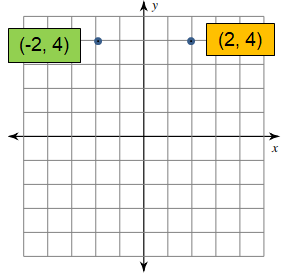
What is preimage ?
Preimage In a transformation, the original figure is called the preimage.
What is image ?
Image In a transformation, the final figure is called the image.
Graph the image of the figure using the transformation given.
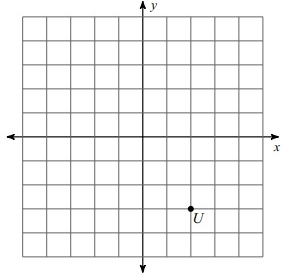
Problem 1 :
Solution :
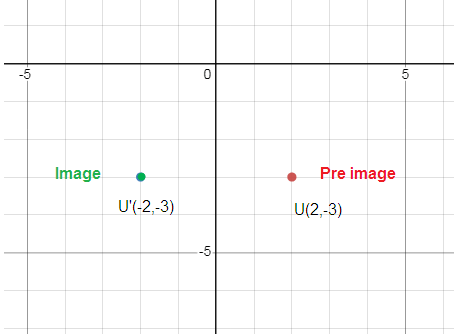
Marking the point U (2, -3). Reflection of U across y-axis is
U’ (-2, -3)
Problem 2 :
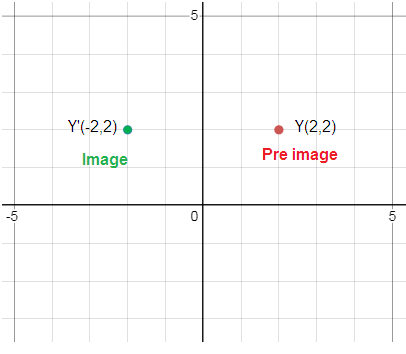
Reflection across the y-axis
Y (2, 2)
Solution :
Marking the point Y (2, 2). Reflection of Y across y-axis is
Problem 3 :
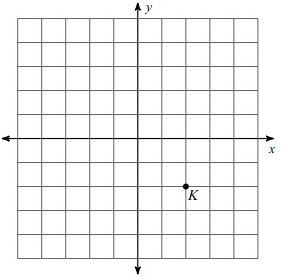
Reflection on y-axis
Solution :
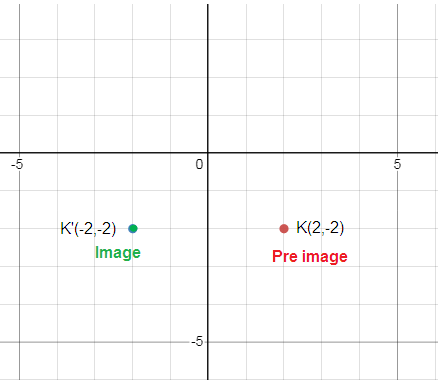
Marking the point K (2, -2). Reflection of K across y-axis is
K’ (-2, -2)
Problem 4 :
Solution :
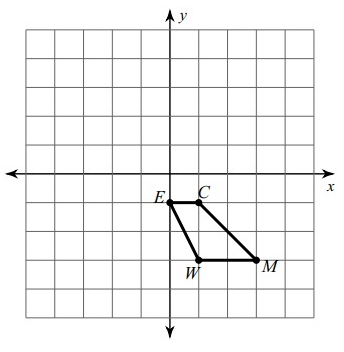
By observing the figure, coordinates of the vertices are
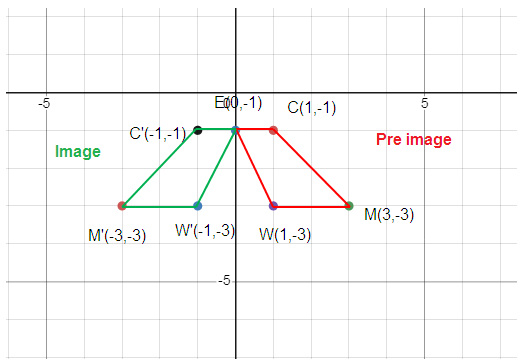
C (1, -1), E (0, -1), M (3, -3) and W (1, -3)
C (1, -1) ==> C’ (-1, -1)
E (0, -1) ==> E’ (0, -1)
M (3, -3) ==> M’ (-3, -3)
W (1, -3) ==> W’ (-1, -3)
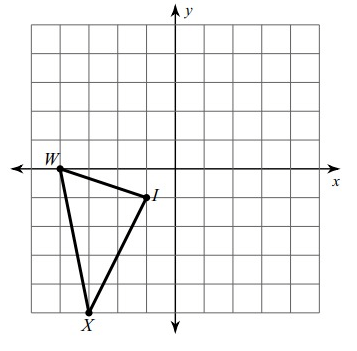
Problem 5 :
Reflection across y-axis
Solution :
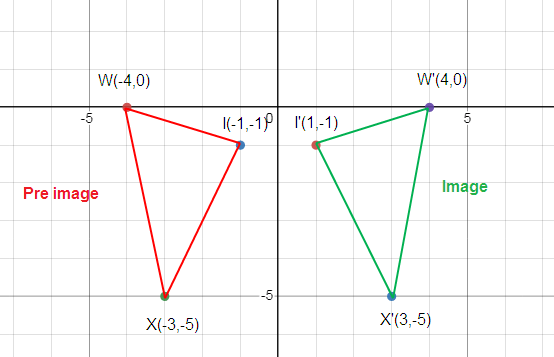
By observing the figure, coordinates of the vertices are
W (-4, 0), I (-1, -1) and X (-3, -5)
W (-4, 0) ==> W’ (4, 0)
I (-1, -1) ==> I’ (1, -1)
X (-3, -5) ==> X’ (3, -5)
Problem 6 :
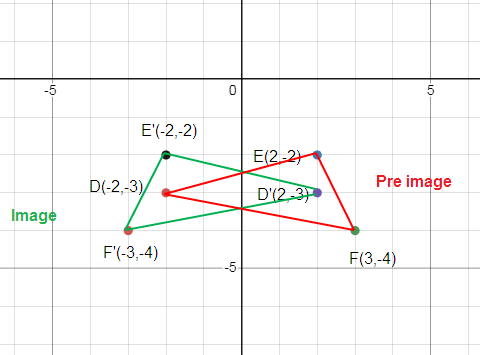
Reflection across the y-axis
D (-2, -3), E (2, -2) and F (3, -4)
Solution :
Rule:
(x, y) ==> (-x, y)
D (-2, -3) ==> D’ (2, -3)
E (2, -2) ==> E’ (-2, -2)
F (3, -4) ==> F’ (-3, -4)
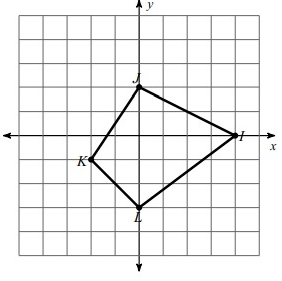
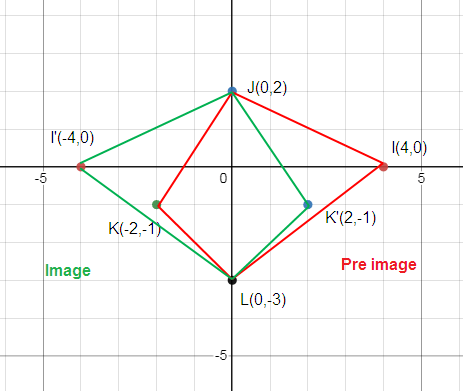
Problem 7:
Solution:
By observing the figure, coordinates of the vertices are
I (4, 0), J (0, 2), K (-2, -1) and L (0, -3)
I (4, 0) ==> I’ (-4, 0)
J (0, 2) ==> J’ (0, 2)
K (-2, -1) ==> K’ (2, -1)
L (0, -3) ==> L’ (0, -3)
Problem 8:
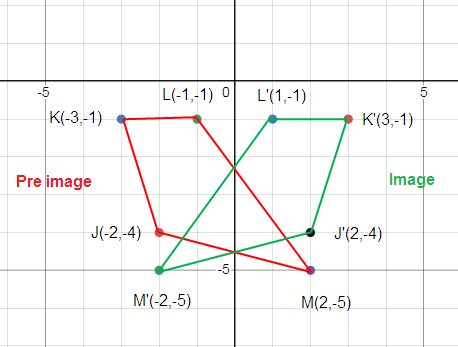
Reflection across the y-axis
J (-2, -4), K (-3, -1), L (-1, -1), M (2, -5)
Solution:
Rule:
(x, y) ==> (-x, y)
J (-2, -4) ==> J’ (2, -4)
K (-3, -1) ==> K’ (3, -1)
L (-1, -1) ==> L’ (1, -1)
M (2, -5) ==> M’ (-2, -5)
Problem 9 :
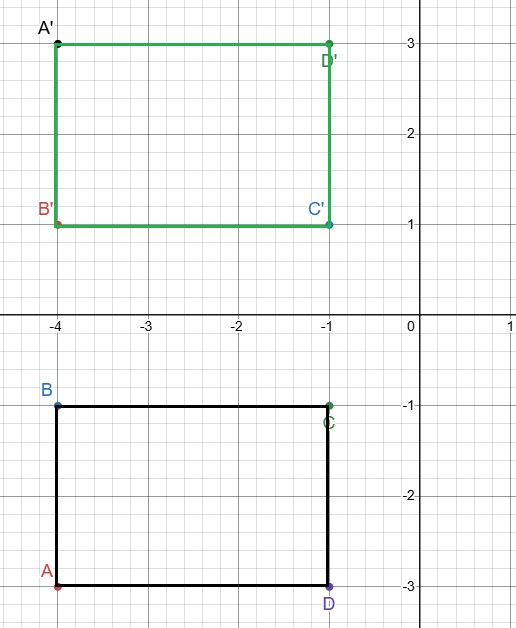
The vertices of a rectangle are A(−4, −3), B(−4, −1), C(−1, −1), and D(−1, −3).
a. Draw the rectangle and its reflection in the x-axis.
b. Draw the rectangle and its reflection in the y-axis.
c. Are the images in parts (a) and (b) the same size and shape? Explain.
Solution :
a) Rule for reflection across x-axis
(x, y) ==> (x, -y)
A(−4, −3) ==> A'(-4, 3)
B(−4, −1) ==> B'(-4, 1)
C(−1, −1) ==> C'(-1, 1)
D(−1, −3) ==> D'(-1, 3)
a) Rule for reflection across y-axis
(x, y) ==> (-x, y)
A(−4, −3) ==> A'(4, -3)
B(−4, −1) ==> B'(4, -1)
C(−1, −1) ==> C'(1, -1)
D(−1, −3) ==> D'(1, -3)
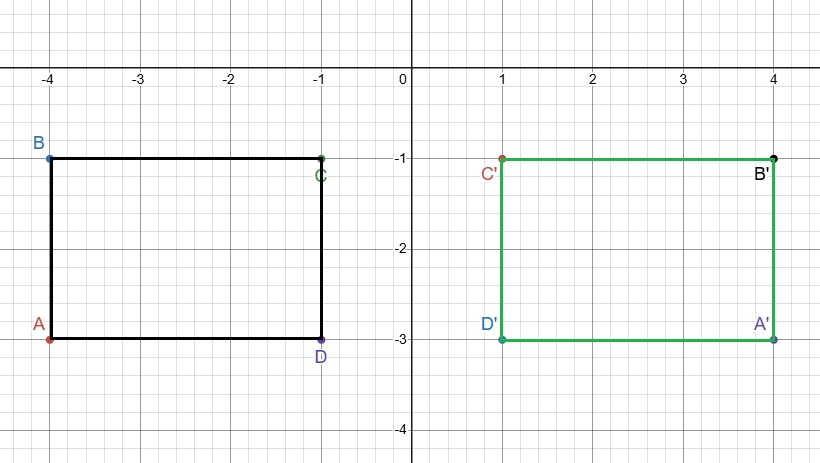
c. Yes, after reflection the shapes are congruent.
Problem 10 :
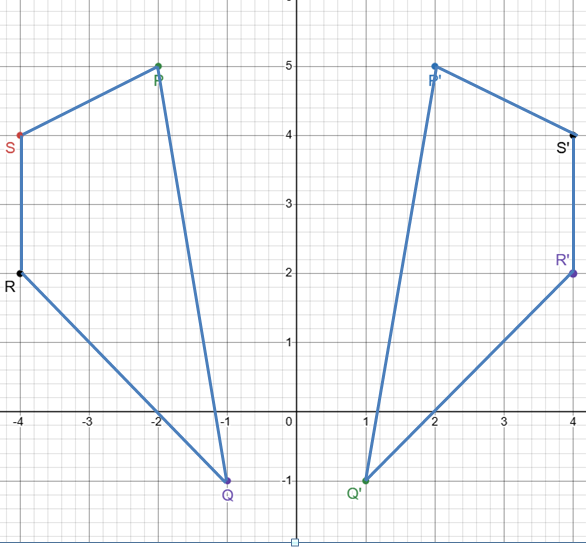
The vertices of a quadrilateral are P(−2, 5), Q(−1, −1), R(−4, 2), and S(−4, 4). Draw this quadrilateral and its reflection in the y-axis. What are the coordinates of the image?
Solution :
P(−2, 5), Q(−1, −1), R(−4, 2), and S(−4, 4)
Reflection across y-axis :
(x, y) ==> (-x, y)
P (−2, 5) ==> P' (2, 5)
Q (−1, −1) ==>Q' (1, -1)
R (−4, 2) ==> R' (4, -2)
S (−4, 4) ==> S' (4, 4)
Problem 11 :
Given the point (3, 4), find its reflection over the x-axis.
Solution :
Reflection across x-axis :
(x, y) ==> (x, -y)
(3, 4) ==> (3, -4)
Problem 12 :
Given the point (3, 4), find its reflection over the y-axis.
Solution :
Reflection across y-axis :
(x, y) ==> (-x, y)
(3, 4) ==> (-3, 4)
Problem 13 :
For the function f(x) = 2x - 3, graph both f(x) and its reflection over the x-axis on the same set of axes.
Solution :
f(x) = 2x - 3
Reflection over the x-axis :
(x, y) ==> (x, -y)
-y = 2x - 3
y = -2x + 3
Problem 14 :
Point P is first reflected in x-axis to P′. P′ is then reflected in y-axis to P′′(–2, 5). The coordinates of P are:
(a) (2, 5) (b) (–2, –5) (c) (2, –5) (d) (–5, 2)
Solution :
To find the point P, we have to work backwards.
After reflections done, we get the point P''(-2, 5)
Reflecting this point with respect to y-axis,
(x, y) ==> (-x, y)
P''(-2, 5) ==> P'(2, 5)
Going back, reflection across x-axis,
(x, y) ==> (x, -y)
P'(2, 5) ==> P(2, -5)
So, option c is correct.
Problem 15 :
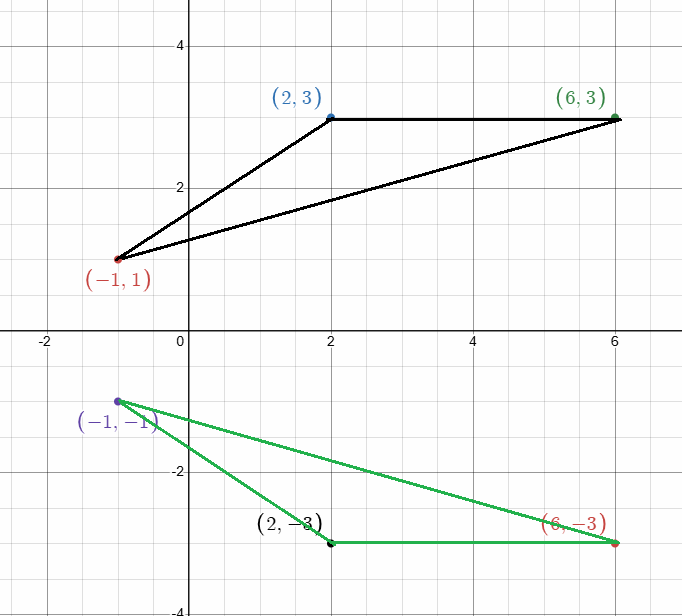
The vertices of a triangle are A (−1, 1), B (2, 3), and C (6, 3). Draw this triangle and its reflection in the x-axis. What are the coordinates of the image?
Solution :
Reflection across x-axis,
(x, y) ==> (x, -y)
A (−1, 1) ==> A'(-1, -1)
B (2, 3) ==> B'(2, -3)
C (6, 3) ==> C' (6, -3)
Subscribe to our ▶️ YouTube channel 🔴 for the latest videos, updates, and tips.
Recent Articles


-
Finding Range of Values Inequality Problems
May 21, 24 08:51 PM
Finding Range of Values Inequality Problems -
Solving Two Step Inequality Word Problems
May 21, 24 08:51 AM
Solving Two Step Inequality Word Problems -
Exponential Function Context and Data Modeling
May 20, 24 10:45 PM
Exponential Function Context and Data Modeling