PRACTICE PROBLEMS ON PROBABILITY
Subscribe to our ▶️ YouTube channel 🔴 for the latest videos, updates, and tips.
Problem 1 :
An urn contains 12 balls :
3 Red, 5 Yellow and 4 Black
A- In this part we draw successfully and without replacement 3 balls from this urn.
Calculate the probability of the following :
D : the three balls are red.
E : the 3 balls have the same color.
F1 : the 3 balls red, Yellow, Black in this order .
F2 : the 3 balls are have different color.
G1: If the 3 balls are Red Red Black in this order.
G2 : If the 3 balls are 2 red and 1 Black.
H : If the 3 balls don't have the same color.
Solution :
Total number of balls = 3 Red + 5 Yellow + 4 Black
D : the three balls are red.
Three balls are red,
3C3 = 1
Doing simplification, we get
= 1/220
E : the 3 balls have the same color.
F1 : the 3 balls Red, Yellow, Black in this order.
P(RYB) = P(R) x P(Y) x P(B)
= (3/12) x (5/11) x (4/10)
= 1/22
F2 : the 3 balls are have different color.
G1: If the 3 balls are Red Red Black in this order.
P(RRB) = P(R) x P(R) x P(B)
= (3/12) x (2/11) x (4/10)
= 1/55
G2 : If the 3 balls are 2 red and 1 Black.
= (3C2 x 4C1)/12C3
= (3x4)/220
= 3/44
H : If the 3 balls don't have the same color.
= 1 - Probability of same color
= 1 - (3/44)
= 41/44
Problem 2 :
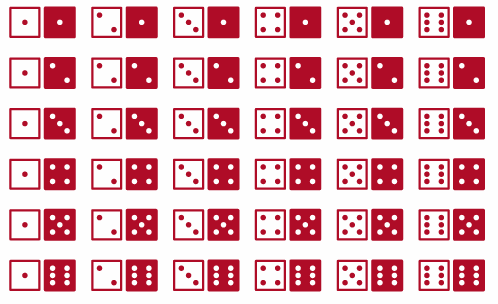
When two six-sided dice are rolled, there are 36 possible outcomes, as shown. Find the probability of each event.
a. The sum is not 6
b. The sum is less than or equal to 9.
Solution :
Total number of outcomes n(S) = 36
Let A be the event of getting 6 in the die.
a) Number of times getting the sum as 6
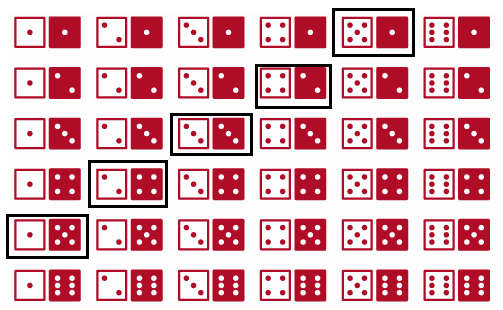
n(A) = 5
P(A) = n(A)/n(S)
= 5/36
P(A') = 1 - (5/36)
= (36 - 5)/36
= 31/36
b) Let B be the event of getting the number greater than 9
Then B' be the event of getting the output less than or equal to 9.
The possible value of B are = 10, 11, 12
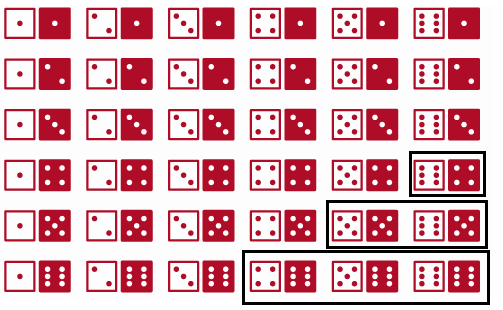
n(B) = 6
P(B) = n(B)/n(S)
= 6/36
= 1/6
P(B') = 1 - 1/6
= 5/6
Problem 3 :
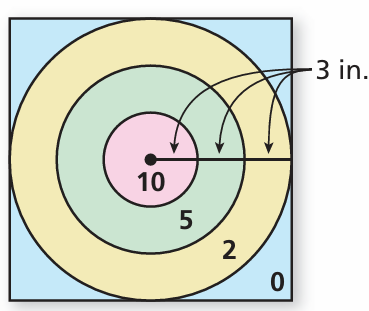
You throw a dart at the board shown. Your dart is equally likely to hit any point inside the square board. Are you more likely to get 10 points or 0 points?
Solution :
Area of circle = πr2
Side length of the square = 18 inches
Area of square = 182
= 324
Area of yellow portion = Area of large circle - area of green circle
Radius of yellow circle = 9 inches
Radius of green circle = 6 inches
Radius of pink circle = 3 inches
Area of pink portion = π(32)
= 9π
= 9(3.14)
= 28.26
Probability of getting 10 points = 28.26/324
= 0.087222....
Approximately 0.0873
Probability of getting 0 points = Area of square - area of yellow portion
= [324 - π(92)]/324
= [324 - 81(3.14)]/324
= [324 - 254.34]/324
= 69.66/324
= 0.215
0.215 > 0.0873
So, you are more likely to get 0 points.
Problem 4 :
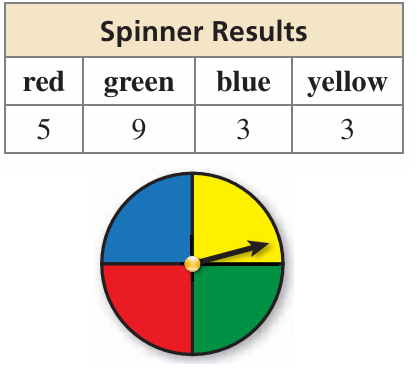
Each section of the spinner shown has the same area. The spinner was spun 20 times. The table shows the results. For which color is the experimental probability of stopping on the color the same as the theoretical probability?
Solution :
Total = 5 + 9 + 3 + 3
= 20
From the table :
Probability of getting yellow = 3/20
Probability of getting blue = 3/20
Probability of getting red = 5/20 ==> 1/4
Probability of getting green = 9/20
For experimental probability :
Probability of getting yellow = 1/4
Probability of getting blue = 1/4
Probability of getting red = 1/4
Probability of getting green = 1/4
So, the probability of getting red using experimental and theoretical are the same.
Problem 5 :
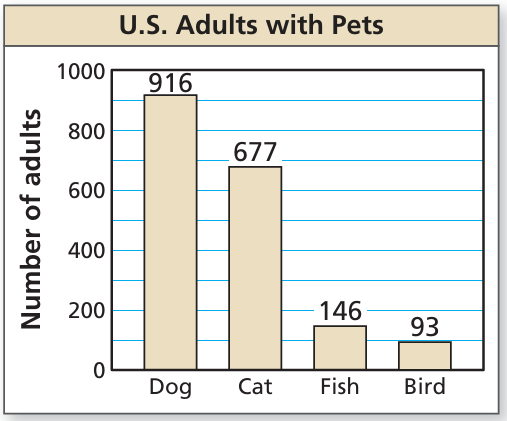
In the United States, a survey of 2184 adults ages 18 and over found that 1328 of them have at least one pet. The types of pets these adults have are shown in the fi gure. What is the probability that a pet-owning adult chosen at random has a dog?
Solution :
The number of trials is the number of pet-owning adults, 1328. A success is a pet-owning adult who has a dog. From the graph, there are 916 adults who said that they have a dog.
P(pet-owning adult has a dog) = 916/1328
= 229/332
= 0.689
Converting into percent, we get
= 0.689 x 100%
= 68.9
≈ 0.690
The probability that a pet-owning adult chosen at random has a dog is about 69%.
Subscribe to our ▶️ YouTube channel 🔴 for the latest videos, updates, and tips.
Recent Articles


-
Finding Range of Values Inequality Problems
May 21, 24 08:51 PM
Finding Range of Values Inequality Problems -
Solving Two Step Inequality Word Problems
May 21, 24 08:51 AM
Solving Two Step Inequality Word Problems -
Exponential Function Context and Data Modeling
May 20, 24 10:45 PM
Exponential Function Context and Data Modeling