PRACTICE PROBLEMS ON LINEAR EQUATIONS
Subscribe to our ▶️ YouTube channel 🔴 for the latest videos, updates, and tips.
Problem 1 :
If 6 = 2x + 4y, what is the value of x + 2y is
(a) 2 (b) 3 (c) 6 (d) 8
Solution :
6 = 2x + 4y
Dividing by 2 on both sides, we get
3 = x + 2y
So, option b is correct.
Problem 2 :
Solve for y in the equation
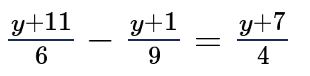
and the value of y is.
(a) -1 (b) 7 (c) 1 (d) -1/7
Solution :
(y + 11)/6 - (y + 1)/9 = (y + 7)/4
By making the denominators same, the least common multiple of 6 and 9 is 18.
[3(y + 11) - 2(y + 1)]/18 = (y + 7)/4
(3y + 33 - 2y - 2)/18 = (y + 7)/4
(y + 31)/18 = (y + 7)/4
4(y + 31) = 18(y + 7)
4y + 124 = 18y + 126
4y - 18y = 126 - 124
-14y = 2
y = -2/14
y = -1/7
So, option d is correct.
Problem 3 :
Pick up the correct value x for which
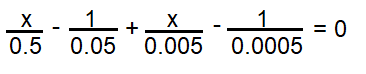
(a) x = 0 (b) x = 1 (c) x = 10 (d) None of these
Solution :
x/0.5 - 1/0.05 + x/0.005 - 1/0.0005 = 0
x/0.5 + x/0.005 = 1/0.05 + 1/0.0005
To remove the decimal which is at the denominator, based on the number of digits we have at the denominator we have to multiply both numerator and denominator by 10, 100, 1000., ..... etc
10x/5 + 1000x/5 = 100/5 + 10000/5
Now the denominators are becoming the same.
10x + 1000x = 100 + 10000
1010x = 10100
x = 10100/1010
x = 10
So, option c is correct.
Problem 4 :
The denominator of the fraction exceed the numerator by 5 and if 3 be added to both the fraction becomes 3/4. Find the fraction.
(a) 12/17 (b) 15/17 (c) 12/25 (d) 13/29
Solution :
Let x/x + 5 be the required fraction.
(x + 3)/[(x + 5) + 3] = 3/4
(x + 3)/(x + 8) = 3/4
4(x + 3) = 3(x + 8)
4x + 12 = 3x + 24
4x - 3x = 24 - 12
x = 12
x + 5 = 17
So, the required fraction is 12/17.
Problem 5 :
Three persons Mr. Roy, Mr Paul and Mr. Singh together have $51. Mr Paul has $4 less than Mr Roy and Mr. Singh has got $5 less than Mr.Roy. They have the money as
(a) (20, 16, 15) (b) (15, 20, 16) (c) (25, 11, 15)
Solution :
Let R, P and S be the amount that Mr. Roy, Mr Paul and Mr. Singh has respectively.
R + P + S = 51
P = R - 4
S = R - 5
Applying the value of P and S, we get
R + R - 4 + R - 5 = 51
3R - 9 = 51
3R = 51 + 9
3R = 60
R = 60/3
R = 20
P = 20 - 4 ==> 16
S = 20 - 5 ==> 15
The amount Mr.Roy has is 20, Mr.Paul has 16 and Mr. Singh has 15.
So, option a is correct.
Problem 6 :
A number consists of two digits. The digits in the ten's place is 3 times the digit in the unit's place. If 54 is subtracted from the number the digits are reversed. The number is
(a) 39 (b) 92 (c) 93 (d) 94
Solution :
Let xy be the two digit number.
x = 3y
Expanded form of xy = x + 10y
xy - 54 = yx
10x + 1y - 54 = 10y + x
10x - x + 1y - 10y = 54
9x - 9y = 54
x - y = 6
Applying the value of x, we get
3y - y = 6
2y = 6
y = 3
x = 3(3) ==> 9
So, the required number is 93, option c is correct.
Problem 7 :
The number consists of two digits, the digit in the ten's place is twice the digit in the unit's place. If 18 be subtracted from the number the digits are reversed. Find the number
(a) 42 (b) 24 (c) 33 (d) 61
Solution :
Let xy be the two digit number.
x = 2y --------(1)
xy - 18 = yx
10x + y - 18 = 10y + x
10x - x + y - 10y = 18
9x - 9y = 18
x - y = 2 --------(2)
Applying the value of x, we get
2y - y = 2
y = 2
x = 2(2)
x = 4
So, the required number is 42, option a is correct.
Problem 8 :
Solving 4x⋅2y = 128 and 33x+2y = 9xy, we get the following roots.
(a) 7/4, 7/2 (b) 2, 3 (c) 1, 2) (d) 1, 3
Solution :
4x⋅2y = 128
(22)x⋅2y = 128
22x+y = 128
22x+y = 27
2x + y = 7
y = 7 - 2x --------(1)
33x+2y = (32)xy
33x+2y = 32xy
3x + 2y = 2xy --------(2)
Applying the value of y in (2), we get
3x + 2(7 - 2x) = 2x(7 - 2x)
3x + 14 - 4x = 14x - 4x2
4x2 - 4x - 14x + 3x + 14 = 0
4x2 - 15x + 14 = 0
4x2 - 8x - 7x + 14 = 0
4x(x - 2) - 7(x - 2) = 0
(4x - 7)(x - 2) = 0
x = 7/4 and x = 2
|
x = 7/4 y = 7 - 2(7/4) = 7 - (7/2) = (14 - 7)/2 = 7/2 |
x = 2 y = 7 - 2(2) = 7 - 4 = 3 |
The roots are 7/4, 7/2, 2 and 3. Option and b are correct.
Problem 9 :
Solving 9x = 3y and 5x+y+1 = 25xy, we get the following roots.
(a) 1, 2 (b) 0, 1 (c) 0, 3 (d) 1, 3
Solution :
9x = 3y and 5x+y+1 = 25xy
(32)x = 3y
32x = 3y
2x = y
y = 2x --------(1)
5x+y+1 = 52xy
x + y + 1 = 2xy
Applying the value of y, we get
x + 2x + 1 = 2x(2x)
3x + 1 = 4x2
4x2 - 3x - 1 = 0
(4x + 1)(x - 1) = 0
x = -1/4 and x = 1
When x = -1/4, y = 2(-1/4) ==> -1/2
When x = 1, y = 2(1) ==> 2
So, option a is correct.
Problem 10 :
Solving 9x + 3y - 4z = 3, x + y - z = 0 and 2x - 5y - 4z = -20 the following roots obtained.
(a) 2, 3, 4 (b) 1, 3, 4 (c) 1, 2, 3 (d) None
Solution :
9x + 3y - 4z = 3 -------(1)
x + y - z = 0 ---------(2)
2x - 5y - 4z = -20 -------------(3)
(1) - 4(2) ==> 9x + 3y - 4z - 4x - 4y + 4z = 3 - 0
5x - y = 3 ----(4)
(1) - (3)
9x + 3y - 4z - 2x + 5y + 4z = 3 + 20
7x + 8y = 23 ----(5)
8 (4) + (5) ==> 40x - 8y + 7x + 8y = 24 + 23
47x = 47
x = 1
Applying x = 1 in (4), we get
5(1) - y = 3
5 - y = 3
y = 5 - 3
y = 2
Applying x = 1 and y = 2 in (2), we get
1 + 2 - z = 0
z = 3
(x, y, z) ==> (1, 2, 3)
So, option c is correct.
Subscribe to our ▶️ YouTube channel 🔴 for the latest videos, updates, and tips.
Recent Articles


-
Finding Range of Values Inequality Problems
May 21, 24 08:51 PM
Finding Range of Values Inequality Problems -
Solving Two Step Inequality Word Problems
May 21, 24 08:51 AM
Solving Two Step Inequality Word Problems -
Exponential Function Context and Data Modeling
May 20, 24 10:45 PM
Exponential Function Context and Data Modeling