MULTIPLYING BINOMIALS WITH RADICALS
Subscribe to our ▶️ YouTube channel 🔴 for the latest videos, updates, and tips.
To multiply binomials, we follow
i) Distributive property
ii) algebraic identity
Problem 1 :
(√5 - 2 ) (√5 + 2)
Solution :
i) Using distributive property, multiplying binomials.
(√5 - 2) (√5 + 2)
Multiply the first term by the first term
Multiply the first term by the outer term
Multiply the second term by first term
Multiply the second term by second term
Simplify the like terms.
= (√5)2 + 2√5 - 2√5 - 4
= 5 - 4
= 1
ii) Using distributive property, multiplying binomials.
= (√5 - 2) (√5 + 2)
= (√5)2 - 22
= 5 - 4
= 1
Expand and simplify :
Problem 1 :
(4 + √3) (4 - √3)
Solution :
(4 + √3) (4 - √3)
= 4(4) - 4√3 + 4√3 - (√3)2
= 16 - 3
= 13
Problem 2 :
(5 - √2) (5 + √2)
Solution :
(5 - √2) (5 + √2)
= 5(5) + 5√2 - 5√2 - (√2)2
= 25 - 2
= 23
Problem 3 :
(√5 - 2 ) (√5 + 2)
Solution :
(√5 - 2) (√5 + 2)
= (√5)2 + 2√5 - 2√5 - 4
= 5 - 4
= 1
Problem 4 :
(√7 + 4 ) (√7 - 4)
Solution :
(√7 + 4) (√7 - 4)
= (√7)2 - 4√7 + 4√7 - 16
= 7 - 16
= -9
Problem 5 :
(3√2 + 2 ) (3√2 - 2)
Solution :
(3√2 + 2) (3√2 - 2)
= 32(√2)2 - 6√2 + 6√2 - 4
= 18 - 4
= 14
Problem 6 :
(2√5 - 1 ) (2√5 + 1)
Solution :
(2√5 - 1) (2√5 + 1)
= 22(√5)2 + 2√5 - 2√5 - 1
= 20 - 1
= 19
Problem 7 :
(5 - 3√3) (5 + 3√3)
Solution :
(5 - 3√3) (5 + 3√3)
= 5(5) + 15√3 - 15√3 - 9(√3)2
= 25 - 27
= -2
Problem 8 :
(2 - 4√2) (2 + 4√2)
Solution :
(2 - 4√2) (2 + 4√2)
= 2(2) + 8√2 - 8√2 - 16(√2)2
= 4 - 32
= -28
Problem 9 :
(1 + 5√7) (1 - 5√7)
Solution :
(1 + 5√7) (1 - 5√7)
= 1(1) - 5√7 + 5√7 - 25(√7)2
= 1 - 175
= -174
Problem 10 :
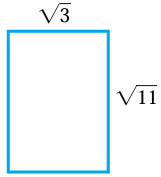
Find the area of the rectangle shown in the figure
Solution :
Area of rectangle = length x width
Length = √11 and width = √3
Area of rectangle = √11 (√3)
= √(11 x 3)
= √33 square units.
Problem 11 :
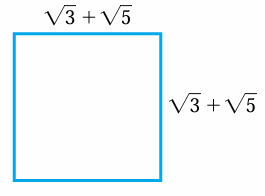
Find the area of the rectangle shown in the figure
Solution :
By looking at the measures, they are the same it must be a square
Area of square = side (side)
Side length = √3 + √5
= (√3 + √5) (√3 + √5)
= √32 + √3√5 + √5√3 + √52
= √32 + √3√5 + √5√3 + √52
= 3 + √15 + √15 + 5
= 8 + 2√15
Problem 12 :
Complete the statement √2 √5 = √10 because
Solution :
√2 √5 = √10
Using the properties of radicals, when two quantities are multiplied then the product of them will be equal to them separately will be equal to the square root of product of those two.
√a x √b = √(a x b)
√a x √b = √ab
So, the given statement is true.
Problem 13 :
Complete the statement 2√3 + 5√3 = 7√3 but 7√3 + 3√5 ≠ 10√8
Solution :
2√3 + 5√3 = 7√3
Here these are like radicals, we may add them. Considering 7√3 and 3√5 the numerals inside the square root are not the same, so they are not like radicals, we cannot add them.
7√3 + 3√5 ≠ 10√8
So, we cannot add them.
Problem 14 :
The radius r of a sphere is given by
r = 3 √(3/4π) V
where V is the volume of the sphere. Estimate the volume of a spherical head of brain coral with a radius of 1.5 feet.
Solution :
r = 3 √(3/4π) V
Here r = 1.5 feet
1.5 = 3 √(3/4π) V
Raising power 3 on both sides, we get
(1.5)3 = (3/4π) V
V = 3.375(4π/3)
V = 14.13
Problem 15 :
The mean sustained wind velocity (in meters per second) of a hurricane is modeled by
v( p) = 6.3 √(1013 − p)
where p is the air pressure (in millibars) at the center of the hurricane. Estimate the air pressure at the center of the hurricane when the mean sustained wind velocity is 54.5 meters per second.
Solution :
v(p) = 6.3 √(1013 − p)
v(p) = 54.5 meter per second
54.5 = 6.3 √(1013 − p)
√(1013 − p) = 54.5/6.3
√(1013 − p) = 8.65
1013 - p = (8.65)2
1013 - p = 74.82
p = 1013 - 74.82
p = 938.17
Problem 16 :
The maximum speed v (in meters per second) of a trapeze artist is represented by
v = √2gh
where g is the acceleration due to gravity (g ≈ 9.8 m/sec2) and h is the height (in meters) of the swing path. Find the height of the swing path for a performer whose maximum speed is 7 meters per second.
Solution :
v = √2gh
Here g = 9.8 and v = 7
7 = √2(9.8)h
49 = 19.6h
h = 49/19.6
h = 2.5
Subscribe to our ▶️ YouTube channel 🔴 for the latest videos, updates, and tips.
Recent Articles


-
Finding Range of Values Inequality Problems
May 21, 24 08:51 PM
Finding Range of Values Inequality Problems -
Solving Two Step Inequality Word Problems
May 21, 24 08:51 AM
Solving Two Step Inequality Word Problems -
Exponential Function Context and Data Modeling
May 20, 24 10:45 PM
Exponential Function Context and Data Modeling