HOW TO TRANSLATE A SHAPE BY A VECTOR
Subscribe to our ▶️ YouTube channel 🔴 for the latest videos, updates, and tips.
A translation of a figure occurs when every point on that is moved the same distance in the same direction.
We can give details of a translation by using a translation vector.
In the vector given,
- the top value represents the horizontal moves.
- the bottom value represents the vertical moves.
Horizontal moves :
- positive (+) means ==> Move right
- Negative (-) means ==> Move left
Vertical moves :
- positive (+) means ==> Move up
- Negative (-) means ==> Move down
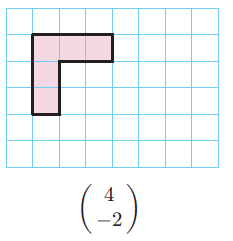
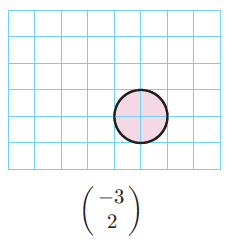
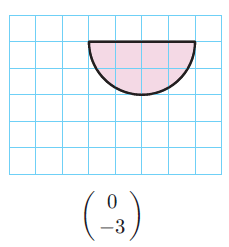
Translate the figures using given vector.
Example 1 :
Solution :
The first value is 4, means move the point 4 units right.
The second value is -2, means move the point 2 units down.

Example 2 :
Solution :
The first value is -3, means move the point 3 units left.
The second value is 2, means move the point 2 units up.

Example 3 :
Solution :
The first value is 0, means don't have to move horizontally.
The second value is -3, means move the point 3 units down.
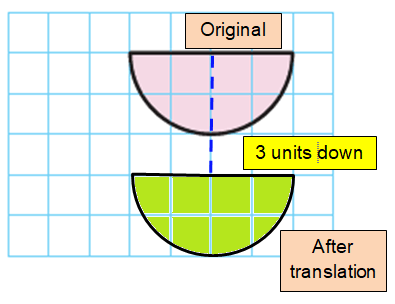
Example 4 :
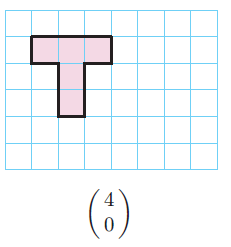
Solution :
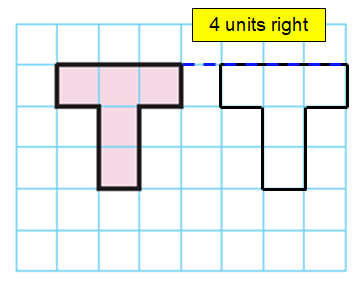
The first value is 4, means move the point 4 units right.
The second value is 0, means don't have to move vertically.
Example 5 :
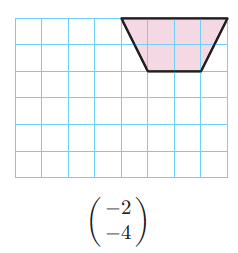
Solution :
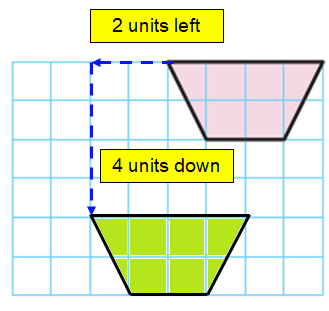
The first value is -2, means move the point 2 units left.
The second value is -4, means move the point 4 units down.
Example 6 :
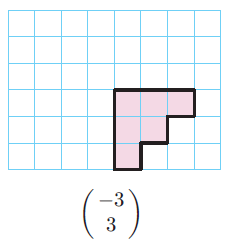
Solution :
The first value is -3, means move the point 3 units left.
The second value is 3, means move the point 3 units up.
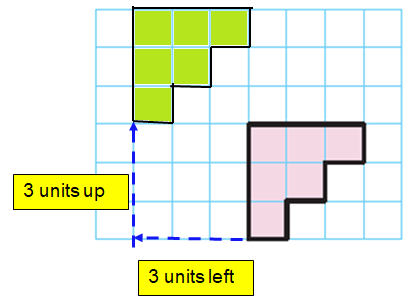
Example 7 :
What translation vector moves Q to P ?
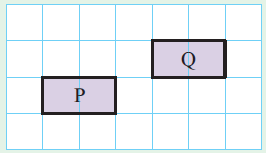
Solution :
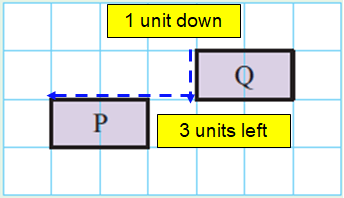
By observing the vertex, moving 1 unit down and 3 units to the left we get the new rectangle.
So, the translation vector is
Example 8 :
Plot these coordinates to reveal a shape :
(-3, -1) (-3, -2) (1, -1) and (1, -2)
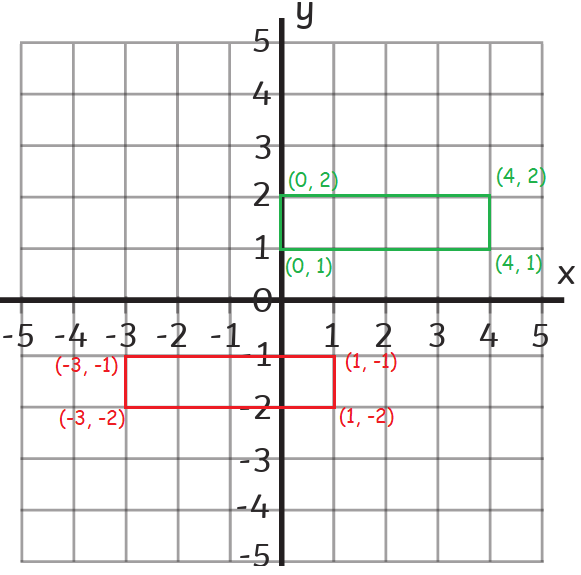
Translate the shape right 3 and up 3.
What are the coordinates of the new shape ?
Solution :
Given points are, (-3, -1) (-3, -2) (1, -1) and (1, -2)
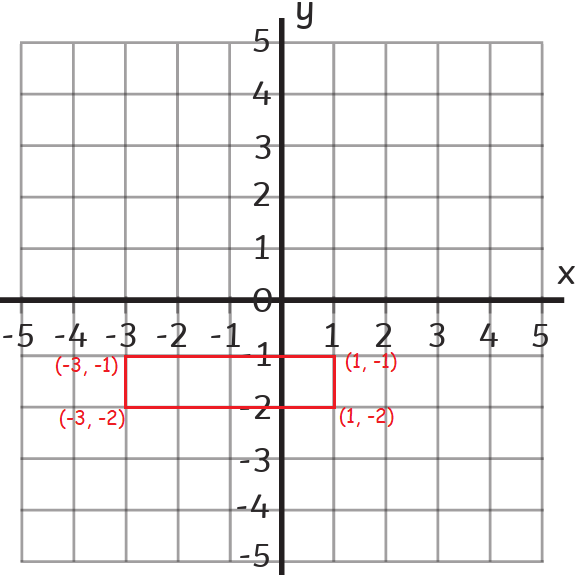
The shape is the rectangle, after doing the translation also we will get the same shape.
Translating each coordinate 3 units right and 3 units up, we get
- (x, y) ==> (x + 3, y + 3)
- (-3, -1) ==> (-3 + 3, -1 + 3) ==> (0, 2)
- (-3, -2) ==> (-3 + 3, -2 + 3) ==> (0, 1)
- (1, -1) ==> (1 + 3, -1 + 3) ==> (4, 2)
- (1, -2) ==> (1 + 3, -2 + 3) ==> (4, 1)
Example 9 :
Plot these coordinates to reveal a shape :
(2, 1) (4, 1) (0, -3) and (0, -1)
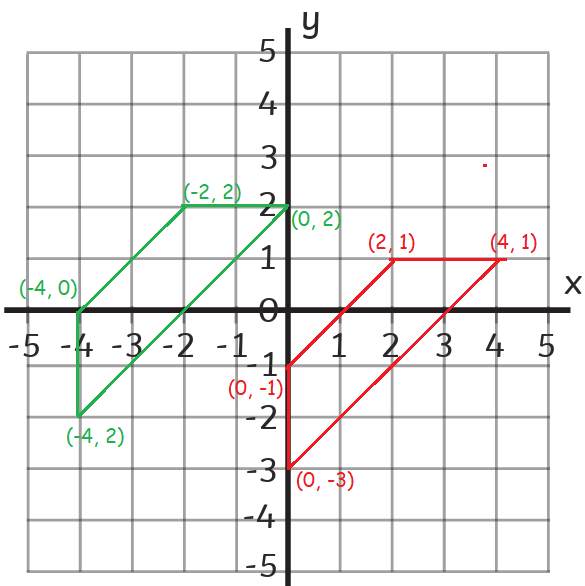
Translate the shape left 4 and up 1
What are the coordinates of the new shape ?
Solution :
Given points are, (2, 1) (4, 1) (0, -3) and (0, -1)
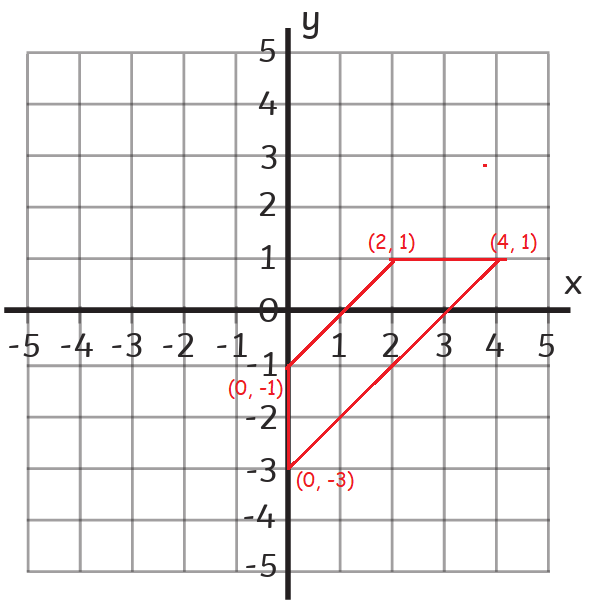
The shape is the trapezium, after doing the translation also we will get the same shape.
Translating each coordinate 4 units left and 1 unit up, we get
- (x, y) ==> (x - 4, y + 1)
- (2, 1) ==> (2 - 4, 1 + 1) ==> (-2, 2)
- (4, 1) ==> (4 - 4, 1 + 1) ==> (0, 2)
- (0, -1) ==> (0 - 4, -1 + 1) ==> (-4, 0)
- (0, -3) ==> (0 - 4, -3 + 1) ==> (-4, -2)
Example 10 :
Describe the positions and translations of the 2D shapes
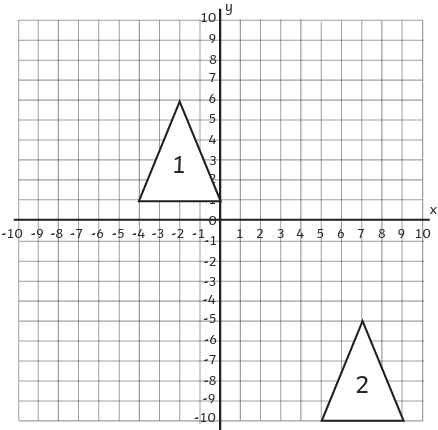
a) Starting coordinates
b) Translation
c) Finishing coordinates
Solution :
a) Starting coordinates are
(-2, 6) (-4, 1) and (0, 1)
b) Translation
9 units to the right and 11 units down
(x, y) ==> (x + 9, y - 11)
c) Finishing coordinates
- (-2, 6) ==> (-2 + 9, 6 - 11) ==> (7, -5)
- (-4, 1) ==> (-4 + 9, 1 - 11) ==> (5, -10)
- (0, 1) ==> (0 + 9, 1 - 11) ==> (9, -10)
Example 11 :
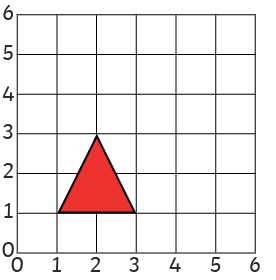
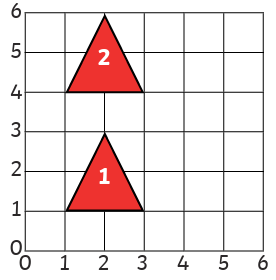
This equilateral triangle is translated up 3.
Draw the triangle in its new position.
Solution :
The coordinates of the triangle given are
(2, 3) (1, 1) and (3, 1)
After translating up for 3 units, we get
- (2, 3) ==> (2, 3 + 3) ==> (2, 6)
- (1, 1) ==> (1, 1 + 3) ==> (1, 4)
- (3, 1) ==> (3, 1 + 3) ==> (3, 4)
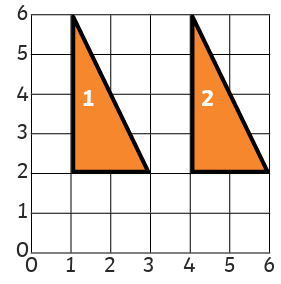
Example 12 :
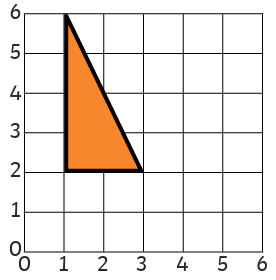
The right angled triangle is translated right 3 units
Draw the triangle in its new position.
Solution :
The coordinates of the triangle given are
(1, 2) (1, 6) and (3, 2)
After translating right for 3 units, we get
- (1, 2) ==> (1 + 3, 2) ==> (2, 6)
- (1, 6) ==> (1 + 3, 6) ==> (4, 6)
- (3, 2) ==> (3 + 3, 2) ==> (6, 2)
Subscribe to our ▶️ YouTube channel 🔴 for the latest videos, updates, and tips.
Recent Articles


-
Finding Range of Values Inequality Problems
May 21, 24 08:51 PM
Finding Range of Values Inequality Problems -
Solving Two Step Inequality Word Problems
May 21, 24 08:51 AM
Solving Two Step Inequality Word Problems -
Exponential Function Context and Data Modeling
May 20, 24 10:45 PM
Exponential Function Context and Data Modeling