HOW TO MULTIPLY BINOMIAL RADICAL EXPRESSIONS
Subscribe to our ▶️ YouTube channel 🔴 for the latest videos, updates, and tips.
Before using distributive property with radical expressions, we should be aware of
- How to multiply radical terms by a constant
- How to multiply the two different radicands
- How to multiply same radicands.
Like radicals :
If the radicands are same with the same index, then we call it as like radicals. We can combine only like radicals.
Unlike radicals :
- Radicands are same, index are not same.
- Index are same, radicands are not same.
we call it as unlike radicals.
Expand and simplify :
Problem 1 :
(1 + √2) (2 + √2)
Solution :
(1 + √2) (2 + √2)
= 1 ⋅ 2 + 1√2 + 2√2 + √2 ⋅ √2
= 2 + 3√2 + 2
= 4 + 3√2
Problem 2 :
(2 + √3) (3 + √3)
Solution :
(2 + √3) (3 + √3)
= 2 ⋅ 3 + 2√3 + 3√3 + √3 ⋅ √3
= 6 + 5√3 + 3
= 9 + 5√3
Problem 3 :
(√3 + 2) (√3 – 1)
Solution :
(√3 + 2) (√3 – 1)
= √3 ⋅ √3 - √3 ⋅ 1 + 2√3 – 2
= 3 - √3 + 2√3 – 2
= 1 + √3
Problem 4 :
(4 - √2) (3 + √2)
Solution :
(4 - √2) (3 + √2)
= 4 ⋅ 3 + 4√2 - 3√2 - √2 ⋅ √2
= 12 + √2 – 2
= 10 + √2
Problem 5 :
(1 + √3) (1 - √3)
Solution :
(1 + √3) (1 - √3)
= (1)2 – (√3)2
= 1 – 3
= -2
Problem 6 :
(5 + √7) (2 - √7)
Solution :
(5 + √7) (2 - √7)
= 5 ⋅ 2 – 5√7 + 2√7 - √7 ⋅ √7
= 10 - 3√7 – 7
= 3 - 3√7
Problem 7 :
(√5 + 2) (√5 – 3)
Solution :
(√5 + 2) (√5 – 3)
= √5 ⋅√5 - √5 ⋅ 3 + 2 ⋅√5 – 6
= 5 - 3√5 + 2√5 – 6
= -1 - √5
Problem 8 :
(6 - √3) (2 + √3)
Solution :
(6 - √3) (2 + √3)
= 6 ⋅ 2 + 6√3 - 2√3 - √3 ⋅√3
= 12 + 4√3 – 3
= 9 + 4√3
Problem 9 :
(4 - √2) (3 - √2)
Solution :
(4 - √2) (3 - √2)
= 4 ⋅ 3 – 4√2 - 3√2 + √2 ⋅√2
= 12 - 7√2 + 2
= 14 - 7√2
Problem 10 :
(4 - 3√3) (2 - √3)
Solution :
(4 - 3√3) (2 - √3)
= 4 ⋅ 2 - 4√3 - 3√3 ⋅ 2 + 3√3 ⋅√3
= 8 - 4√3 - 6√3 + 3 ⋅ 3
= 8 - 10√3 + 9
= 17 - 10√3
Problem 11 :
(-1 + 2√2) (2 - √2)
Solution :
(-1 + 2√2) (2 - √2)
= -1 ⋅ 2 + 1 ⋅ √2 + 2√2 ⋅ 2 - 2√2 ⋅√2
= -2 + √2 + 4√2 – 2 ⋅ 2
= -2 + 5√2 – 4
= -6 + 5√2
Problem 12 :
(2√2 + 3) (2√2 + 5)
Solution :
(2√2 + 3) (2√2 + 5)
= 2√2 ⋅ 2√2 + 2√2 ⋅ 5 + 3 ⋅ 2√2 + 3 ⋅ 5
= 2 ⋅ 2 ⋅√2 ⋅ √2 + 2 ⋅ 5√2 + 3 ⋅ 2√2 + 3 ⋅ 5
= 4 ⋅ 2 + 10√2 + 6√2 + 15
= 8 + 10√2 + 6√2 + 15
= 23 + 16√2
Problem 13 :
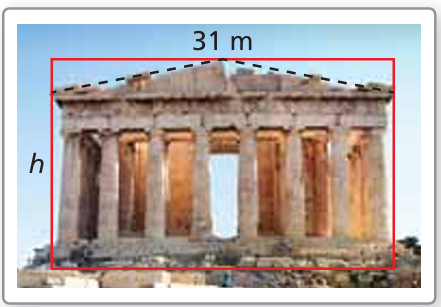
The ratio of the length to the width of a golden rectangle is (1 + √5) : 2. The dimensions of the face of the Parthenon in Greece form a golden rectangle. What is the height h of the Parthenon?
Solution :
Think of the length and height of the Parthenon as the length and width of a golden rectangle. The length of the rectangular face is 31 meters. You know the ratio of the length to the height. Find the height h.
(1 + √5) : 2 = 31 : h
(1 + √5) / 2 = 31 / h
Doing cross multiplication, we get
h(1 + √5) = 31(2)
h = 62/(1 + √5)
Multiplying both numerator and denominator by the conjugate of the denominator, we get
= 62/(1 + √5) ⋅ [(1 - √5) / (1 - √5)]
= 62(1 - √5)/(1 + √5)(1 - √5)
= 62(1 - √5)/(12 - √52)
= 62(1 - √5)/(-4)
= -15.5(1 - √5)
= -15.5(1 - 2.23)
= 15.5(1.23)
= 19.06
Problem 14 :
A rectangular walkway is √5 ft wide and 8√5 ft long. Find the perimeter of the walkway.
Solution :
Length = 8√5 ft and width = √5 ft
Perimeter of walkway = 2(length + width)
= 2(8√5 + √5)
= 2(9 √5)
= 18 √5 ft
So, the perimeter is 18 √5 ft.
Problem 15 :
The process of eliminating a radical from the denominator of a radical expression is called _______________.
Solution :
The process of eliminating a radical from the denominator of a radical expression is called rationalizing the denominator.
Subscribe to our ▶️ YouTube channel 🔴 for the latest videos, updates, and tips.
Recent Articles


-
Finding Range of Values Inequality Problems
May 21, 24 08:51 PM
Finding Range of Values Inequality Problems -
Solving Two Step Inequality Word Problems
May 21, 24 08:51 AM
Solving Two Step Inequality Word Problems -
Exponential Function Context and Data Modeling
May 20, 24 10:45 PM
Exponential Function Context and Data Modeling