HOW TO FIND THE VALUE OF UNKNOWN IN SIMILAR FIGURES
Subscribe to our ▶️ YouTube channel 🔴 for the latest videos, updates, and tips.
If two shapes are similar, their corresponding angles are congruent and their corresponding sides are proportional.
- If two shapes are similar, the ratio of their corresponding sides will be equal.
- Their perimeters are proportional to the measures of the corresponding sides.
- Their areas are proportional to the measures of square of their corresponding sides.
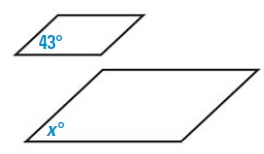
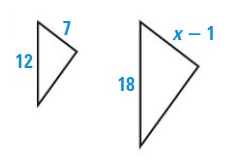
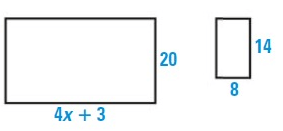
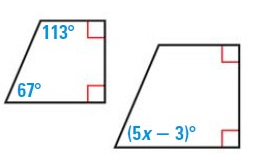
The two polygons are similar. Find the value of x.
Problem 1 :
Solution :
The two polygons are similar.
x = 43
Problem 2 :
Solution :
The two polygons are similar.
12/18 = 7/(x - 1)
Using cross multiplication.
12(x – 1) = 18(7)
12x - 12 = 126
12x = 126 + 12
12x = 138
x = 11.5
Problem 3 :
Solution :
The two polygons are similar.
(4x + 3)/8 = 20/14
Using cross multiplication.
14(4x + 3) = 20(8)
56x + 42 = 160
Subtracting 42
56x = 160 - 42
56x = 118
x = 118/52
x = 2.27
Problem 4 :
Solution :
The two polygons are similar.
67º = (5x – 3)º
67 + 3 = 5x
70 = 5x
x = 14
Problem 5 :
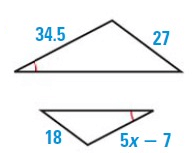
Solution :
The two polygons are similar.
27/18 = 34.5/(5x - 7)
27(5x - 7) = 34.5(18)
135x - 189 = 621
135x = 621 + 189
135x = 810
x = 810/135
x = 6
Problem 6 :
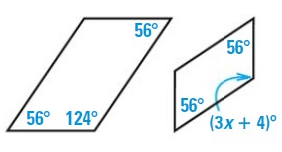
Solution :
The two polygons are similar.
124º = (3x + 4)º
124 – 4 = 3x
120 = 3x
x = 120/3
x = 40
Problem 7 :
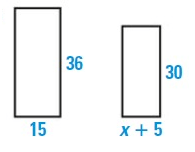
Solution :
The two polygons are similar.
36/30 = 15/(x + 5)
Using cross multiplication.
36(x + 5) = 30 × 15
36x + 180 = 450
Subtracting 180 on both sides.
36x = 450 – 180
36x = 270
x = 7.5
Problem 8 :
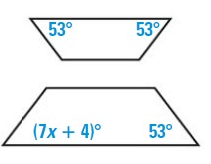
Solution :
The two polygons are similar.
(7x + 4)º = 53º
7x = 53 – 4
7x = 49º
x = 49/7
x = 7
Problem 9 :
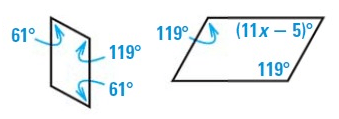
Solution :
The two polygons are similar.
61º= (11x – 5)º
61 + 5 = 11x
66 = 11x
66/11 = x
x = 6
Problem 10 :
Figure A has a perimeter of 60 inches and one of the side lengths is 5 inches. Figure B has a perimeter of 84 inches. Find the missing corresponding side length.
Solution :
Let x be the missing side.
Side length of figure A : side length of figure B = Perimeter of figure A : perimeter of figure B
5 : x = 60 : 84
5/x = 60/84
60x = 5(84)
x = 5(84) / 60
x = 7
So, the missing side is 7 inch.
Problem 11 :
Figure A has an area of 4928 square feet and one of the side lengths is 88 feet. Figure B has an area of 77 square feet. Find the missing corresponding side length.
Solution :
Let x be the missing side.
(Side length of figure A : side length of figure B)2 = Area of figure A : Area of figure B
882 : x2 = 4928 : 77
7744 : x2 = 4928 : 77
7744 / x2 = 4928 / 77
4928x2 = 7744(77)
x2 = 7744(77)/4928
x2 = 7744(77)/4928
x2 = 379456
x = √379456
x = 616
So, the measure of missing side is 616 feet.
Problem 12 :
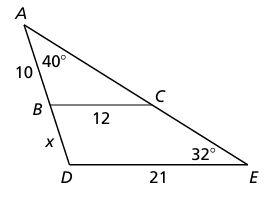
In the diagram triangle ABC ~ triangle ADE
a) Find the scale factor from triangle ABC to ADE
b) Find the value of x
c) Find <ABC
d) The perimeter of triangle ABC is about 42.4 units. Find the perimeter of triangle ADE.
e) The area of triangle ABC is about 71.75 square units. Find the area of triangle ADE
f) Is BC || DE explain your reasoning.
Solution :
In the diagram triangle ABC ~ triangle ADE
a) Comparing the corresponding sides,
AB : AD = AC : AE = BC : DE
The scale factor is 12 : 21
= 12/21
= 4 / 7
= 4 : 7
b)
10 : (10 + x) = 12 : 21
10/(10 + x) = 12/21
21(10) = 12(10 + x)
210 = 120 + 12x
210 - 120 = 12x
90 = 12x
x = 90/12
x = 7.5
c) ∠ABC = ∠ADE
∠ADE = 180 - (40 + 32)
= 180 - 72
∠ADE = 108
∠ABC = 108
d) Perimeter of triangle ABC : Perimeter of triangle ADE = 12 : 21
42.4 : Perimeter of triangle ADE = 12 : 21
42.4/Perimeter of triangle ADE = 12/21
Perimeter of triangle ADE (12) = 42.4(21)
Perimeter of triangle ADE = 42.4(21) / 12
= 74.2
e) The area of triangle ABC = 71.75 square units.
Area of triangle ABC : Area of triangle ADE = 122 : 212
71.75/Area of triangle ADE = 144 / 441
71.75(441) = 144 (Area of triangle ADE)
Area of triangle ADE = 71.75(441) / 144
= 219.73 square units.
f) Since corresponding sides are equal, the sides BC and DE are parallel.
Problem 13 :
ABCDE ~ KLMNP
a) Find the scale factor from ABCDE to KLMNP.
b) Find the scale factor from KLMNP to ABCDE.
c) Find the values of x, y, and z.
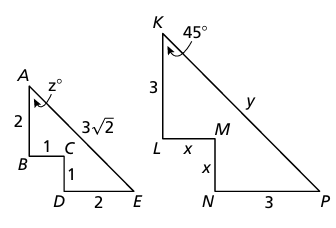
d) Find the perimeter of each polygon.
e) Find the ratio of the perimeters of ABCDE to KLMNP.
f) Find the ratio of the areas of ABCDE to KLMNP.
Solution :
a) The scale factor from ABCDE to KLMNP = 2 : 3
b) The scale factor from KLMNP to ABCDE = 3 : 2
c)
|
2 : 3 = 1 : x 2/3 = 1/x 2x = 3 x = 3/2 |
2 : 3 = 3√2 : y 2/3 = 3√2/y 2y = 3(3√2) y = 9(√2/2) y = 4.5√2 |
z = 45 |
d) Perimeter of polygon ABCDE = 2 + 1 + 1 + 2 + 3√2
= 6 + 3√2
Perimeter of polygon KLMNP = 3 + x + x + 3 + y
= 3 + 3/2 + 3/2 + 3 + 4.5√2
= 9 + 4.5√2
e) Since the corresponding sides is in the ratio 2 : 3, then the perimeter will also be in the same ratio.
f)
Area of ABCDE = Area of triangle - area of square
= (1/2) ⋅ 3 ⋅ 3 - 1 ⋅ 1
= 9/2 - 1
= 4.5 - 1
= 3.5 square units
Area of KLMNP = (1/2) ⋅ 4.5 ⋅ 4 - 3/2 ⋅ 3/2
= 9 - 9/4
= 9 - 2.25
= 6.75 square units
Subscribe to our ▶️ YouTube channel 🔴 for the latest videos, updates, and tips.
Recent Articles


-
Finding Range of Values Inequality Problems
May 21, 24 08:51 PM
Finding Range of Values Inequality Problems -
Solving Two Step Inequality Word Problems
May 21, 24 08:51 AM
Solving Two Step Inequality Word Problems -
Exponential Function Context and Data Modeling
May 20, 24 10:45 PM
Exponential Function Context and Data Modeling