HOW TO FIND THE POINT OF DISCONTINUITY OF A RATIONAL FUNCTION
Subscribe to our ▶️ YouTube channel 🔴 for the latest videos, updates, and tips.
Points of discontinuity, also called removable discontinuities, are moments within a function that are undefined and appear as a break or hole in a graph.
A point of discontinuity is created when a function is presented as a fraction and an inputted variable creates a denominator equal to zero.
Find any points of discontinuity for each rational function.
Problem 1 :
y = (x + 3)/(x – 4) (x + 3)
Solution :
To find points of discontinuity, let us equate the denominators to 0.
y = (x + 3)/(x – 4) (x + 3)
x – 4 = 0
x = 4
x + 3 = 0
x = -3
The function is discontinuous at x = -3 and 4.
Problem 2 :
y = (x - 2)/(x2 – 4)
Solution :
To find point of discontinuity, let us equate the denominator to 0.
y = (x - 2)/(x2 – 4)
x2 – 4 = 0
(x + 2)(x - 2) = 0
x + 2 = 0 and x - 2 = 0
x = -2 and x = 2
The function is discontinuous at x = ±2.
Problem 3 :
y = (x - 3) (x + 1)/(x – 2)
Solution :
To find point of discontinuity, let us equate the denominator to 0.
y = (x - 3) (x + 1)/(x – 2)
x – 2 = 0
x = 2
The function is discontinuous at x = 2.
Problem 4 :
y = 3x(x + 2)/x(x + 2)
Solution :
To find point of discontinuity, let us equate the denominator to 0.
y = 3x(x + 2)/x(x + 2)
x(x + 2) = 0
x = 0, x + 2 = 0
x = -2
The function is discontinuous at x = 0, -2.
Problem 5 :
y = 2/(x + 1)
Solution :
To find point of discontinuity, let us equate the denominator to 0.
y = 2/(x + 1)
x + 1 = 0
x = -1
The function is discontinuous at x = -1.
Problem 6 :
y = 4x/(x3 – 9x)
Solution :
To find point of discontinuity, let us equate the denominator to 0.
y = 4x/(x3 – 9x)
x3 – 9x = 0
x(x2 - 9) = 0
x(x2 - 32) = 0
x(x + 3)(x - 3) = 0
x = 0, x = 3 and x = -3
The function is discontinuous at x = 0, ±3.
Problem 7 :
Check the function
g(x) = (x2 + 7x + 10)/(x - 3)(x + 2)
for discontinuities. Conduct appropriate tests to determine if asymptotes exist at the discontinuity values. State the equations of any asymptotes and the domain of g(x)
Solution :
g(x) = (x2 + 7x + 10)/(x - 3)(x + 2)
Factoring the numerator, we get
= (x + 5)(x + 2)/(x - 3)(x + 2)
Since the common factor is (x + 2), there must be a hole at x = -2.
x - 3 = 0
x = 3
Domain is all real values except -2 and 3.
Problem 8 :
Match the equation of each rational function with the most appropriate graph. Explain your reasoning.
a) y = (x + 4) / (x2 - 3x - 4)
b) y = (x + 4) / (x2 + 5x + 4)
c) y = (x2 + 4x)/(x + 4)
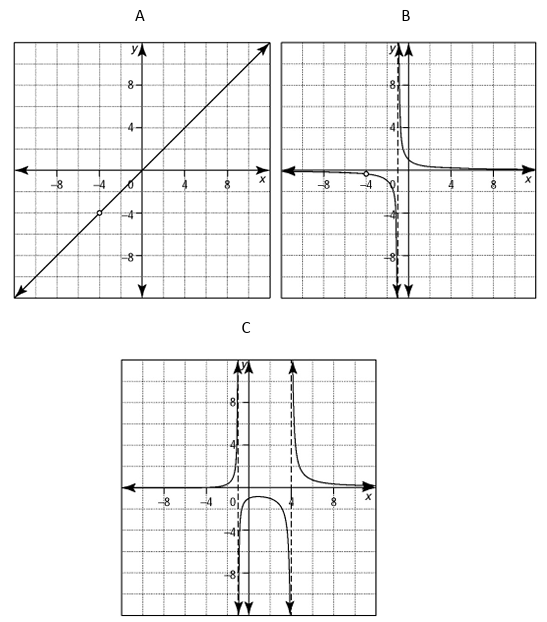
Solution :
a) y = (x + 4) / (x2 - 3x - 4)
Factoring the denominator, we get
y = (x + 4) / (x - 4) (x + 1)
Since there is no common factor, there is no hole.
x - 4 = 0 and x + 1 = 0
x = 4 and x = -1
The function is discontinuous at x = 4 and x = -1. Vertical asymptotes are at x = 4 and x = -1. Option c matches these conditions.
b) y = (x + 4) / (x2 + 5x + 4)
Factoring the denominator, we get
y = (x + 4) / (x + 4) (x + 1)
There is a hole at x = -4
x + 1 = 0
x = -1
The function is discontinuous at x = -1. Vertical asymptote is at x = -1. Option b matches these conditions.
c) y = (x2 + 4x)/(x + 4)
Factoring the numerator, we get
y = x(x + 4)/(x + 4)
(x + 4) is a common factor, then there must be hole
x + 4 = 0
x = -4
There is hole at x = -4. There is no vertical asymptote. So, option a matches this condition.
Problem 9 :
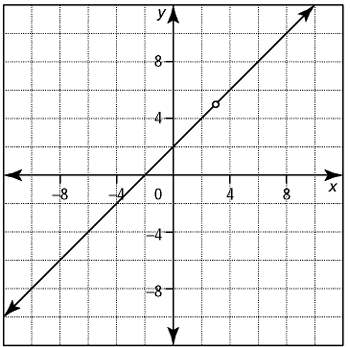
Write the equation for each graphed rational function.
Solution :
By observing the figure, there is hole at x = 3, since it straight line and y-intercept is b = 2
Slope = 1
y = mx + b
y = x + 2
The common factor at the numerator and denominator is (x - 3)
y = (x + 2)(x - 3)/(x - 3)
Problem 10 :
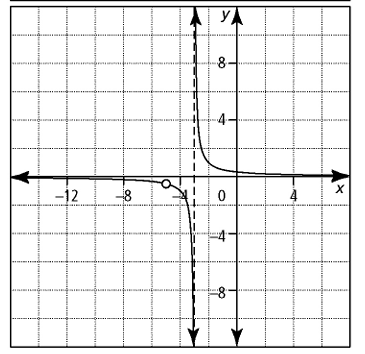
Write the equation for each graphed rational function.
Solution :
By observing the figure, there is hole at x = -5
- The common factor at the numerator and denominator is (x + 5). The graph is the parent graph of reciprocal function (1/x).
- Moving the graph 3 units towards the left, then the function will be x + 3
y = (x + 5)/(x + 5)(x + 3)
Subscribe to our ▶️ YouTube channel 🔴 for the latest videos, updates, and tips.
Recent Articles


-
Finding Range of Values Inequality Problems
May 21, 24 08:51 PM
Finding Range of Values Inequality Problems -
Solving Two Step Inequality Word Problems
May 21, 24 08:51 AM
Solving Two Step Inequality Word Problems -
Exponential Function Context and Data Modeling
May 20, 24 10:45 PM
Exponential Function Context and Data Modeling