HOW TO FIND THE LEAST NUMBER TO BE SUBTRACTED TO GET A PERFECT SQUARE
Subscribe to our ▶️ YouTube channel 🔴 for the latest videos, updates, and tips.
A perfect square is a number that can be expressed as the product of an integer by itself or as the second exponent of an integer.
To check the least number to be subtracted to make the number as perfect square, we have to follow the steps.
Step 1 :
Using long division, find the out the nearest perfect square of the given number.
Step 2 :
Definitely the given value must be greater than the nearest perfect square.
Step 3 :
The remainder should be subtracted from the given number to make the given number as perfect square.
Problem 1 :
What is the smallest number to be subtracted from 549162 in order to make it a perfect square?
a) 28 b) 36 c) 62 d) 81
Solution :
Put comma for every two digits starting from the last.
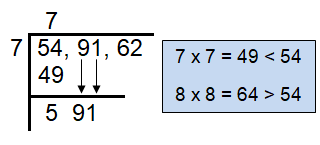
To get the next step, we will multiply the quotient by 2.

Now multiply 74 by 2, we get 148.
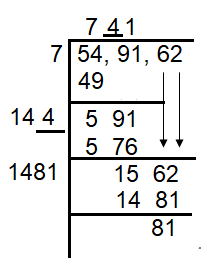
The nearest perfect square (741)2
(741)2 = 549081
549081 < 549162
To get the number to be subtracted = 549162 - 549081
= 81
So option (d) is correct.
Problem 2 :
What is the least number which should be subtracted from 0.000326 to make it a perfect square?
a) 0.000002 b) 0.000004 c) 0.02 d) 0.04
Solution :
The given number is 0.000326 = 326 × 10-6
= (324 + 2) × 10-6
= (18 × 18 + 2) × 10-6
326 - 2 is a square number.
Therefore, 2 × 10-6 = 0.000002 should be subtracted from 0.000326.
So, option (a) is correct.
Problem 3 :
A general wishes to draw up his 36581 soldiers in the form of a solid square. After arranging them, he found that some of them are left over. How many are left ?
(a) 65 (b) 81 (c) 100 (d) None
Solution :
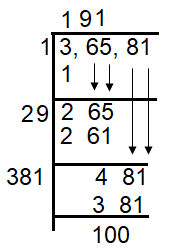
So, 100 is the left over.
Problem 4 :
Find the smallest number that must be subtracted to 1780 to make it a perfect square.
Solution :
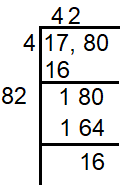
(42)2 = 1764
1764 < 1780
So, the required number to be subtracted is 16.
Problem 5 :
Find the least number which must be subtracted from 3250 so as to get a perfect square
Solution :
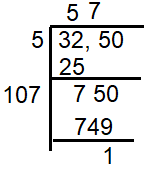
So, 1 to be subtracted to make 3250 as perfect square.
Problem 6 :
What is the least number should be subtracted from 1385 to get a perfect square ? Also find the square root of the perfect square.
Solution :
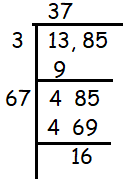
From the calculation above, 16 is the number to be subtracted from 1385 to make it as perfect square.
Problem 7 :
Find the least number which must be subtracted from each of the following numbers so as to get a perfect square. Also find the square root of the perfect square so obtained.
(a) 402 (b) 1989 (c) 3250 (d) 825
Solution :
a) 402
Nearest perfect square for 402 is 400. Then this 2 is extra. So, 2 is the number to be subtracted from 402 to make it as perfect square.
√400 = √(20 x 20)
= 20
So, 2 is the number to be subtracted from 402 to make it as perfect square. The square root of the number obtained after subtracting, we get 20.
b) 1989
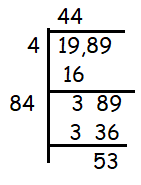
This 53 is extra. Then by subtracting 53 from 1989, we get
1989 - 53 = 1936
√1936 = √(44 x 44)
= 44
So, 53 is the number to be subtracted from 1989 to make it as perfect square. The square root of the number obtained after subtracting, we get 44.
c) 3250
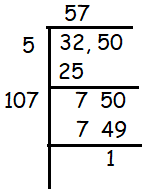
This 1 is extra. Then by subtracting 1 from 3250, we get
3250 - 1 = 3249
√3249 = √(57 x 57)
= 57
So, 1 is the number to be subtracted from 3250 to make it as perfect square. The square root of the number obtained after subtracting, we get 57.
d) 825
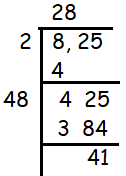
This 41 is extra. Then by subtracting 41 from 825, we get
825 - 41 = 784
√784 = √(2 x 7 x 2 x 7 x 2 x 2)
= 2 x 2 x 7
= 28
So, 41 is the number to be subtracted from 825 to make it as perfect square. The square root of the number obtained after subtracting, we get 28.
Problem 8 :
Find the least number which must be added to each of the following numbers so as to get a perfect square. Also find the square root of the perfect square so obtained.
(a) 525 (b) 1750 (c) 1825
Solution :
(a) 525
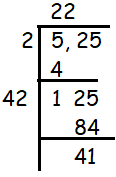
222 = 484
232 = 529
529 - 525 ==> 4
So, 4 is the number to be added to make it as perfect square.
√529 = √(23 x 23)
= 23
After adding 4, we get the answer 23.
(b) 1750
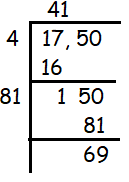
412 = 1681
422 = 1764
1764 - 1750 ==> 14
1750 + 14 ==> 1764
So, 14 is the number to be added to make it as perfect square.
√1764 = √(2 x 2 x 3 x 7 x 3 x 7)
= 2 x 3 x 7
= 42
After adding 14, we get the answer 42
(c) 1825
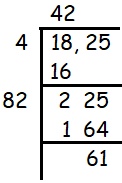
422 = 1764
432 = 1849
1849 - 1825 ==> 24
1825 + 24 ==> 1849
So, 24 is the number to be added to make it as perfect square.
√1849 = √(43 x 43)
= 43
After adding 24, we get the answer 43
Subscribe to our ▶️ YouTube channel 🔴 for the latest videos, updates, and tips.
Recent Articles


-
Finding Range of Values Inequality Problems
May 21, 24 08:51 PM
Finding Range of Values Inequality Problems -
Solving Two Step Inequality Word Problems
May 21, 24 08:51 AM
Solving Two Step Inequality Word Problems -
Exponential Function Context and Data Modeling
May 20, 24 10:45 PM
Exponential Function Context and Data Modeling