HOW TO FIND SURFACE AREA OF SIMILAR SOLIDS
Subscribe to our ▶️ YouTube channel 🔴 for the latest videos, updates, and tips.
If two figures are similar then:
- the figures are equiangular, and
- the corresponding sides are in proportion.
Surface area of similar figures :
If two solids are similar, then the ratio of their surface areas is equal to the square of the ratio of their corresponding linear measures.
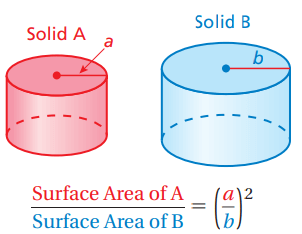
The solids are similar. Find the surface area S of the red solid. Round your answer to the nearest tenth.
Problem 1 :
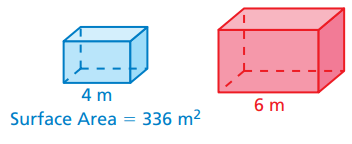
Solution :
Surface area of small solid = k2 x surface area of large solid
Surface area of small solid = 336 m2
Scale factor = (4/6) ==> 2/3
336 = (2/3)2 x surface area of large solid
surface area of large solid = 336 (9/4)
= 756 m2
Problem 2 :
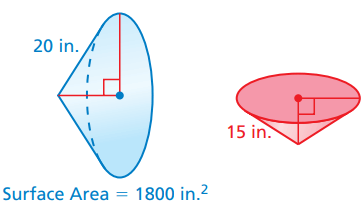
Solution :
Surface area of large solid = k2 x surface area of small solid
Surface area of large solid = 1800 in2
Scale factor = (20/15) ==> 4/3
1800 = (4/3)2 x surface area of small solid
surface area of small solid = 1800 (9/16)
= 1012.5 in2
Problem 3 :
The ratio of the corresponding linear measures of two similar cans of fruit is 4 to 7. The smaller can has a surface area of 220 square centimeters. Find the surface area of the larger can
Solution :
Surface area of smaller can = 220
Ratio between small can to large can = 4 : 7
Surface area of small can = (4/7)2 x Surface area of large can
220 = (16/49) x Surface area of large can
Surface area of large can = 220(49/16)
= 673.75 square centimeters
Problem 4 :
A model of sky scraper was made with the scale factor of 3 : 13. What is the ratio of the surface area of model to the surface area of original sky scrapers?
Solution :
Ratio between model to original sky scraper = 3 : 13
Ratio between surface area of model to original sky scraper
= 32 : 132
= 9 : 169
Problem 5 :
Each pair of figures is similar. Find the scale factor of the figure on the left to the figure on the right. Then find
(i) the ratio of surface areas
and
(ii) the ratio of volumes.

Solution :
Slant height of the large cone : Slant height of the small cone
200 = 160
5 : 4
So, the two cone are in the ratio is 5 : 4.
(i) The surface area of the two cones will be in the ratio :
52 : 42
So, the ratio of surface area is 25 :16
(ii) The volume of these two cones will be in the ratio :
53 : 43
So, the ratio of volume is 125 : 64.
Problem 6 :

Solution :
Height of the large prism : height of the small prism
42 : 24
7 : 4
So, the two prism are in the ratio is 7: 4.
(i) The surface area of the two prism will be in the ratio :
72 : 42
So, the ratio of surface area is 49:16
(ii0 The volume of these two prism will be in the ratio :
73 : 43
So, the ratio of volume is 343 : 64.
Problem 7 :
Cylinders A and B are similar.
- The height of A is 6 cm.
- The volume of A is 240 cm³ to 2 significant figures.
- The height of B is 15 cm and the volume of B is y.
Work out the error interval of y.
Solution :
Ratio between heights of Cylinder A to Cylinder B.
= 6 : 15
= 2 : 5
(2 : 5)3 = Volume of cylinder A : Volume of cylinder B
8 : 125 = 240 : y
8/125 = 240/y
8y = 240(125)
y = 240(125) / 8
= 3750
Volume of cylinder B is 3750 cm3
Problem 8 :
The square based pyramid A is divided into Pyramid B and Frustum C.
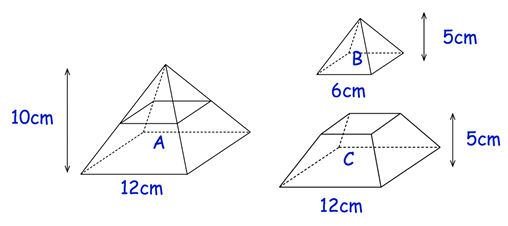
(a) Express the volume of Pyramid B as a fraction of the volume of Pyramid A.
(b) Express the volume of Frustum C as a fraction of the volume of Pyramid A.
Solution :
Volume of pyramid A = (1/3) x base area x height
base area = 12 x 12
= 144 cm2
Volume of pyramid A = 144 x 10
= 1440 cm3
Volume of pyramid B = (1/3) x 6 x 6 x 5
= 60 cm3
Volume of Frustum C = base area x height
= 12 x 12 x 5
= 144 x 5
= 720 cm3
a) Volume of Pyramid B : volume of Pyramid A
= 60 : 1440
= 60/1440
= 1 : 24
(b) Volume of Frustum C : volume of Pyramid A.
= 720 : 1440
= 1 : 2
Problem 9 :
Ornament A and B are mathematically similar. They are solid and both made from copper and zinc in the ratio 3:2
- Ornament A has a height of 5 cm and volume of 30 cm³
- Ornament B has a height of 18 cm. The density of copper is 8.96 g/cm³
- The density of zinc is 7.13 g/cm³
Work out the difference in mass between ornament A and ornament B.
Solution :
Volume of ornament B be x.
(5 : 18)3 = 30 : x
53/183 = 30/x
125x = 30(5832)
x = 1399.68
So, volume of ornament B is 1399.68 cm³
Ratio between copper and zinc = 3 : 2
Quantity of copper used = 3/5 of 8.96
= 5.376
Quantity of zinc used = 2/5 of 7.13
= 2.852
Quantity of copper and zinc used = 5.376 + 2.852
= 8.228 g/cm³
Mass of ornament A = 30 x 8.228
= 246.84
Mass of ornament B = 1399.68 x 8.228
= 11516.56
Difference between the mass = 11516.56 - 246.86
= 11269.70 grams
Subscribe to our ▶️ YouTube channel 🔴 for the latest videos, updates, and tips.
Recent Articles


-
Finding Range of Values Inequality Problems
May 21, 24 08:51 PM
Finding Range of Values Inequality Problems -
Solving Two Step Inequality Word Problems
May 21, 24 08:51 AM
Solving Two Step Inequality Word Problems -
Exponential Function Context and Data Modeling
May 20, 24 10:45 PM
Exponential Function Context and Data Modeling