HOW TO FIND MISSING ANGLES OF A RHOMBUS WITH DIAGONALS
Subscribe to our ▶️ YouTube channel 🔴 for the latest videos, updates, and tips.
What is rhombus ?
A rhombus is a quadrilateral in which all sides are equal is length.
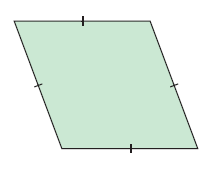
- Opposite angles are equal in size.
- Diagonals bisect each other at right angles.
- Diagonals bisect the angles at the vertex.
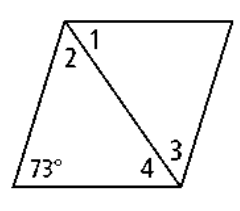
Find the all numbered angles in the following rhombus.
Problem 1 :
Solution :
Here ∠2 = ∠1, because the diagonal is the angle bisector.
∠2 = ∠4, because the equal sides will create equal angles.
∠4 = ∠3
73 + ∠2 + ∠4 = 180
73 + ∠2 + ∠2 = 180
73 + 2∠2 = 180
2∠2 = 180 - 73
2∠2 = 107
∠2 = 107/2 ==> 53.5
∠2 = 53.5
∠1 = 53.5
∠4 = 53.5
∠3 = 53.5
Problem 2 :
Solution :
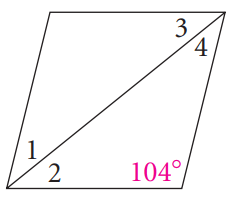
∠2 = ∠4
In the triangle below,
∠2 + ∠4 + 104 = 180
∠4 + ∠4 = 180 - 104
2∠4 = 76
∠4 = 76/2
∠4 = 38
∠3 = 38 (angle bisector)
∠2 = 38 (Equal sides, will have same angles)
∠1 = 38 (Angle bisector)
Problem 3 :
Solution :
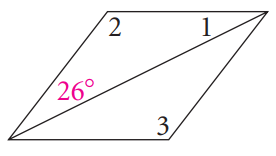
In the triangle above,
∠1 + ∠2 + 26 = 180
∠1 = 26
26 + ∠2 + 26 = 180
52 + ∠2 = 180
∠2 = 180 - 52
∠2 = 128
∠3 = 128 (Opposite angles)
Problem 4 :
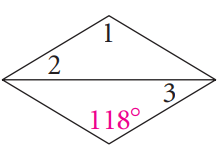
Solution :
∠1 = 118
∠1 + ∠2 + ∠2 = 180
118 + 2∠2 = 180
2∠2 = 180 - 118
2∠2 = 62
∠2 = 62/2
∠2 = 31
∠3 = 31
Problem 5 :
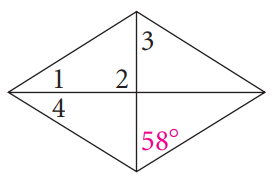
Solution :
From the figure given above, ∠3 = 58
∠2 = 90
∠1 + ∠2 + ∠3 = 180
∠1 + 90 + 58 = 180
∠1 + 148 = 180
∠1 = 180 - 148
∠1 = 32
∠4 = 32
Problem 6 :
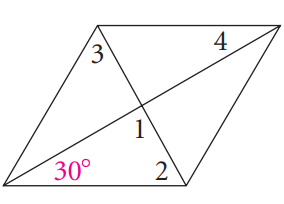
Solution :
∠2 = ∠3
Here ∠1 = 90
∠1 + 30 + ∠2 = 180
90 + 30 + ∠2 = 180
120 + ∠2 = 180
∠2 = 180 - 120
∠2 = 60
∠3 = 60
∠4 = 30
Problem 7 :
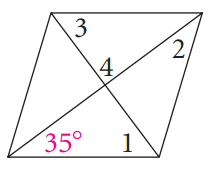
Solution :
∠4 = 90
∠2 = 35
∠3 + ∠4 + 35 = 180
∠3 + 90 + 35 = 180
∠3 + 125 = 180
∠3 = 180 - 125
∠3 = 55
∠1 = 55
Problem 8 :
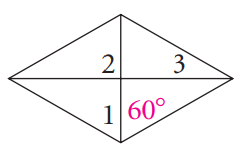
Solution :
∠2 = 90, ∠1 = 60
∠1 + ∠2 + ∠3 = 90
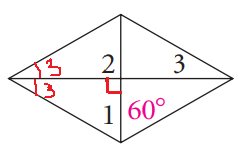 |
60 + 90 + ∠3 = 180 150 + ∠3 = 180 ∠3 = 180 - 150 ∠3 = 30 |
Problem 9 :
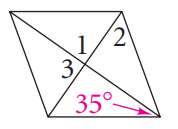
Solution :
∠1 = ∠3 = 90
In a triangle,
∠1 + ∠2 + 35 = 180
90 + ∠2 + 35 = 180
∠2 + 125 = 180
∠2 = 180 - 125
∠2 = 55
Problem 10 :
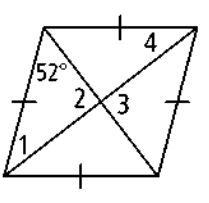
Solution :
∠1 = ∠4
∠1 + 52 + 52 + ∠4 = 180
∠1 + ∠1 + 104 = 180
2∠1 = 180 - 104
2∠1 = 76
∠1 = 76/2
∠1 = 38
∠2 = 90
∠3 = 90 (vertically opposite angles)
Problem 11 :
for any rhombus JKLM, decide whether the statement is always or sometimes true. Draw a diagram and explain your reasoning.
a) ∠L ≅ ∠M
b)∠K ≅ ∠M
c) JM ≅ KL
d) JK ≅ KL
e) JL ≅ KM
f) ∠JKM ≅ ∠LKM
Solution :
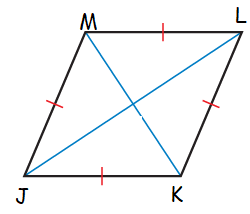
a) In the rhombus JKLM, ∠L and ∠M are co-interior angles they add upto 180 degree. They are not congruent to each other. So, it is sometimes true.
b)∠K and ∠M are opposite angles and they are congruent. So, it is always true.
c) JM and KL are opposite sides, they must be equal. So, it is true always.
d) In rhombus all four sides will be equal then JK and KL are adjacent sides and they are equal. So, it is true always.
e) JL and KM are diagonals, so they are not equal always. Then it is sometimes true.
f) ∠JKM ≅ ∠LKM
The diagonals are angle bisector, then they must be equal. True always.
Problem 12 :
Name each quadrilateral parallelogram, rectangle, rhombus, or square for which the statement is always true.
a) It is equiangular.
b) It is equiangular and equilateral.
c) The diagonals are perpendicular.
d) Opposite sides are congruent.
e) The diagonals bisect each other.
f) The diagonals bisect opposite angles.
Solution :
a) It is equiangular.
In square, rectangle all angles measures must be 90 degree.
b) It is equiangular and equilateral.
All four angle measures will be equal and all side lengths will be equal in the shape of square.
c) The diagonals are perpendicular.
Diagonals are perpendicular in the shape of rhombus.
d) Opposite sides are congruent.
Opposite sides will be equal in the shapes parallelogram, square, rectangle and rhombus.
e) The diagonals bisect each other.
Diagonals will bisect each other in all the shapes parallelogram, square, rectangle and rhombus.
f) The diagonals bisect opposite angles.
In the quadrilaterals like parallelogram, square, rectangle and rhombus, the diagonals will bisect opposite angles.
Problem 13 :
Given a quadrilateral ABCD, and diagonals AC and BD bisect each other at P such that AP = CP and BP = DP. Also ∠APD = 90°, then quadrilateral is a
(a) rhombus (b) trapezium (c) parallelogram (d) rectangle
Solution :
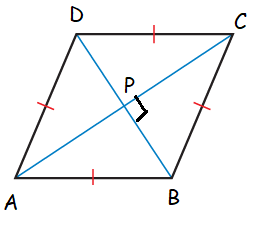
It must be the rhombus.
Subscribe to our ▶️ YouTube channel 🔴 for the latest videos, updates, and tips.
Recent Articles


-
Finding Range of Values Inequality Problems
May 21, 24 08:51 PM
Finding Range of Values Inequality Problems -
Solving Two Step Inequality Word Problems
May 21, 24 08:51 AM
Solving Two Step Inequality Word Problems -
Exponential Function Context and Data Modeling
May 20, 24 10:45 PM
Exponential Function Context and Data Modeling