HOW TO FIND MAXIMUM OR MINIMUM OF A ABSOLUTE VALUE FUNCTION
Subscribe to our ▶️ YouTube channel 🔴 for the latest videos, updates, and tips.
Maximum or minimum of a absolute value function will be at vertex.
The absolute value function will be in the form
y = a|x - h| + k
Here (h, k) is the vertex, that would be maximum or minimum based on the direction of opening it may be decided.
How to find direction of opening ?
The sign of a will decide the direction of opening.
- If a is positive, then the curve will open up and it will have minimum.
- If a is negative, the the curve will open down and it will have maximum.
Identify the vertex.
- Determine if the graph opens up or down.
- Determine if the graph has a maximum or minimum and its value.
- Decide if the graph is narrower, wider, or the same width as the parent graph.
Problem 1 :
y = -|x + 1|
Solution :
y = -|x + 1|
y = a|x - h| + k
y = -1|x - (-1)| + 0
The vertex (h, k):
(-1, 0)
Open: UP/DOWN
a = -1, the curve will open down.
Maximum/Minimum:
The maximum is at x = -1.
Narrower/Wider/Same :
Comparing with parent function y = |x|
y = -|x + 1|
Coefficient of absolute value function is same as the given function. So, width of this curve will be same.
Problem 2 :
y = 7|x - 3| - 4
Solution :
y = 7|x - 3| - 4
y = a|x - h| + k
The vertex (h, k) :
(3, -4)
Open: UP/DOWN :
a = 7, the curve will open up.
Maximum/Minimum :
The minimum is at x = 3.
Narrower/Wider/Same :
a = 7 which is greater than 1. So, width of this curve will be narrower.
Problem 3 :
y = -2/3|x - 1|
Solution :
y = -2/3|x - 1| + 0
y = a|x - h| + k
The vertex (h, k) :
(1, 0)
Open: UP/DOWN
a = -2/3, the curve will open down.
Maximum/Minimum:
The maximum is at x = 1
Narrower/Wider/Same :
a = 2/3 < 1, so it is wider.
Problem 4 :
y = 5/2|x + 9| - 1
Solution :
y = 5/2|x + 9| - 1
y = a|x - h| + k
y = 5/2|x - (-9)| - 1
The vertex (h, k) :
(-9, -1)
Open: UP/DOWN :
a = 5/2, the curve will open up.
Maximum/Minimum :
The minimum is at x = -9
Narrower/Wider/Same :
a = 5/2 > 1, so the curve is narrower.
Problem 5 :
y = 3/4|x + 3| - 6
Solution :
y = 3/4|x + 3| - 6
y = a|x - h| + k
y = 3/4|x - (-3)| - 6
The vertex (h, k) :
(-3, -6)
Open: UP/DOWN
a = 3/4, the curve will open up.
Maximum/Minimum:
The minimum is at x = -3
Narrower/Wider/Same:
a = 3/4 < 1, so it is wider.
Problem 6 :
y = -|x| + 5
Solution :
y = -|x| + 5
y = a|x - h| + k
y = -1|x - 0| + 5
The vertex (h, k) :
(0, 5)
Open: UP/DOWN :
a = -1, the curve will open down.
Maximum/Minimum :
Maximum is at x = 0
Narrower/Wider/Same :
a = 1. so it is same.
Problem 7 :
You are running a ten-mile race. The function d(t) = (1/8) ∣t − 40∣ represents the distance (in miles) you are from a water stop after t minutes.
a. Graph the function. Find the domain and range in this context.
b. Interpret the intercepts and the vertex. When is the function decreasing? increasing? Explain what each represents in this context.
Solution :
d(t) = (1/8) ∣t − 40∣
Comparing the given function with y = a|x - h| + k
a = 1/8, h = 40 and k = 0
Vertex is at (40, 0)
a)
Finding domain :
Here t is the minutes. Distance between the starting point and ending point is 10 miles. So, domain is t ≥ 0
Finding range :
When t = 0
d(t) = (1/8) ∣t − 40∣
d(0) = (1/8) ∣0 − 40∣
= (1/8)(40)
d(0) = 5
So, the range is 0 ≤ d(t) ≤ 5
b)
x-intercept is at (40, 0) and y-intercept is (0, 5)
Since the absolute value function opens up, decreasing 0 < t < 40 and increasing at 40 < t ≤ 80
Distance covered in between 40 seconds is lesser than distance covered in between 40 to 80 seconds.
Problem 8 :
Write the vertex of the absolute value function f(x) = ∣ax − h∣ + k in terms of a, h, and k.
Solution :
f(x) = ∣ax − h∣ + k
f(x) = a|x - (h/a)| + k
Vertex is at (h/a, k)
Problem 9 :
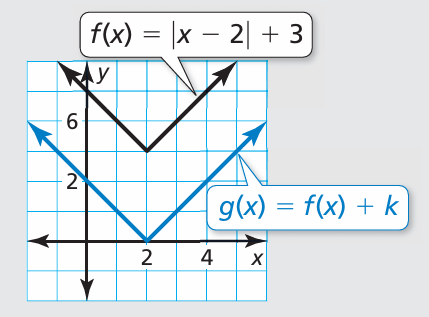
Describe the transformation from the graph of f to the graph of g.
Solution :
y = a|x - h| + k
Observing the blue graph, (2, 0) is the vertex.
y = a|x - 2| + 0
y = a|x - 2|
(0, 2) and (4, 2) are the points on the graph.
2 = a|0 - 2|
2 = 2a
a = 1
y = |x - 2|
So, while moving the down the graph of f(x), we get the graph g(x).
y = |x - 2| + 3 - 3
y = |x - 2|
Then the value of k is -3.
Subscribe to our ▶️ YouTube channel 🔴 for the latest videos, updates, and tips.
Recent Articles


-
Finding Range of Values Inequality Problems
May 21, 24 08:51 PM
Finding Range of Values Inequality Problems -
Solving Two Step Inequality Word Problems
May 21, 24 08:51 AM
Solving Two Step Inequality Word Problems -
Exponential Function Context and Data Modeling
May 20, 24 10:45 PM
Exponential Function Context and Data Modeling