GRAPHING INEQUALITIES IN TWO VARIABLES
Subscribe to our ▶️ YouTube channel 🔴 for the latest videos, updates, and tips.
To graph inequalities in two variables, we will follow the instruction given below.
Step 1 :
Consider the given inequalities as equations. By finding x and y intercepts, we will get two points on the x and y axis respectively.
Step 2 :
To find x intercept, we put y = 0
To find y intercept, put x = 0
Step 3 :
If we have lesser than or equal to sign ≤, greater than or equal to sign ≥, we have to use solid line to draw the graph.
If we have lesser than sign <, greater than >, we have to use the dotted line to draw the graph.
Step 4 :
Take one point above or below the line and put in the given inequality.
If the given inequality satisfies the point, we can shade that particular region. Other wise shade the opposite region.
Graph the solutions to each of the following inequalities on a separate set of axes.
Problem 1 :
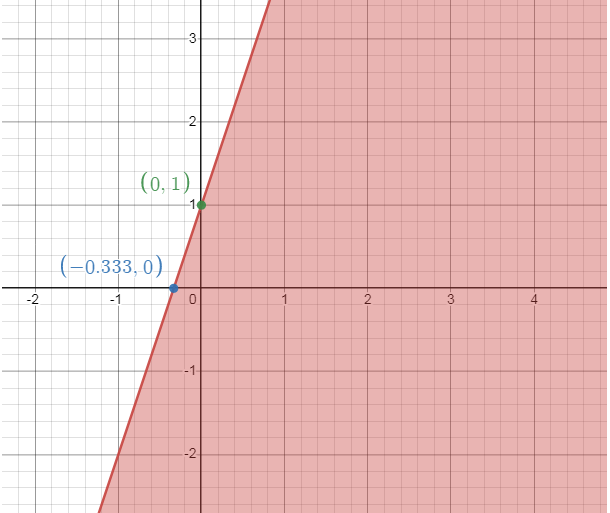
y ≤ 3x + 1
Solution :
y = 3x + 1
x -intercept : y = 0
3x + 1 = 0
3x = -1
x = -1/3
x -intercept: (-1/3, 0)
y -intercept : x = 0
y = 3(0) + 1
y = 0 + 1
y = 1
y -intercept: (0, 1)
Check :
|
Point (2, -1) -1 ≤ 3(2) + 1 -1 ≤ 6 + 1 -1 ≤ 7 True |
Point (1, -2) -2 ≤ 3(1) + 1 -2 ≤ 3 + 1 -2 ≤ 4 True |
So, we shade the region below the line.
Problem 2 :
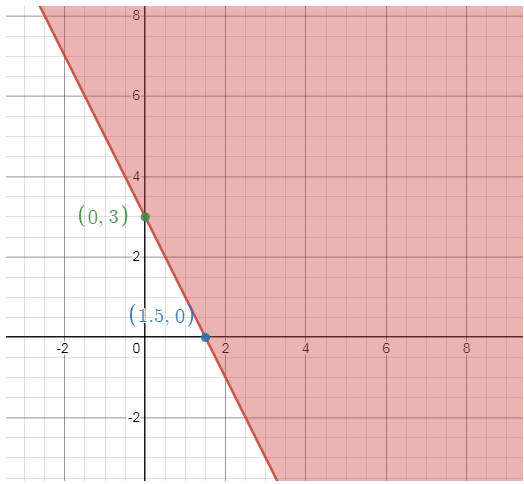
y ≥ -2x + 3
Solution :
y = -2x + 3
x -intercept : y = 0
-2x + 3 = 0
-2x = -3
x = 3/2
x -intercept: (3/2, 0)
y -intercept : x = 0
y = -2(0) + 3
y = 3
y -intercept: (0, 3)
Check :
|
Point (3, 1) 1 ≥ -2(3) + 3 1 ≥ -6 + 3 1 ≥ -3 True |
Point (5, 2) 2 ≥ -2(5) + 3 2 ≥ -10 + 3 2 ≥ -7 True |
Problem 3 :
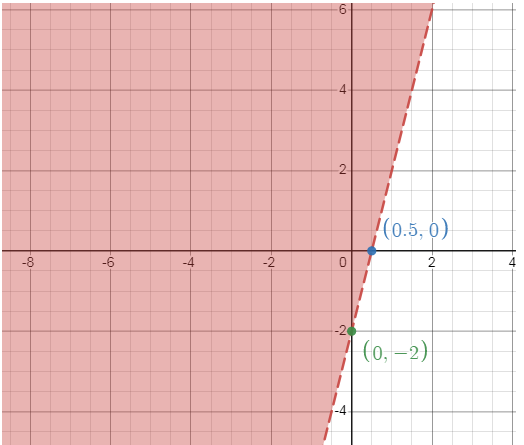
y > 4x - 2
Solution :
y = 4x - 2
x -intercept : y = 0
4x - 2 = 0
4x = 2
x = 1/2
x -intercept: (1/2, 0)
y -intercept : x = 0
y = 4(0) - 2
y = -2
y -intercept: (0, -2)
Check :
|
Point (-1, 1) 1 > 4(-1) - 2 1 > -4 - 2 1 > -6 True |
Point (-2, 5) 5 > 4(-2) - 2 5 > -8 - 2 5 > -10 True |
Problem 4 :
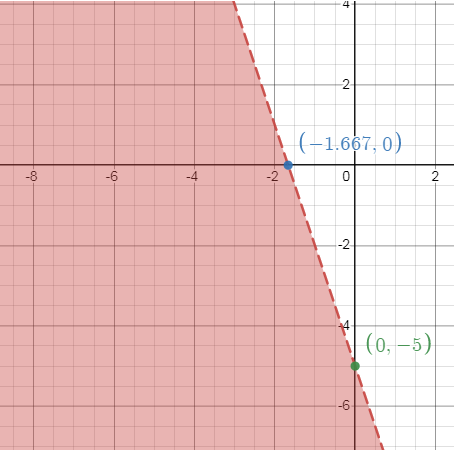
y < -3x - 5
Solution :
y = -3x - 5
x -intercept : y = 0
-3x - 5 = 0
-3x = 5
x = -5/3
x -intercept: (-5/3, 0)
y -intercept : x = 0
y = -3(0) - 5
y = -5
y -intercept is (0, -5)
Check :
|
Point (-3, -2) -2 < -3(-3) - 5 -2 < 9 - 5 -2 < 4 True |
Point (-5, 1) 1 < -3(-5) - 5 1 < 15 - 5 1 < 10 True |
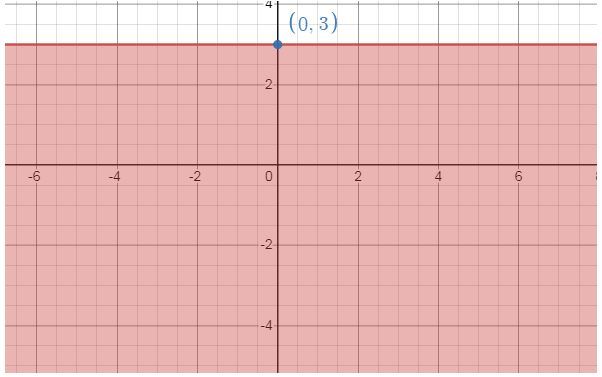
Problem 5 :
y ≤ 3
Solution :
y = 3
y -intercept is (0, 3)
Problem 6 :
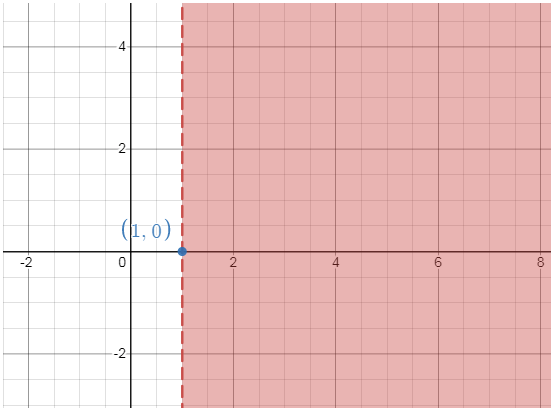
x > 1
Solution :
x = 1
x -intercept: (1, 0)
Problem 7 :
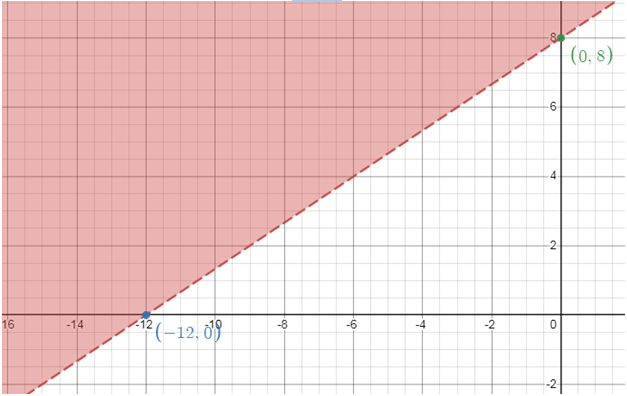
y > 2/3x + 8
Solution :
y = 2/3x + 8
x -intercept : y = 0
2/3x + 8 = 0
2/3x = -8
x = -12
x -intercept: (-12, 0)
y -intercept : x = 0
y = 2/3(0) + 8
y = 8
x -intercept: (0, 8)
Check :
|
Point (-12, 9) 9 > 2/3(-12) + 8 9 > -4 + 8 9 > 4 True |
Point (-15, 10) 10 > 2/3(-15) + 8 10 > -10 + 8 10 > -2 True |
Problem 8 :
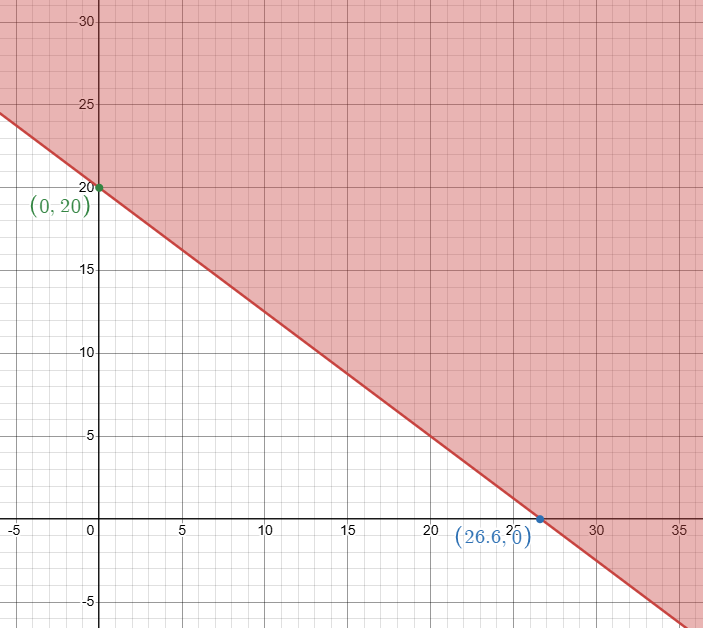
You have two part-time summer jobs, one that pays $9 an hour and another that pays $12 an hour. You would like to earn at least $240 a week. Write an inequality describing the possible amounts of time you can schedule at both jobs.
Solution :
Let x be the number of hours working for the first part time job
Let y be the number of hours working for the second part time job.
9x + 12y ≥ 240
12y ≥ -9x + 240
y ≥ (-9x + 240)/12
y ≥ (-9x/12) + (240/12)
y ≥ (-3x/4) + 20
Finding x and y-intercepts :
x-intercept, put y = 0
0 = (-3x/4) + 20
-20 = -3x/4
80/3 = x
x = 26.6
y-intercept, put x = 0
y = 0 + 20
y = 20
Problem 9 :
The graph of an inequality is shown below.
a) Write the inequality represented by the graph.
b) On the same set of axes, graph the inequality x + 2y < 4
c) The two inequalities graphed on the set of axes form a system. Oscar thinks that (2, 1) the point is in the solution set for this system of inequalities. Determine and state whether you agree with Oscar. Explain your reasoning.

Solution :
Choosing two points lies on the line, we get (2, 1) and (0, -3)
slope m = (-3 - 1) / (0 - 2)
= -4/(-2)
= 2
Since it is solid line, we have to use ≤ or ≥ sign.
y = 2x + (-3)
y = 2x - 3
|
y ≤ 2x - 3 Choosing the point above the line (0, 0) 0 ≤ 2(0) - 3 0 ≤ - 3 False |
y ≥ 2x - 3 Choosing the point below the line (0, 0) 0 ≥ 2(0) - 3 0 ≥ - 3 True |
So, the inequality represented by the graph is y ≥ 2x - 3.
x + 2y < 4
2y = -x + 4
y = (-1/2)x + 4
|
x-intercept : Put y = 0 0 = (-1/2)x + 4 -4 = (-1/2)x x = 8 |
y-intercept : Put x = 0 y = (-1/2)(0) + 4 y = 4 |
(8, 0) and (0, 4)
Choosing the point above the line (4, 8),
4 + 2(8) < 4
4 + 16 < 4
20 < 4
False, so we have to shade the region below the line.
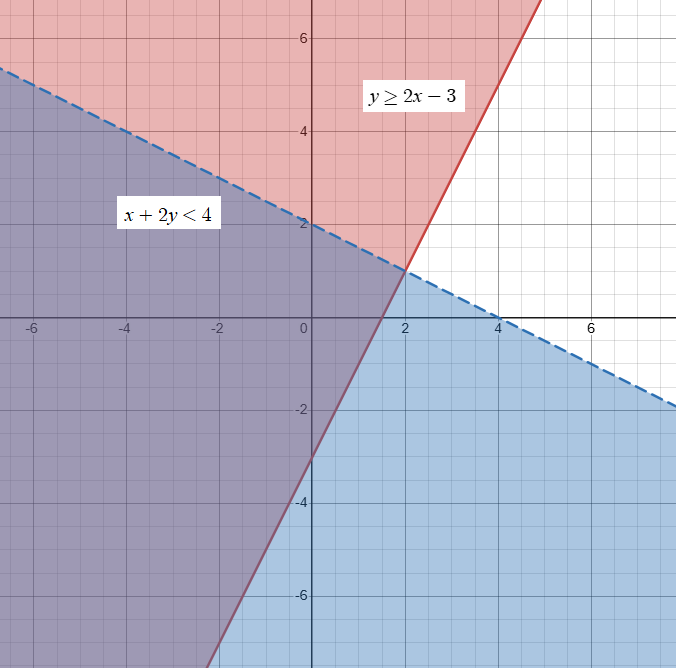
(2, 1) is the point of intersection of the inequality. So, it must be a solution.
Subscribe to our ▶️ YouTube channel 🔴 for the latest videos, updates, and tips.
Recent Articles


-
Finding Range of Values Inequality Problems
May 21, 24 08:51 PM
Finding Range of Values Inequality Problems -
Solving Two Step Inequality Word Problems
May 21, 24 08:51 AM
Solving Two Step Inequality Word Problems -
Exponential Function Context and Data Modeling
May 20, 24 10:45 PM
Exponential Function Context and Data Modeling