GRAPHING COSECANT FUNCTIONS
Subscribe to our ▶️ YouTube channel 🔴 for the latest videos, updates, and tips.
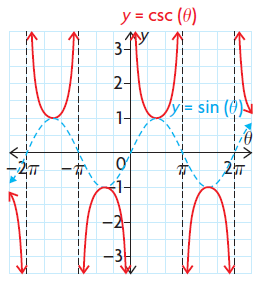
The graph of a reciprocal functions is related to the graph of its corresponding reciprocal trigonometric function in the following ways.
The graph of the reciprocal function has a vertical asymptote at each zero of the corresponding primary trigonometric function.
- It has the vertical asymptotes at the points where sin θ = 0
- It has the same period 2Π as y = sinθ
- It has the domain x ∈R, θ ≠ nΠ, n ∈ I
- It has the range {y ∈R, |y| ≥1}
Problem 1 :
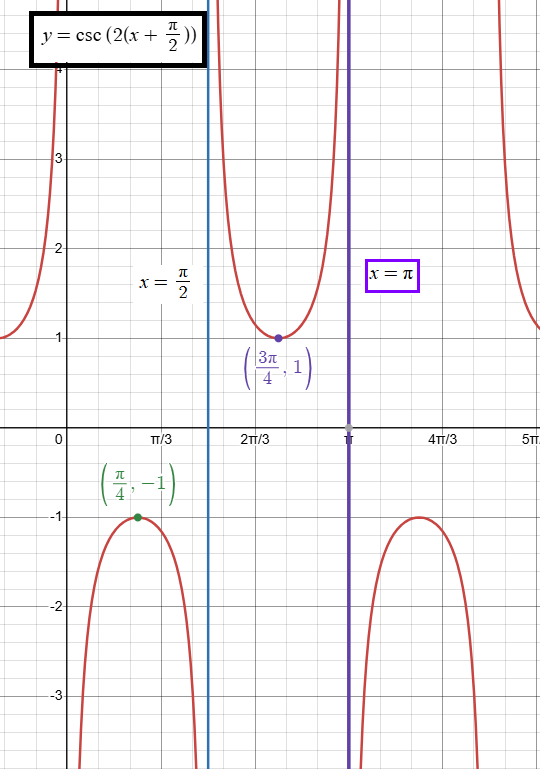
y = csc (2(x + Π/2))
Solution :
y = csc (2(x + Π/2))
Comparing with y = a csc (k(x - c)) + d
- Amplitude a = 1
- k = 2
- Horizontal translation c = -Π/2
- Moving the graph towards the left of Π/2 units.
- No vertical shift.
Vertical asymptotes :
csc (2(x + Π/2)) = 1/sin (2(x + Π/2))
2(x + Π/2) = 0
x = -Π/2
Vertical asymptotes are -Π/2 + kΠ
|
When k = 0 = -Π/2 + 0Π = -Π/2 |
When k = 1 = -Π/2 + 1Π = Π/2 |
When k = 2 = -Π/2 + 2Π = 3Π/2 |
|
When k = 3 = -Π/2 + 3Π = 5Π/2 |
When k = 4 = -Π/2 + 4Π = 7Π/2 |
Vertical asymptotes are at -Π/2, Π/2, 3Π/2, 5Π/2, 7Π/2,............
Period :
= 2Π/|k|
= 2Π/2
= Π
Π/4, Π/4 + Π/4, 2Π/4 + Π/4, 3Π/4 + Π/4
Inputs are Π/4, 2Π/4, 3Π/4, 4Π/4
|
When x = Π/4 y = csc (2(Π/4 + Π/2)) = csc 2(3Π/4) = csc (3Π/2) = 1/sin (3Π/2) = 1/-1 = -1 |
When x = Π/2 y = csc (2(Π/2 + Π/2)) = csc 2(Π) = 1/sin (2Π) = 1/0 Vertical asymptote at x = Π/2 |
|
When x = 3Π/4 y = csc (2(3Π/4 + Π/2)) = csc 2(5Π/4) = csc (5Π/2) = 1/sin (5Π/2) = 1/1 = 1 |
Vertical asymptote at x = Π |
(Π/4, -1) and (3Π/4, 1)
Problem 2 :
y = 2csc (x + Π/3)
Solution :
y = 2 csc (x + Π/3)
Comparing with y = a csc (k(x - c)) + d
- Amplitude a = 2
- k = 1
- Horizontal translation c = -Π/3
- Moving the graph towards the left of Π/3 units.
- No vertical shift.
Vertical asymptotes :
2 csc (x + Π/3) = 1/2sin (x + Π/3)
(x + Π/3) = 0
x = -Π/3
Vertical asymptotes are -Π/3 + kΠ
|
When k = 1 = -Π/3 + Π = 2Π/3 |
When k = 2 = -Π/3 + 2Π = 5Π/3 |
When k = 3 = -Π/3 + 3Π = 8Π/3 |
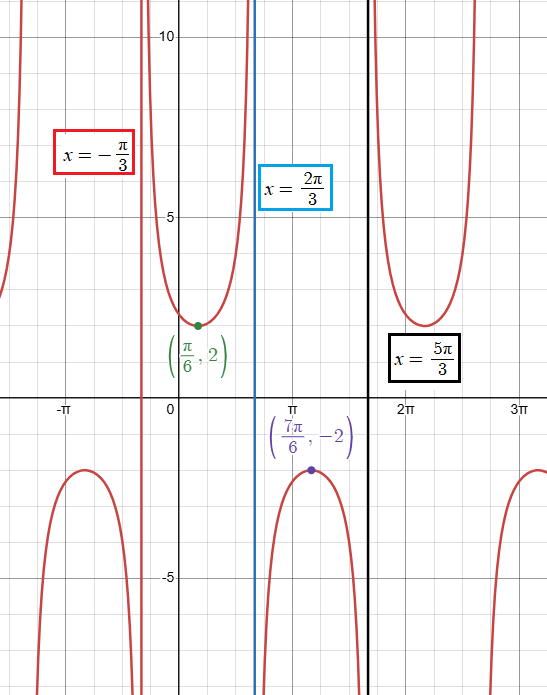
Vertical asymptotes are at x = -Π/3, 2Π/3, 5Π/3, 8Π/3
Period :
= 2Π/|k|
= 2Π/1
= 2Π
To find input, we divide the period by 4.
2Π/4 ==> Π/2
-Π/3, -Π/3 + Π/2, Π/6 + Π/2, 2Π/3 + Π/2
Inputs are -Π/3, Π/6, 2Π/3, 7Π/6
|
y = 2 csc (x + Π/3) When x = -Π/3 y = 2 csc (-Π/3 + Π/3) = 2 csc (0) Vertical asymptote is at x = -Π/3 |
y = 2 csc (x + Π/3) When x = Π/6 y = 2 csc (Π/6 + Π/3) = 2 csc (3Π/6) = 2 csc (Π/2) = 2 (1) (Π/6, 2) |
|
y = 2 csc (x + Π/3) When x = 2Π/3 y = 2 csc (2Π/3 + Π/3) = 2 csc (3Π/3) = 2 csc (Π) Vertical asymptote is at x = 2Π/3 |
y = 2 csc (x + Π/3) When x = 7Π/6 y = 2 csc (7Π/6 + Π/3) = 2 csc (9Π/6) = 2 csc (3Π/2) = 2 (-1) (7Π/6, -2) |
Problem 3 :
y = 1 + 3 csc x
Solution :
y = 1 + 3 csc x
Comparing with y = a csc (k(x - c)) + d
- Amplitude a = 3
- k = 1
- No horizontal translation. No horizontal shift.
- Vertical shift of 1 unit up.
Vertical asymptotes :
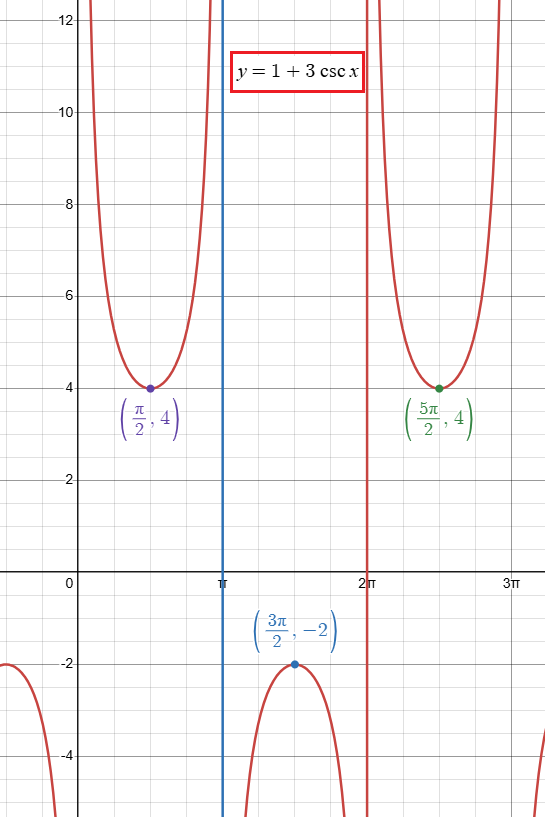
x = Π, 2Π, 3Π,...............
Period :
= 2Π/|k|
= 2Π/1
= 2Π
To find the horizontal distance of each input, we divide period by 4. Then
= 2Π/4
= Π/2
Π, Π + Π/2, 3Π/2 + Π/2, 2Π + Π/2, 5Π/2 + Π/2
Π, 3Π/2, 2Π, 5Π/2, 3Π
y = 1 + 3 csc x
When x = Π
y = 1 + 3 csc (Π)
Vertical asymptote is at x = Π
|
y = 1 + 3 csc x x = 3Π/2 y = 1 + 3 csc (3Π/2) = 1 + 3 (1/sin 3 Π/2) = 1 + 3 (-1) = 1 - 3 = -2 (3Π/2, -2) |
y = 1 + 3 csc x x = 2Π y = 1 + 3 csc (2Π) = 1 + 3 (1/sin 2 Π) Vertical asymptote is at x = 2Π |
|
y = 1 + 3 csc x x = 5Π/2 y = 1 + 3 csc (5Π/2) = 1 + 3 (1/sin 5 Π/2) = 1 + 3 (1) = 1 + 3 = 4 (5Π/2, 4) |
y = 1 + 3 csc x x = 3Π y = 1 + 3 csc (3Π) Vertical asymptote is at x = 3Π |
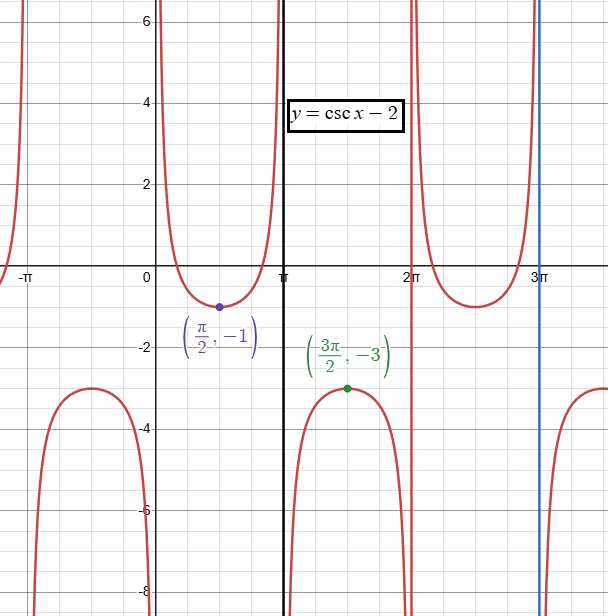
Problem 4 :
Graph one period of each function. Describe the transformation of the graph of its parent function.
g(x) = csc x − 2
Solution :
g(x) = csc x − 2
Comparing with y = a csc (k(x - c)) + d
- Amplitude a = 1
- k = 1
- No horizontal translation. No horizontal shift.
- Vertical shift of 2 units down.
Vertical asymptotes :
x = Π, 2Π, 3Π,...............
Period :
= 2Π/|k|
= 2Π/1
= 2Π
To find the horizontal distance of each input, we divide period by 4. Then
= 2Π/4
= Π/2
Π - Π/2, Π, Π + Π/2, 3Π/2 + Π/2, 2Π + Π/2, 5Π + Π/2
Π/2, Π, 3Π/2, 2Π, 5Π/2, 11Π/2
|
When x = Π/2 g(Π/2) = csc Π/2 − 2 = 1 - 2 = -1 (Π/2, -1) |
When x = 3Π/2 g(3Π/2) = csc 3Π/2 − 2 = -1 - 2 = -3 (3Π/2, -3) |
Subscribe to our ▶️ YouTube channel 🔴 for the latest videos, updates, and tips.
Recent Articles


-
Finding Range of Values Inequality Problems
May 21, 24 08:51 PM
Finding Range of Values Inequality Problems -
Solving Two Step Inequality Word Problems
May 21, 24 08:51 AM
Solving Two Step Inequality Word Problems -
Exponential Function Context and Data Modeling
May 20, 24 10:45 PM
Exponential Function Context and Data Modeling