GRAPHING ABSOLUTE VALUE FUNCTIONS WORKSHEET
Subscribe to our ▶️ YouTube channel 🔴 for the latest videos, updates, and tips.
Graph the following absolute value function by finding the following.
(i) Vertex
(ii) Slope
(iii) Direction of opening
(iv) x and y intercepts
(v) Domain and range
(vi) Increasing and decreasing
Problem 1 :
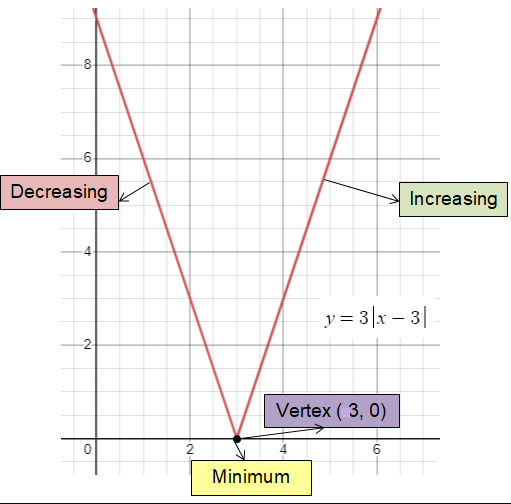
y = 3|x - 3|
Problem 2 :
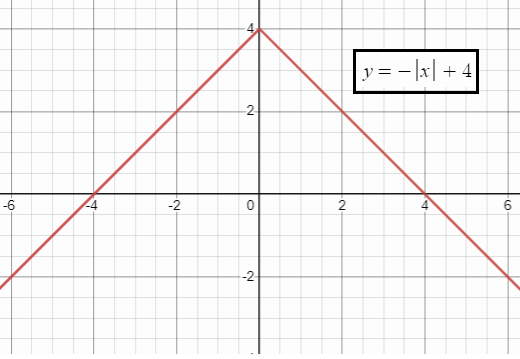
y = -|x| + 4
Problem 3 :
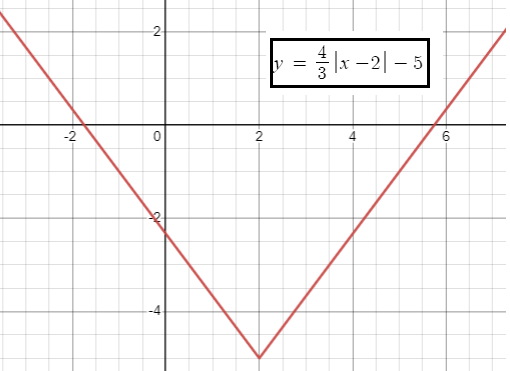
y = (4/3) |x + 2| - 5
Problem 4 :
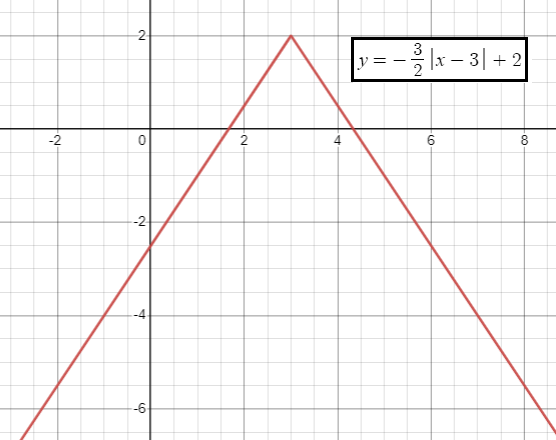
y = -(3/2) |x - 3| + 2
Answer Key
1) Vertex is at (3, 0)
Slope (a) = 3
Direction of opening = open up
x-intercept is at (3, 0)
y-intercept is at (0, 9).
- All real values is domain.
- Range is 3 ≤ y ≤ ∞
- To the left of minimum, it is decreasing.
- To the right of minimum, it is increasing.
2) Vertex is at (0, 4).
x-intercepts are (4, 0) and (-4, 0).
y-intercept is at (0, 4).
Slope (a) = -1
The curve will open down.
- All real values is domain.
- Range is 4 ≤ y ≤ -∞
- To the left of maximum, it is increasing.
- To the right of maximum, it is decreasing.
3) Vertex is at (-2, -5).
x-intercept is at (7/4, 0) and (-19/2, 0).
y-intercept (0, -7/3).
Slope (a) = 4/3
The curve will open up.
- All real values is domain.
- Range is 4 ≤ y ≤ -∞
- To the left of minimum, it is decreasing.
- To the right of minimum, it is increasing.
4) Vertex is at (3, 2).
x-intercept is at (13/3, 0) and (5/3, 0).
y-intercept is (0, -5/2).
Slope (a) = -3/2
The curve will open down.
- All real values is domain.
- Range is -5 ≤ y ≤ ∞
- To the left of maximum, it is increasing.
- To the right of maximum, it is decreasing.
Graph each equation.
Problem 1 :
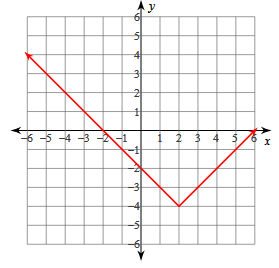
y = |x - 2| - 4
Problem 2 :
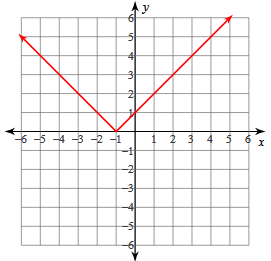
y = |x + 1|
Problem 3 :
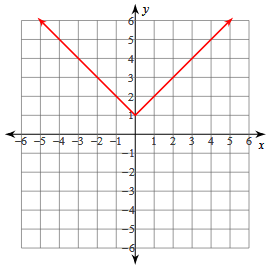
y = |x| + 1
Problem 4 :
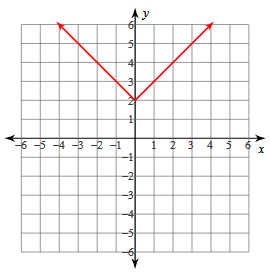
y = |x| + 2
Problem 5 :
y = |x + 2|
Problem 6 :
y = |x + 1| + 3
Problem 7 :
y = - |x - 2| - 2
Problem 8 :
y = - |x + 1| + 4
Problem 9 :
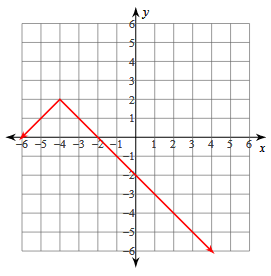
y = -|x + 4| + 2
Problem 10 :
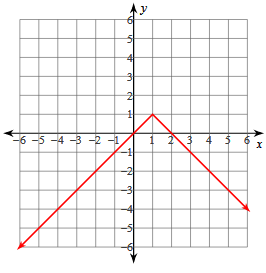
y = -|x - 1| + 1
Problem 11 :
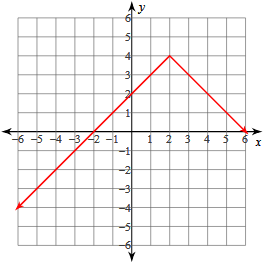
y = - |x - 2| + 4
Problem 12 :
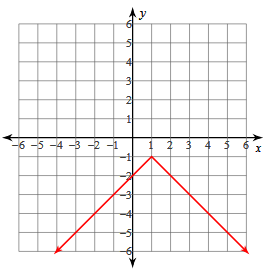
y = -|x - 1| - 1
Answer Key
1) opens upward
Vertex (2, -4)
x- Intercepts = (6, 0) and (-2, 0)
y- Intercept = (0, -2)
2) opens upward
Vertex (h, k) = (-1, 0)
x- Intercept = (-1, 0)
y- Intercept = (0, 1)
3) a > 0, opens upward
Vertex (h, k) = (0, 1)
|x| = -1
y- Intercept = (0, 1)
4) a > 0, opens upward
Vertex (h, k) = (0, 2)
|x| = -2
y- Intercept = (0, 2)
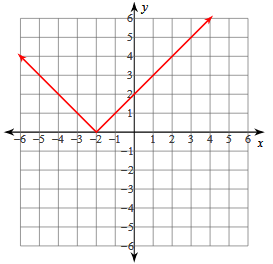
5) a > 0, opens upward
Vertex (h, k) = (-2, 0)
x- Intercept = (-2, 0)
y- Intercept = (0, 2)
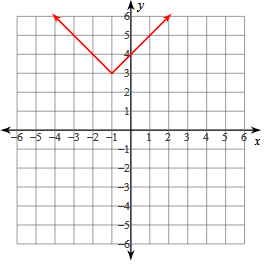
6) a > 0, opens upward
Vertex (h, k) = (-1, 3)
|x + 1| = -3
y- Intercept = (0, 4)
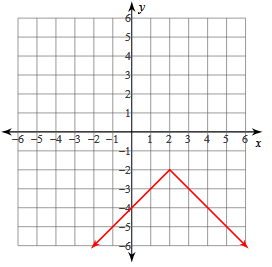
7) a < 0, opens downward
Vertex (h, k) = (2, -2)
-|x - 2| = 2
y- Intercept = (0, -4)
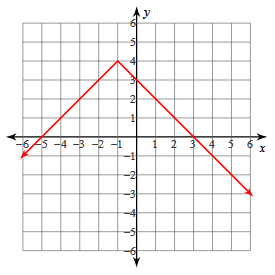
8) a < 0, opens downward
Vertex (h, k) = (-1, 4)
x- Intercept = (3, 0) and (-5, 0)
y- Intercept = (0, 3)
9) a < 0, opens downward
Vertex (h, k) = (-4, 2)
x- Intercepts = (-2, 0) and (-6, 0)
y- Intercept = (0, -2)
10) a < 0, opens downward
Vertex (h, k) = (1, 1)
x- Intercepts = (2, 0) and (0, 0)
y- Intercept = (0, 0)
11) a < 0, opens downward
Vertex => (2, 4)
x- Intercepts = (6, 0) and (-2, 0)
y- Intercept = (0, 2)
12) a < 0, opens downward
Vertex (h, k) = (1, -1)
-|x - 1| = 1
y- Intercept = (0, -2)
Solve for x using
i) graphical method ii) an algebraical method.
Problem 1 :
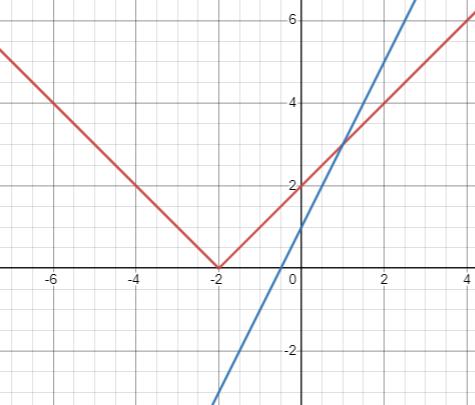
|x + 2| = 2x + 1
Problem 2 :
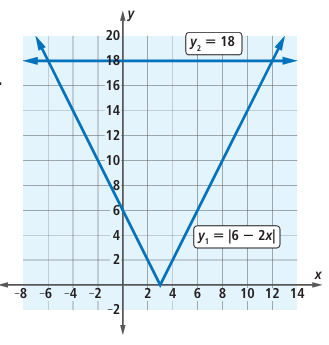
Consider the graph, which shows y1 = |6 - 2x| and y2 = 18. Use the graph and use algebraic properties to solve |6 - 2x| = 18.
Problem 3 :
You are asked for the year of the Emancipation Proclamation in the United States on a test. The correct answer is 1863. You guessed g and you were off by 4 years. What equation’s solution gives the possible values of g?
a) |1863 - 4| = g b) |g| = 1863 - 4 c) |g - 1863| = 4 d) |g - 4| = 1863
Problem 4 :
Determine whether the number is a solution to the equation
60 = |n - 90|
a) 30 b) −30 c) 150 d) −150
Problem 5 :
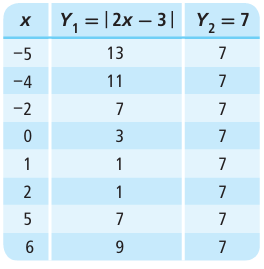
Use the table below to solve each sentence.
a) |2x - 3| = 7 b) |2x - 3| < 7 c) |2x - 3| > 7
Answer Key
1)
i) Solution is (1, 3).
ii) |x + 2| = 2x + 1
|
x + 2 = (2x + 1) x + 2 = 2x + 1 x - 2x = 1 - 2 -x = -1 x = 1 |
(x + 2) = -(2x + 1) x + 2 = -2x - 1 x + 2x = -1 - 2 -3x = 3 x = -1 |
(1, 3) is the point of intersection.
2) the point of intersections are -6 and 12.
3) |g - 1863| = 4
4) 30 and 150 are solutions.
5)
Option a :
x = -2 and x = 5
Option b :
-2 < x < 5
Option c :
(-∞, -2) (5, ∞)
Subscribe to our ▶️ YouTube channel 🔴 for the latest videos, updates, and tips.
Recent Articles


-
Finding Range of Values Inequality Problems
May 21, 24 08:51 PM
Finding Range of Values Inequality Problems -
Solving Two Step Inequality Word Problems
May 21, 24 08:51 AM
Solving Two Step Inequality Word Problems -
Exponential Function Context and Data Modeling
May 20, 24 10:45 PM
Exponential Function Context and Data Modeling