FROM MINIMUM AND MAXIMUM POINT FIND EQUATION OF SINUSOIDAL FUNCTION
Subscribe to our ▶️ YouTube channel 🔴 for the latest videos, updates, and tips.
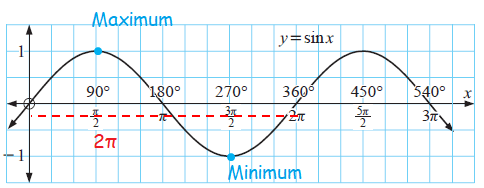
Amplitude Period Maximum and Minimum of Sine Functions
A periodic function is one which repeats itself over and over in horizontal direction.
What is period ?
The period of a periodic function is the length of one repetition or cycle
What is amplitude ?
The amplitude is the vertical distance between a maximum point and the principal axis.
What is maximum and minimum ?
- The maximum points occurs at the top of the crest.
- The minimum points occurs at the bottom of a through.
What is principal axis or man line ?
The graph oscillates about horizontal line called the principal axis or mean line.
y = A sin (B(x - h)) + k
or
y = A cos (B(x - h)) + k
Amplitude = (y coordinate of max - y coordinate of min)/2
Vertical shift = (y coordinate of max + y coordinate of min)/2
Period = 2|x coordinate of max - x coordinate of min|
Frequency = 2π/T
Where T is the period
Phase shift for sin :
x-coordinate of max
Phase shift for cos :
x coordinate of max - T/4
- The amplitude is |A|
- Period is 2π/|k|, for B > 0
Problem 1 :
The trigonometric function k has a maximum at the point (0, 8). After this maximum , the next minimum occurs at the point (2π, 2). Which of the following could be the expression for k(x) ?
a) 3 cos (x/2) + 5 b) 3 cos (2x) + 5 c) 3 sin (x/2) + 5 d) 3 sin (2x) + 5
Solution :
x-coordinate of maximum = 0
y-coordinate of maximum = 8
x-coordinate of minimum = 2π
y-coordinate of minimum = 2
Amplitude = (y coordinate of max - y coordinate of min)/2
= (8 - 2)/2
= 3
Vertical shift = (y coordinate of max + y coordinate of min)/2
= (8 + 2)/2
= 5
Period = 2|x coordinate of max - x coordinate of min|
= 2|0 - 2π|
= 2|2π|
= 4π
Frequency = 2π/T
Where T is the period
= 2π/4π
= 1/2
It must be the cosine function, because the cos (0) = 1
y = A cos (B(x - h)) + k
y = 3 cos (1/2(x - 0)) + 5
y = 3 cos (x/2) + 5
Problem 2 :
The trigonometric function k has a maximum at the point (π/2, 30). After this maximum , the next minimum occurs at the point (3π/2, 20). Which of the following could be the expression for k(x) ?
a) 5 cos (x) + 25 b) 10 cos x + 20 c) 5 sin x + 25 d) 10 sin x + 20
Solution :
From the given information, it is clear that the function is sin, because sin π/2 = 1
x-coordinate of maximum = π/2
y-coordinate of maximum = 30
x-coordinate of minimum = π/2
y-coordinate of minimum = 20
Amplitude = (30 - 20)/2
= 10/2
= 5
Vertical shift = (30 + 20)/2
= 50/2
= 25
Period = 2|π/2 - 3π/2|
= 2|-2π/2|
= 2π
Frequency = 2π/2π
= 1
y = A sin (B(x - h)) + k
y = 5 sin (1(x - 0)) + 25
y = 5 sin x + 25
Option c is correct.
Problem 3 :
The trigonometric function k has a minimum at (0, -6). After this minimum, the next maximum occurs at the point (3π, 0). Which of the following could be the expression for k(x) ?
a) 3 cos (3x) - 3 b) -3 cos (3x) - 3 c) 3 cos (x/3) - 3 d) -3 cos (x/3) - 3
Solution :
From the given information, it is clear that the function is cos, because cos 0 = 1 and there must be reflection, because it is not (0, 6) it is (0, -6).
x-coordinate of maximum = 3π
y-coordinate of maximum = 0
x-coordinate of minimum = 0
y-coordinate of minimum = -6
Amplitude = (0 - (-6))/2
= 6/2
= 3
Vertical shift = (0 - 6)/2
= -3
Period = 2|3π - 0|
= 6π
Frequency = 2π/T
= 2π/6π
= 1/3
y = A cos (B(x - h)) + k
y = 3 cos (1/3(x - 0)) + (-3)
y = 3 cos (x/3) - 3
Since there must be the reflection, we use negative sign
y = -3 cos (x/3) - 3
Option d is correct.
Problem 4 :
The graph of a sinusoidal function has been horizontally compressed and horizontally translated to the left. It has maximums at the points (-5π/7, 1) (-3π/7, 1) and its minimum at (-4π/7, -1). If the x-axis is in radians, what is the period of the function.
Solution :
x-coordinate of maximum = -5π/7
y-coordinate of maximum = 1
x-coordinate of minimum = -4π/7
y-coordinate of minimum = -1
Period = 2|x coordinate of max - x coordinate of minimum|
= 2 |-5π/7 - (-4π/7)|
= 2|-π/7|
= 2π/7
Problem 5 :
The graph of a sinusoidal function has been vertically stretched, vertically translated up, and horizontally translated to the right. The graph has a maximum at (π/13, 13) and the equation of axis is y = 9. If the x-axis is in radians, list one point where the graph has a minimum.
Solution :
Amplitude = 13 - 9
= 4
When maximum has its y-coordinate as 13 (going up for 4 units), its minimum will have the y-coordinate as 9 - 4 that is 5.
There is no horizontal stretch, then sinusoidal function will have the period 2π, after the maximum or minimum the next turning point will appear at 2π/2, that is in the interval of π.
π/13 + π = 14 π/13
So, the required point is (14π/13, 5).
Subscribe to our ▶️ YouTube channel 🔴 for the latest videos, updates, and tips.
Recent Articles


-
Finding Range of Values Inequality Problems
May 21, 24 08:51 PM
Finding Range of Values Inequality Problems -
Solving Two Step Inequality Word Problems
May 21, 24 08:51 AM
Solving Two Step Inequality Word Problems -
Exponential Function Context and Data Modeling
May 20, 24 10:45 PM
Exponential Function Context and Data Modeling