FROM INPUT AND OUTPUTS HOW TO FIND CONCAVE UP OR DOWN
Subscribe to our ▶️ YouTube channel 🔴 for the latest videos, updates, and tips.
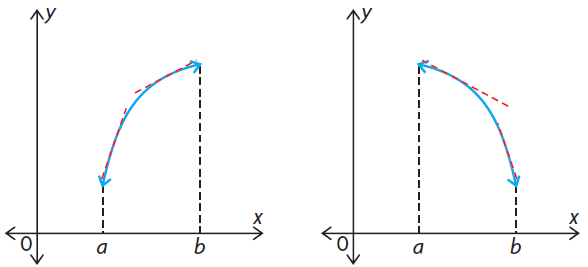
The graph of y = f(x) is concave up on an interval a ≤ x ≤ b in which the slopes of f(x) are increasing. On this interval f''(x) exists and f'(x) > 0. The graph of the function is above the tangent at every point on the interval.
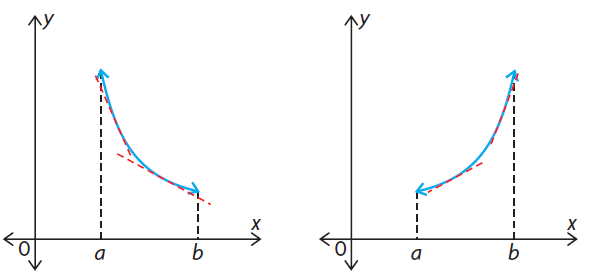
The graph of y = f(x) is concave down on an interval a ≤ x ≤ b in which the slopes of f(x) are decreasing. On this interval f''(x) exists and f'(x) < 0. The graph of the function is above the tangent at every point on the interval.
Determine if the following functions could be concave up, concave down, or neither. Explain your reasoning.
Problem 1 :
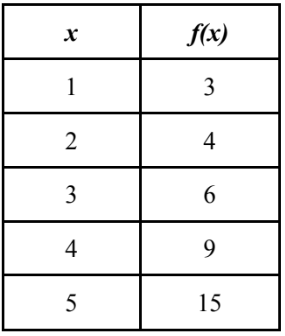
Solution :
Rate of change of (1, 3) and (2, 4)
= (4 - 3) / (2 - 1)
= 1
Rate of change of (2, 4) and (3, 6)
= (6 - 4) / (3 - 2)
= 2
Rate of change of (3, 6) and (4, 9)
= (9 - 6) / (4 - 3)
= 3
Rate of change of (4, 9) and (5, 15)
= (15 - 9) / (5 - 4)
= 6
Slopes are increasing then it could be concave up.
Problem 2 :
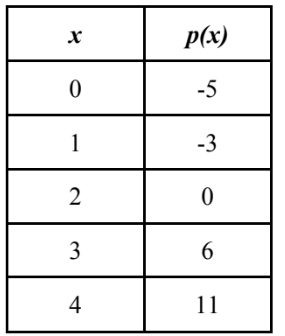
Solution :
Rate of change of (0, -5) and (1, -3)
= (-3 + 5) / (1 - 0)
= 2/1
= 2
Rate of change of (1, -3) and (2, 0)
= (0 + 3) / (2 - 1)
= 3/1
= 3
Rate of change of (2, 0) and (3, 6)
= (6 - 0) / (3 - 2)
= 6/1
= 6
Rate of change of (3, 6) and (4, 11)
= (11 - 6) / (4 - 3)
= 5/1
= 5
Neither because the average rates of change are increasing and decreasing.
Problem 3 :
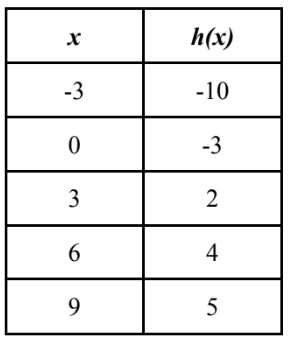
Solution :
Rate of change of (-3, -10) and (0, -3)
= (-3 + 10) / (0 + 3)
= 7/3
Rate of change of (0, -3) and (3, 2)
= (2 + 3) / (3 - 0)
= 5/3
Rate of change of (3, 2) and (6, 4)
= (4 - 2) / (6 - 3)
= 2/3
Rate of change of (6, 4) and (9, 5)
= (5 - 4) / (9 - 6)
= 1/3
Concave down because the average rates of change are decreasing.
Problem 4 :
Each of the following graphs represents the second derivative, f''(x) of the function f(x).
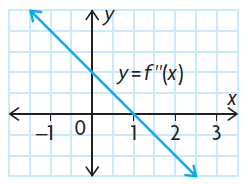
f''(x) is linear function
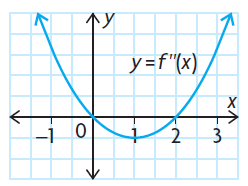
f''(x) is quadratic function
For each of the graphs above, answer the following questions.
i) On which intervals is the graph of f(x) concave up ? on which intervals is the graph concave down ?
ii) List the x-coordinates of all the points of inflections.
iii) Make a rough sketch of a possible graph of f(x), assuming that f(0) = 2
Solution :
For linear function
i) When x < 1, the curve is above the x-axis. Then it is concave up at x < 1.
When x > 1, the curve is below the x-axis, then it is concave down at x >1
ii) Point of inflection is at x = 1
iii) Graph may differ
Solution :
For quadratic function
i) When x < 0 and at x > 2, the curve is above the x-axis. Then it is concave up at x < 0 and x > 2.
When 0 < x < 2, the curve is below the x-axis, then it is concave down in the interval [0, 2]
ii) Point of inflection is at x = 0 and x = 2
iii) Graph may differ
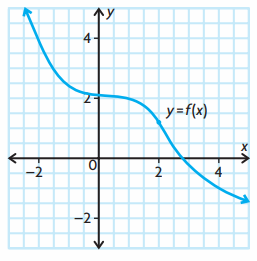
Problem 5 :
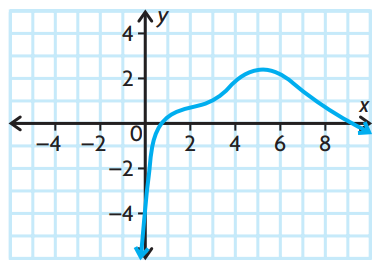
Sketch the graph of a function with the following properties :
a) f'(x) > 0 when x < 2 and when 2 < x < 5
b) f'(x) < 0 when x > 5
c) f'(2) = 0 and f'(5) = 0
d) f''(x) < 0 when x < 2 and when 4 < x < 7
e) f''(x) > 0 when 2 < x < 4 when x > 7
f) f(0) = -4
Solution :
a) Since f'(x) > 0 when x < 2 and when 2 < x < 5, it must be increasing function in the interval (-∞, 2) and (2, 5)
b) It is decreasing at the interval (5, ∞).
c) 2 and 5 are critical numbers.
d) f''(x) < 0, then it is concave down in the interval (-∞, 2) and (4, 7)
e) f''(x) > 0 then it is concave up in the interval (2, 4) and (7, ∞).
f) -4 is the y-intercept.
Problem 6 :
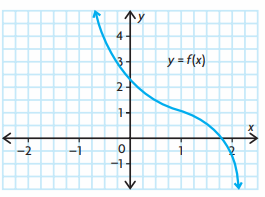
Use the given graph of f to find the following
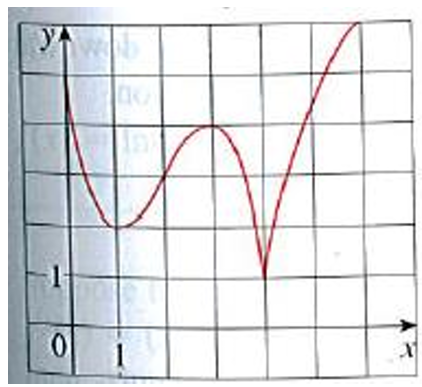
a) The open intervals of which f is increasing.
b) The open intervals of which f is decreasing.
c) The open intervals of which f is concave upward.
d) The open intervals of which f is concave downward.
e) The coordinates of the points of inflection.
Solution :
a) In the interval (1, 3) and (4, 6) f(x) is increasing.
b) In the interval (-∞, 1) and (3, 4) f(x) is decreasing.
c) Concave up is at (0, 2)
d) Concave down is at (2, 4) and (4, 6)
e) (2, 3) is the coordinates of points of inflection.
Subscribe to our ▶️ YouTube channel 🔴 for the latest videos, updates, and tips.
Recent Articles


-
Finding Range of Values Inequality Problems
May 21, 24 08:51 PM
Finding Range of Values Inequality Problems -
Solving Two Step Inequality Word Problems
May 21, 24 08:51 AM
Solving Two Step Inequality Word Problems -
Exponential Function Context and Data Modeling
May 20, 24 10:45 PM
Exponential Function Context and Data Modeling