FINDING VOLUME AND SURFACE AREA OF CYLINDERS
Subscribe to our ▶️ YouTube channel 🔴 for the latest videos, updates, and tips.
A cylinder is a three dimensional solid that holds two parallel bases joined by a curved surface at a fixed distance.
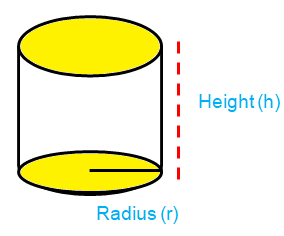
Lateral surface area of cylinder = 2πrh
Total surface area = 2πr(h + r)
Volume of cylinder = πr2h
What is surface area of cylinder ?
The surface area of a cylinder can be defined as the total space covered by the flat surfaces of the bases of the cylinder and its curved surface.
Difference between lateral and total surface area :
Lateral surface area is the area around the shape excluding top and bottom.
Total surface area is the area including top and bottom.
What is volume of cylinder ?
The volume of a cylinder is the density of the cylinder which signifies the amount of material it can carry or how much amount of any material can be immersed in it.
Problem 1 :
A school provides milk to the students daily in a cylindrical glasses of diameter 7 cm. if the glass is filled with milk up to height of 12 cm, find how many liters of milk is needed to serve 1600 students.
Solution :
Diameter = 7 cm, Radius = 3.5 cm and Height = 12 cm
Volume of milk in 1 glass = πr²h
= π × (3.5)² × 12
= 22/7 × 12.25 × 12
= 462 cm³
For 1600 students milk needed is
= 1600 × 462
= 739200
1 cm³ = 1000 litres
= 739200/1000
= 739.2 litres
Therefore, the quantity of milk required is 739.2 litres.
Problem 2 :
If the radius of a right circular cylinder is decreased by 50% and its height is increased by 60%, its volume will be decreased by
a) 10% b) 60% c) 40% d) 20%
Solution :
Let the original measures be 100%.
Radius of new cylinder = 50% of r ==> (50r/100)
height of the new cylinder = 160% of h ==> (160h/100)
Volume = π (50r/100)2 × (160h/100)
= 40% of πr²h
So, 60% of decreased.
So, option (b) is correct.
Problem 3 :
The ratio of radii of two cylinders is 1:2 and the heights are in the ratio 2:3. Find the ratio of their volumes.
Solution :
Let, V1 be the volume of first cylinder
V2 be the volume of first cylinder
V1 = πr12h1
V2 = πr22h2
V1/V2 = (r1/r2)² × h1/h2
= (1/2)2× 2/3
= 1/4 × 2/3
= 1/6
So, the ratio is 1 : 6.
Problem 4 :
If the capacity of a cylindrical tank is 1848 m³ and the diameter of its base is 14 m. find the depth of the tank.
Solution :
Volume of the cylinder = 1848 m³
Diameter of the base = 14 m
Radius r = d/2
= 14/2
= 7 cm
Volume of the cylinder = πr²h
1848 = (22/7) ⋅ 7 ⋅ 7 ⋅ h
1848 = 154 h
h = 1848/154
h = 12 m
Therefore, the depth of the tank is found to be 12 m.
Problem 5 :
The radius of the base of a cylinder is 39 in. and its height is 33 in. Find the surface area of the cylinder in terms of π.
Solution :
Radius = 39 inches and height = 33 inches
Surface area of cylinder = 2 π r h
= 2 x π x 39 x 33
= 2574π square inches
Problem 6 :
Andrew is planning to cover the lateral surface of a large cylindrical garbage can with decorative fabric for a theme party. The can has a diameter of 3 feet and a height of 3.5 feet. How much fabric does he need if he covers the lid but not the bottom of the can?
Solution :
Radius = 3/2 ==> 1.5 feet
height = 3.5 feet
Surface area of cylinder = 2 π r h
= 2 x π x 1.5 x 3.5
= 10.5 π square feet
Problem 7 :
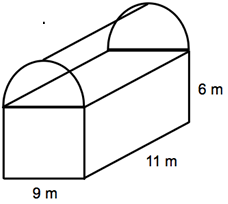
Find the surface area of the composite figure.
Solution :
Surface area of rectangular prism + surface area of cylinder/2
= 2(11 x 6) + (11 x 9) + (2 π x 4.5 x 11)/2
= 132 + 99 + 155.43
= 386.43
So, the surface area of the composite figure is 386.43 square meter
Problem 8 :
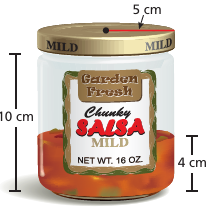
How much salsa is missing from the jar?
Solution :
Quantity of salsa = πr2 h
r = 5 cm and height = 4 cm
= 3.14 x 52 x 4
= 314 cm2
Problem 9 :
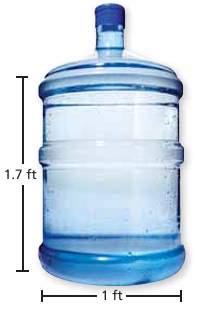
About how many gallons of water does the water cooler bottle contain? (1 ft3 ≈ 7.5 gal)
a) 5.3 gal b) 10 gal c) 17 gal d) 40 gal
Solution :
Quantity of water = πr2 h
r = 0.5 ft and height = 1.7 ft
= 3.14 x 0.52 x 1.7
= 1.3345 cubic ft
1 ft3 ≈ 7.5 gal
Converting into gallons,
= 1.3345 x 7.5
= 10.008 gallons
Approximately 10 gallons, option b is correct.
Problem 10 :
A cylindrical swimming pool has a diameter of 16 feet and a height of 4 feet. About how many gallons of water can the pool contain? Round your answer to the nearest whole number. (1 ft3 ≈ 7.5 gal)
Solution :
Quantity of water = πr2 h
Radius = 8 ft and height = 4 ft
= 3.14 x 82 x 4
= 803.84 cubic ft
1 ft3 ≈ 7.5 gal
Converting into gallons,
= 803.84 x 7.5
= 6028.8 gallons
Approximately 6029 gallons.
Subscribe to our ▶️ YouTube channel 🔴 for the latest videos, updates, and tips.
Recent Articles


-
Finding Range of Values Inequality Problems
May 21, 24 08:51 PM
Finding Range of Values Inequality Problems -
Solving Two Step Inequality Word Problems
May 21, 24 08:51 AM
Solving Two Step Inequality Word Problems -
Exponential Function Context and Data Modeling
May 20, 24 10:45 PM
Exponential Function Context and Data Modeling