FINDING OBLIQUE ASYMPTOTES OF RATIONAL FUNCTIONS
Subscribe to our ▶️ YouTube channel 🔴 for the latest videos, updates, and tips.
A slant (oblique) asymptote occurs when the polynomial in the numerator is a higher degree than the polynomial in the denominator.
To find the slant asymptote you must divide the numerator by the denominator using either long division or synthetic division.
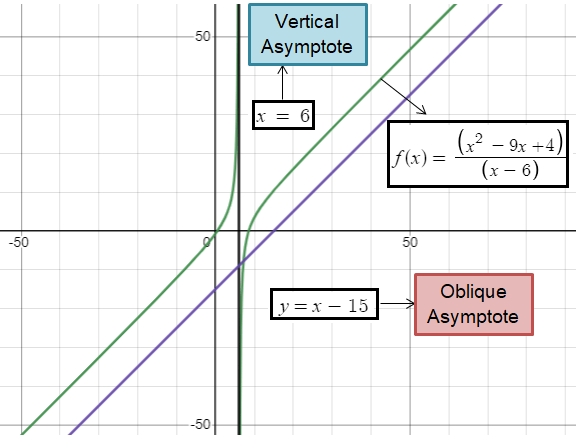
Find the oblique asymptote of the rational function
Problem 1 :
f(x) = (x2 + 8x – 20)/(x – 1)
Solution :
Given, f(x) = (x2 + 8x – 20)/(x – 1)
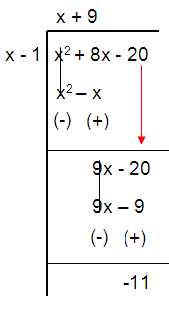
y = (x + 9) -11/(x – 1)
So, the oblique asymptote of the rational function is
y = x + 9
Find the oblique asymptote of the rational functions :
Problem 2 :
f(x) = (6x3 – 1)/(-2x2 + 18)
Solution :
f(x) = (6x3 – 1)/(-2x2 + 18)
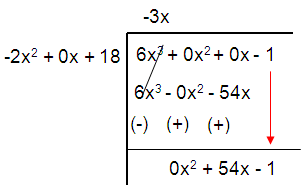
y = -3x + (0x2 + 54x – 1)/(-2x2 + 0x + 18)
So, the oblique asymptote of the rational function is
y = -3x.
Problem 3 :
f(x) = (2x2 + x – 5)/(x + 1)
Solution :
f(x) = (2x2 + x – 5)/(x + 1)
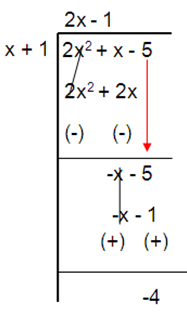
y = (2x – 1) + (-4)/(x + 1)
So, the oblique asymptote of the rational function is
y = 2x - 1
Problem 4 :
f(x) = (2x2 - 5x + 3)/(x – 1)
Solution :
f(x) = (2x2 - 5x + 3)/(x – 1)
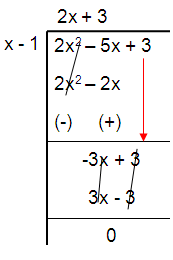
y = (2x + 3) + 0/(x - 1)
So, the oblique asymptote of the rational function is
y = 2x + 3
Problem 5 :
f(x) = (2x2 - 5x + 5)/(x – 2)
Solution :
f(x) = (2x2 - 5x + 5)/(x – 2)
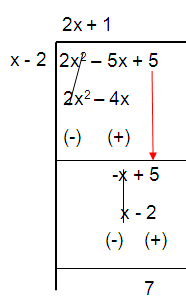
y = (2x + 1) + 7/(x - 2)
So, the oblique asymptote of the rational function is
y = 2x + 1
Problem 6 :
f(x) = (x3 - 2x2 + 5)/x2
Solution :
f(x) = (x3 - 2x2 + 5)/x2
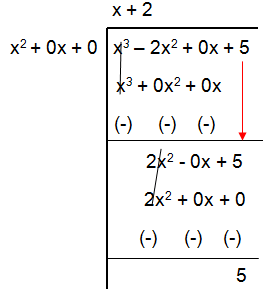
y = (x + 2) + 5/x2
So, the oblique asymptote of the rational function is
y = x + 2
Identify the vertical and oblique asymptotes of the following rational function.
Problem 7 :
f(x) = (x3 - x2 - x - 1)/(x – 3) (x + 4)
Solution :
f(x) = (x3 - x2 - x - 1)/(x – 3) (x + 4)
x – 3 = 0
x = 3
x + 4 = 0
x = -4
Vertical asymptotes at x = 3 and -4.
f(x) = (x3 - x2 - x - 1)/(x – 3) (x + 4)
= (x3 - x2 - x - 1)/(x2 + 4x – 3x – 12)
f(x) = (x3 - x2 - x - 1)/(x2 + x – 12)
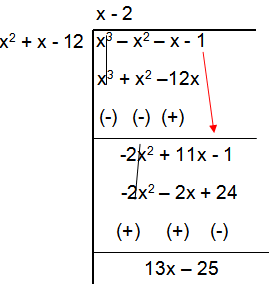
f(x) = (x – 2) + 13x – 25/(x2 + x – 12)
So, the oblique asymptote of the rational function is
y = x – 2.
Find the asymptotes and intercepts of the function:
Problem 8 :
f(x) = x3/(x2 – 4)
Solution :
f(x) = x3/(x2 – 4)
Horizontal Asymptote :
Degree of numerator > degree of denominator
So, there is no horizontal asymptotes.
Vertical asymptote :
x2 – 4 = 0
(x + 2) (x – 2) = 0
x + 2 = 0 and x – 2 = 0
x = -2 x = 2
Vertical asymptotes at x = -2 and 2.
Oblique asymptote :
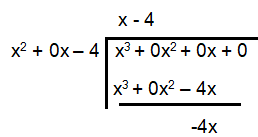
Oblique asymptote is at y = x-4.
x – intercept :
x – intercepts occurs when y = 0.
f(x) = x3
0 = x3
x = 0
So, the x – intercepts is (0, 0).
y – intercept :
y – intercepts occurs when x = 0.
f(x) = 0/(0 – 4)
f(0) = 0/4
f(0) = 0
So, the y – intercepts is (0, 0).
Problem 9 :
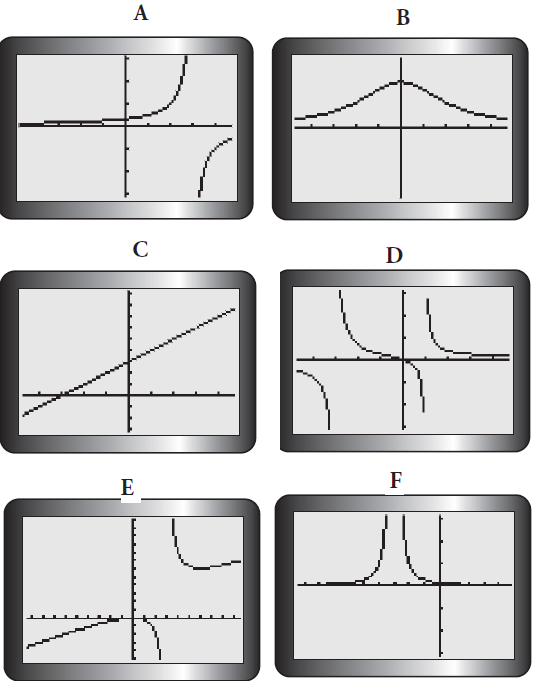
Without using graphing technology, match each equation with its corresponding graph. Explain your reasoning.
a) y = -1/(x - 3)
b) y = x/(x - 1)(x + 3)
c) y = (x2 - 9)/(x - 3)
d) y = 1/(x2 + 5)
e) y = 1/(x + 3)2
f) y = x2/(x + 3)
Solution :
a) y = -1/(x - 3)
This is the reciprocal of linear function. It has the vertical asymptote at x = 3. Since we have negative sign in front of the function, the graph should be reflected over the x-axis. So, option A is correct.
b) y = x/(x - 1)(x + 3)
Since we don't have common factors, there is no hole. The vertical asymptotes are x = 1 and x = -3. These conditions suits for the graph D.
c) y = (x2 - 9)/(x - 3)
Let us factorize the numerator, we get
= (x2 - 32)/(x - 3)
= (x - 3)(x + 3) / (x - 3)
After simplifying, we get
y = x - 3
Then graph C is correct.
d) y = 1/(x2 + 5)
The function has no zeros and no vertical asymptotes or holes So, graph B matches this.
e) y = 1/(x + 3)2
Vertical asymptote is x = -3. The function is always positive. By observing the given graphs option F matches.
f) y = x2/(x + 3)
There is no common factor, then there is no hole. The highest exponent of the numerator is greater than the highest exponent of the denominator. So, it must have slant asymptote.
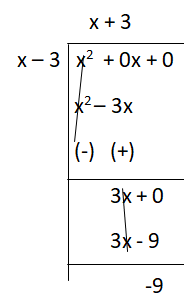
y = (x + 3) + (-9)/(x - 3)
So, option E is correct.
Subscribe to our ▶️ YouTube channel 🔴 for the latest videos, updates, and tips.
Recent Articles


-
Finding Range of Values Inequality Problems
May 21, 24 08:51 PM
Finding Range of Values Inequality Problems -
Solving Two Step Inequality Word Problems
May 21, 24 08:51 AM
Solving Two Step Inequality Word Problems -
Exponential Function Context and Data Modeling
May 20, 24 10:45 PM
Exponential Function Context and Data Modeling