FINDING MISSING ANGLES OF PARALLELOGRAM
Subscribe to our ▶️ YouTube channel 🔴 for the latest videos, updates, and tips.
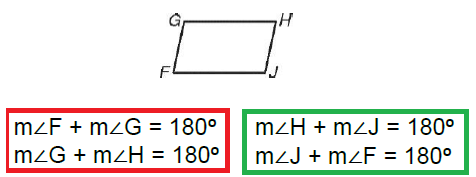
Consecutive Angles in Parallelogram
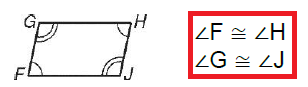
Opposite Angles in Parallelogram
Problem 1 :
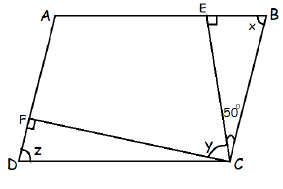
From the parallelogram given below, find the value of x, y and z.
Solution :
In triangle EBC.
∠EBC + ∠BCE + ∠CEB = 180
x + 50 + 90 = 180
x + 140 = 180
x = 180 - 140
x = 40
Opposite angles are equal, x = z = 40
In triangle FDC.
∠FDC + ∠DCF + ∠CFD = 180
z + ∠DCF + 90 = 180
40 + 90 + ∠DCF = 180
130 + ∠DCF = 180
∠DCF = 180 - 130
∠DCF = 50
z + ∠DCF + y + 50 = 180
40 + 50 + y + 50 = 180
140 + y = 180
y = 180 - 140
y = 40
Problem 2 :
If one angle of a parallelogram is 24 degree less than twice the smallest angle then, find the largest angle of the parallelogram.
Solution :
Let the smallest angle be x
Larger angle measure = 2x - 24
Sum of consecutive angles = 180
x + 2x - 24 = 180
3x - 24 = 180
3x = 180 + 24
3x = 204
x = 204/3
x = 68
The largest angle measure = 2(68) - 24
= 136 - 24
= 112
So, the largest angle measure is 112.
Problem 3 :
In a parallelogram PQRS, if
∠P = (3x − 5)° and ∠Q = (2x + 15)°
then find the value of x.
Solution :
Since ∠P and ∠Q are consecutive integers, sum of the consecutive integers = 180.
∠P + ∠Q = (3x − 5) + (2x + 15)
3x + 2x - 5 + 15 = 180
5x + 10 = 180
5x = 170
x = 170/5
x = 34
Problem 4 :
If PQRS is a parallelogram, then ∠P − ∠R is
(a) 90° (b) 45° (c) 60° (d) 0°
Solution :
In any parallelogram, the opposite angles will be equal.
∠P = ∠R
∠P − ∠R = 0
Problem 5 :
Two adjacent angles of a parallelogram are 3x - 4 and 3x + 10. Find the angles of parallelogram.
Solution :
Adjacent angles are 3x - 4 and 3x + 10.
Sum of adjacent angles (Consecutive angles) = 180
3x - 4 + 3x + 10 = 180
6x + 6 = 180
6x = 180 - 6
6x = 174
x = 174/6
x = 29
|
3x - 4 = 3(29) - 4 = 87 - 4 = 83 |
3x + 10 = 3(29) + 10 = 87 + 10 = 97 |
So, the angles are 83 and 97.
Problem 6 :
One angle of a parallelogram is 60 degree. Find its opposite angle and the adjacent angle.
Solution :
Sum of adjacent angels = 180
One of the angle = 60
Adjacent angle = 180 - 60
= 120
In parallelogram, opposite angle will be equal. Opposite angle 60 degree is also 60 degree.
Problem 7 :
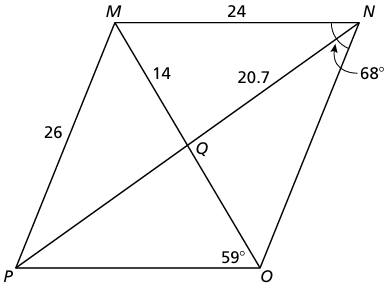
Find the indicated measure in parallelogram MNOP, explain your reasoning.
|
a) PO b) QO c) NO d) PQ |
e) m∠PMN f) m∠NOP g) m∠OPM h) m∠NMO |
Solution :
a) PO
Opposite sides will be equal in parallelogram, then MN = PO = 24 units
b) QO
Diagonals will bisect each other, then OQ = QM = 14 units
c) NO
Opposite sides will be equal, then OP = NO = 26 units
d) PQ
Diagonals will bisect each other, then QN = PQ = 20.7 units
e) m∠PMN
Adjacent angles are supplementary, then
m∠PMN + m∠MNO = 180
m∠PMN + 68 = 180
= 180 - 68
m∠PMN = 112
f)
m∠NOP = m∠NOM + m∠MOP
m∠NOP = 180 - 68
= 112
m∠NOM + m∠MOP = 112
m∠NOM + 59 = 112
m∠NOM = 112 - 59
m∠NOM = 53
g) In parallelogram, the opposite angles will be equal. Then
m∠OPM = 68
h) m∠NMO = 59 (Alternate interior angles are equal)
Find the value of each of the variable in the parallelogram.
Problem 8 :
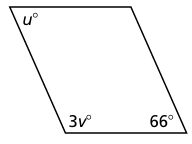
Solution :
Adjacent angles are supplementary.
3v + 66 = 180
3v = 180 - 66
3v = 114
v = 114/3
v = 38
u + 3v = 180
u + 3(38) = 180
u + 114 = 180
u = 180 - 114
u = 66
Problem 9 :
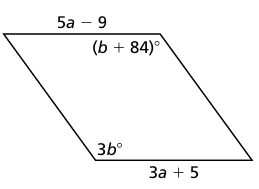
Solution :
Opposite sides are equal in parallelogram.
5a - 9 = 3a + 5
5a - 3a = 5 + 9
2a = 14
a = 14/2
a = 7
Adjacent angles are supplementary.
Opposite angles are equal.
b + 84 = 3b
b - 3b = -84
-2b = -84
b = 41
Problem 10 :
Find the value(s) of the variable(s) in each parallelogram
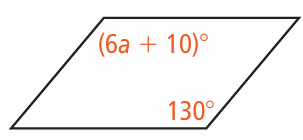
Solution :
Since opposite angles are equal,
6a + 10 = 130
6a = 130 - 10
6a = 120
a = 120/6
a = 20
So, the value of a is 20.
Problem 11 :
Two consecutive angles in a parallelogram have measures x + 5 and 4x - 10. Find the measure of the smaller angle.
Solution :
Sum of adjacent angles = 180
x + 5 + 4x - 10 = 180
5x - 5 = 180
5x = 180 + 5
5x = 185
x = 185/5
x = 37
Applying the value of x, we get
x + 5 ==> 37 - 5 ==> 32 degree
4x - 10 ==> 4(37) - 10 ==> 148 - 10
= 138
So, the smaller angle measure is 32 degree.
Subscribe to our ▶️ YouTube channel 🔴 for the latest videos, updates, and tips.
Recent Articles


-
Finding Range of Values Inequality Problems
May 21, 24 08:51 PM
Finding Range of Values Inequality Problems -
Solving Two Step Inequality Word Problems
May 21, 24 08:51 AM
Solving Two Step Inequality Word Problems -
Exponential Function Context and Data Modeling
May 20, 24 10:45 PM
Exponential Function Context and Data Modeling