FINDING DOMAIN AND RANGE OF MODULUS FUNCTION AS INTERVAL NOTATION
Subscribe to our ▶️ YouTube channel 🔴 for the latest videos, updates, and tips.
Domain :
The set of all possible inputs is known as domain. For absolute value functions all real numbers will be domain.
Because there is no restriction to give inputs. So, for all absolute value functions domain will be (-∞, ∞).
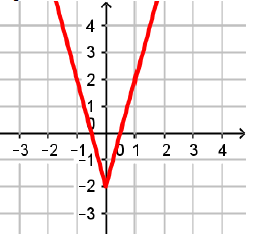
This graph will not go below -2 on y-axis. So, range is
-2 ≤ y ≤∞
Use interval notation to describe the domain and range of the given function.
Problem 1 :
f(x) = |-x|
Solution :
f(x) = |-x|
Domain: (-∞, ∞)
Range: [0, ∞), y ≥ 0
Problem 2 :
f(x) = -|x|
Solution :
f(x) = -|x|
Domain: (-∞, ∞)
Range: (-∞, 0], y ≤ 0
Problem 3 :
f(x) = (1/2)|x|
Solution :
f(x) = (1/2)|x|
Domain: (-∞, ∞)
Range: [0, ∞), y ≥ 0
Problem 4 :
f(x) = -2|x|
Solution :
f(x) = -2|x|
Domain: (-∞, ∞)
Range: (-∞, 0], y ≤ 0
Problem 5 :
f(x) = |x + 4|
Solution :
f(x) = |x + 4|
Domain: (-∞, ∞)
Range: [0, ∞), y ≥ 0
Problem 6 :
f(x) = |x - 2|
Solution :
f(x) = |x - 2|
Domain: (-∞, ∞)
Range: [0, ∞), y ≥ 0
Problem 7 :
f(x) = |x| + 2
Solution :
f(x) = |x| + 2
Domain: (-∞, ∞)
Range: [2, ∞), y ≥ 2
Problem 8 :
f(x) = |x| - 3
Solution :
f(x) = |x| - 3
Domain: (-∞, ∞)
Range: [-3, ∞), y ≥ -3
Problem 9 :
f(x) = |x + 3| + 2
Solution :
f(x) = |x + 3| + 2
Domain: (-∞, ∞)
Range: [2, ∞), y ≥ 2
Problem 10 :
f(x) = |x - 3| - 4
Solution :
f(x) = |x - 3| - 4
Domain: (-∞, ∞)
Range: [-4, ∞), y ≥ -4
Problem 11 :
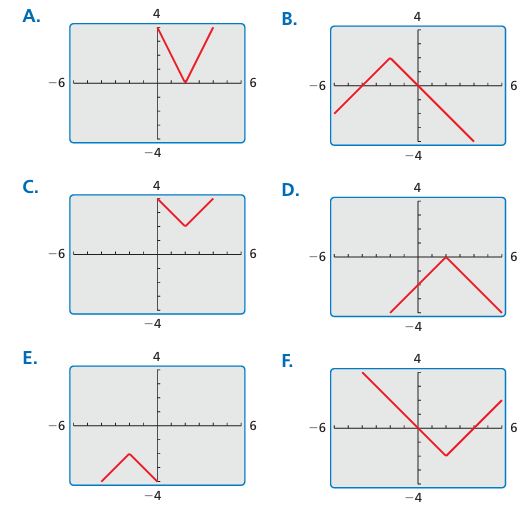
Match each absolute value function with its graph. Then use a graphing calculator to verify your answers.
|
a. g(x) = − ∣x − 2∣ b. g(x) = ∣x − 2∣ + 2 c. g(x) = − ∣x + 2∣ − 2 |
d. g(x) = ∣x − 2∣ − 2 e. g(x) = 2 ∣x − 2∣ f. g(x) = − ∣x + 2∣ + 2 |
Solution :
a. g(x) = − ∣x − 2∣
- Direction of opening : Down
- Vertex : (2, 0)
- Domain : all real values
- Range : (0, -∞)
Considering all these conditions, option D suits for the situation.
b. g(x) = ∣x − 2∣ + 2
- Direction of opening : Up
- Vertex : (2, 2)
- Domain : all real values
- Range : (2, ∞)
Considering all these conditions, option C suits for the situation.
c. g(x) = −∣x + 2∣ − 2
- Direction of opening : Down
- Vertex : (-2, -2)
- Domain : all real values
- Range : (-2, -∞)
Considering all these conditions, option E suits for the situation.
d. g(x) = ∣x − 2∣ − 2
- Direction of opening : Up
- Vertex : (2, -2)
- Domain : all real values
- Range : (-2, ∞)
Considering all these conditions, option F suits for the situation.
e. g(x) = 2 ∣x − 2∣
- Direction of opening : Up
- Vertex : (2, 0)
- Domain : all real values
- Range : (2, ∞)
- Vertical stretch of 2
Considering all these conditions, option A suits for the situation.
f. g(x) = − ∣x + 2∣ + 2
- Direction of opening : Down
- Vertex : (-2, 2)
- Domain : all real values
- Range : (-2, -∞)
Considering all these conditions, option B suits for the situation
Problem 12 :
Graph each function. Compare each graph to the graph of f(x) = ∣x∣ . Describe the domain and range.
a. g(x) = ∣x∣ + 3
b. m(x) = ∣x − 2∣
Solution :
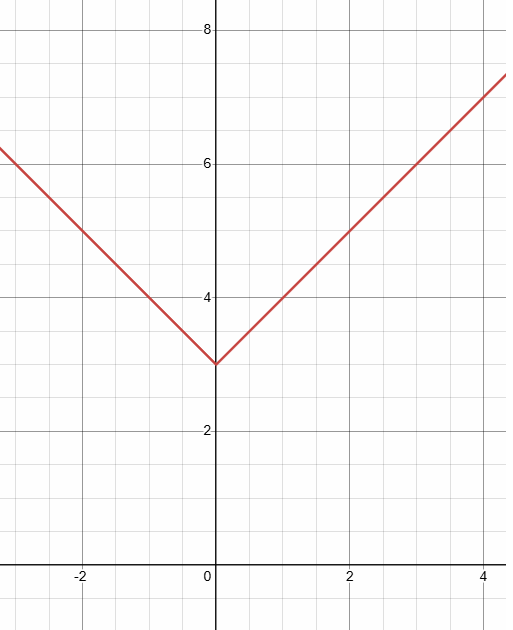
a. g(x) = ∣x∣ + 3
Comparing the given absolute value function with y = a|x - h| + k, we get
(h, k) ==> (0, 3)
Direction of opening the absolute value function is open up.
Domain : all real values
Range : (3, ∞)
x-intercept :
Put y = 0
|x| + 3 = 0
|x| = -3
No solution, then no x-intercept.
y-intercept :
Put x = 0
y = |0| + 3
y = 3
(0, 3)
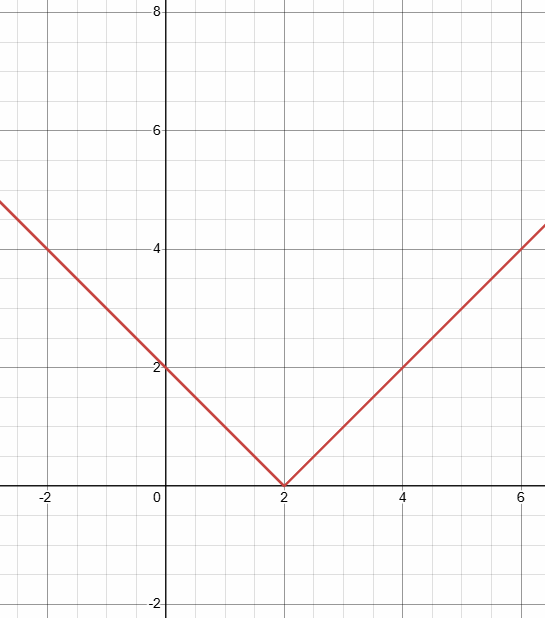
b. m(x) = ∣x − 2∣
Comparing the given absolute value function with y = a|x - h| + k, we get
(h, k) ==> (2, 0)
Direction of opening the absolute value function is open up.
Domain : all real values
Range : (2, ∞)
x-intercept :
Put y = 0
|x - 2| = 0
x - 2 = 0
x = 2
(2, 0)
y-intercept :
Put x = 0
y = |0 - 2|
y = |-2|
y = 2
(0, 2)
Problem 13 :
The point (1, −4) is the _______ of the graph of f(x) = −3 ∣ x − 1 ∣ − 4.
Solution :
f(x) = −3 ∣x − 1∣ − 4
Comparing with f(x) = −3 |x − h∣ + k
(h, k) is (1, -4)
So, for the given absolute value function (1, -4) is the vertex.
Subscribe to our ▶️ YouTube channel 🔴 for the latest videos, updates, and tips.
Recent Articles


-
Finding Range of Values Inequality Problems
May 21, 24 08:51 PM
Finding Range of Values Inequality Problems -
Solving Two Step Inequality Word Problems
May 21, 24 08:51 AM
Solving Two Step Inequality Word Problems -
Exponential Function Context and Data Modeling
May 20, 24 10:45 PM
Exponential Function Context and Data Modeling