FINDING AREA OF KITE
Subscribe to our ▶️ YouTube channel 🔴 for the latest videos, updates, and tips.
Area of kite ?
A kite is a quadrilateral which has two pairs of adjacent sides equal in length.
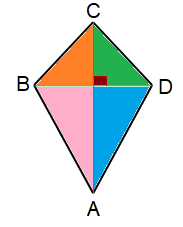
To find area of kite we need diagonals.
Area of kite = (1/2) x diagonal 1 x diagonal 2
Find the area of each kite.
Problem 1 :
Solution :
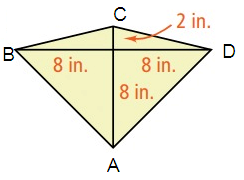
Area of a kite = 1/2 d1d2
AC perpendicular BD
d1 = 2 + 8 = 10
d2 = 8 + 8 = 16
= 1/2 (10)(16)
= 80
So, area of a kite is 80 in2.
Problem 2 :
Solution :
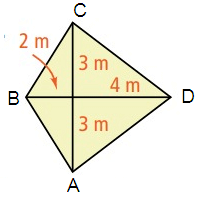
Area of a kite = 1/2 d1d2
AC perpendicular BD
d1 = 3 + 3 = 6
d2 = 2 + 4 = 6
= 1/2 (6)(6)
= 18
So, area of a kite is 18 m2.
Problem 3 :
Solution :
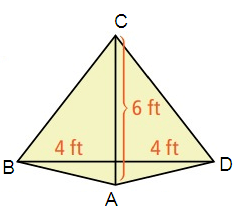
Area of a kite = 1/2 d1d2
AC perpendicular BD
d1 = 4 + 4 = 8
d2 = 6
= 1/2 (8)(6)
= 24
So, area of a kite is 24 ft2.
Problem 4 :
The area of a kite is 120 cm2. The length of one diagonal is 20 cm. what is the length of the other diagonal?
a) 12cm b) 20 cm c) 24 cm d) 48 cm
Solution :
Given, area of a kite is 120 cm2
Length of one diagonal d1 = 20 cm.
Let length of the other diagonal d2 be x.
Area of a kite = 1/2 d1d2
120 = 1/2 (20)(x)
120 = 10x
Divide both sides by 10.
120/10 = 10x/10
12 = x
So, length of the other diagonal is12 cm.
Problem 5 :
A kite has vertices at the points (2, 0) (3, 2) (4, 0) and (3, -3). Find the perimeter and area of the kite.
Solution :
Let the given points be A (2, 0) B (3, 2) C (4, 0) and D (3, -3)
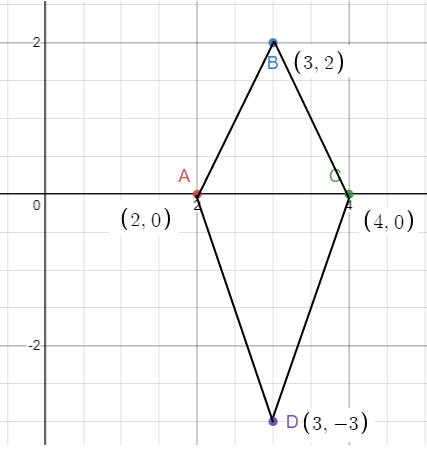
Finding area :
Area of kite = (1/2) x AC x BD
AC = 2 units
BD = 5 units
= (1/2) x 4 x 5
= 10 square units.
Finding perimeter :
To find the perimeter of the kite, we need length of all sides. To figure out the length of the sides, we may use Pythagorean theorem.
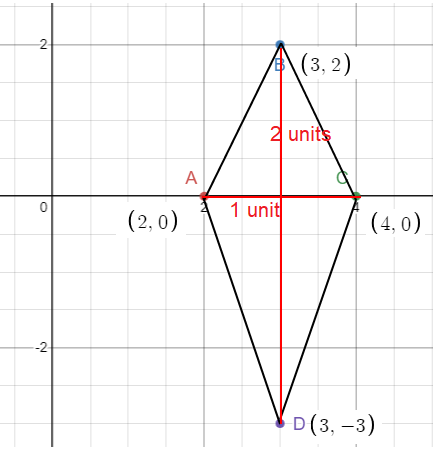
Finding Perimeter :
Let AB = x
We know that diagonals of a kite bisect each other at right angles. Let O be the point of intersection of diagonals.
Using Pythagorean theorem, we get
|
x2 = AO2 + OB2 x2 = 12 + 22 x2 = 1 + 4 x2 = 5 x = √5 AB = BC = √5 |
y2 = AO2 + OD2 y2 = 12 + 32 y2 = 1 + 9 y2 = 10 y = √10 AD = DC = √10 |
Perimeter of kite ABCD = 2√5 + 2√10
= 2(2.23) + 2(3.16)
= 10.78 units.
So, perimeter of the kite is 10.78 units.
Problem 6 :
The area of a kite is 324 square inches. One diagonal is twice as long as the other diagonal. Find the length of each diagonal.
Solution :
Length of one diagonal = 2(length of other diagonal)
Let d1 and d2 be the lengths of diagonals.
Area of kite = (1/2) ⋅ d1 ⋅ d2
324 = (1/2) ⋅ d1 ⋅ (2d1)
d12 = 324
d1 = 18
d2 = 2(18)
= 36 inches
So, the lengths of diagonals are 18 inches and 36 inches.
Problem 7 :
The vertices of the quadrilateral are A(2, 8), B (7, 9), C(11, 2) and D(3, 3). Show that ABCD is a kite and find the area of the kite.
Solution :
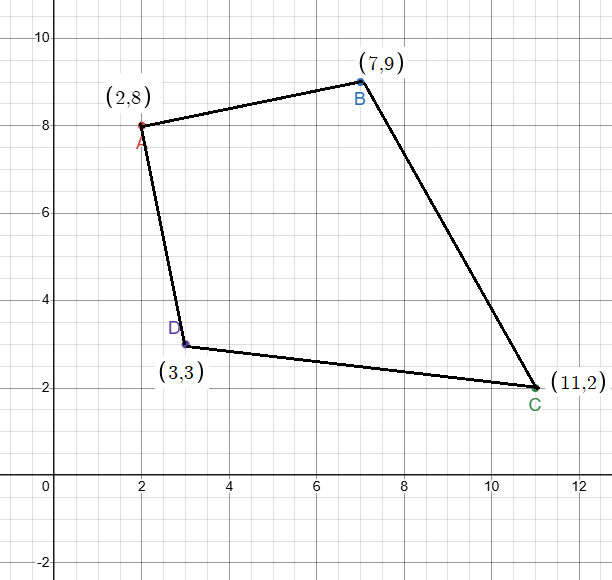
The diagonals will be perpendicular in kite.
Slope of AC = (y2 - y1) / (x2 - x1)
= (2 - 8) / (11 - 2)
= -6/9
= -2/3
Slope of BD = (9 - 3) / (7 - 3)
= 6/4
= 3/2
Slope of BD is the negative reciprocal of slope of AC.
Distance between AC = √(x2 - x1)2 + (y2 - y1)2
= √(11 - 2)2 + (2 - 8)2
= √92 + (-6)2
= √(81 + 36)
= √117
= √3 x 3 x 13
= 3√13
Distance between BD = √(3 - 7)2 + (3 - 9)2
= √(-4)2 + 62
= √(16 + 36)
= √52
= √2 x 2 x 13
= 2√13
Area of kite ABCD = (1/2) x AC x BD
= (1/2) x 3√13 x 2√13
= 3√13√13
= 3(13)
= 39 square units.
Perimeter of kite ABCD :
Length of AD = √(3 - 2)2 + (8 - 3)2
= √12 + 52
= √(1 + 25)
= √26
Length of DB = √(11 - 3)2 + (2 - 3)2
= √82 + (-1)2
= √(64 + 1)
= √65
Perimeter of kite = 2(AD + BD)
= 2(√26 + √65)
= 2(5.09 + 8.06)
= 2(13.15)
= 26.3 units.
Problem 8 :
You and a friend are building a kite. You need a stick to place from X to W and a stick to place from W to Z to finish constructing the frame. You want the kite to have the geometric shape of a kite. How long does each stick need to be? Explain your reasoning
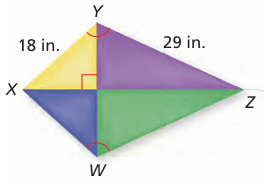
Solution :
Length of stick to be placed ZW = 18 inches
Length of stick to be placed WZ = 29 inches
Since it is kite, pair of sides will be equal.
Subscribe to our ▶️ YouTube channel 🔴 for the latest videos, updates, and tips.
Recent Articles


-
Finding Range of Values Inequality Problems
May 21, 24 08:51 PM
Finding Range of Values Inequality Problems -
Solving Two Step Inequality Word Problems
May 21, 24 08:51 AM
Solving Two Step Inequality Word Problems -
Exponential Function Context and Data Modeling
May 20, 24 10:45 PM
Exponential Function Context and Data Modeling